FPV vs. Stabilized Drone: Which Is Right for Your Production?
FPV drones and stabilized camera drones can both produce cinematic aerial footage, but they are designed for very different types of shots. FPV drones are particularly strong when movement, proximity and dynamic camera paths are important. Stabilized drones are often better suited to smooth, controlled aerial cinematography and precise establishing shots.
The right choice therefore depends less on which drone is "better" and more on what the shot needs to achieve.
At NextFlow Studios, we use both approaches depending on the production, location and visual objective.
FPV vs. stabilized drone: the fundamental difference
The biggest difference is not simply the appearance of the drone. It is the way the camera moves through space.
A stabilized drone is designed around controlled, smooth movement. Its camera is mounted on a mechanical gimbal that keeps the image stable while the aircraft moves.
An FPV drone is much more directly connected to the pilot's movement. The aircraft can tilt, accelerate and change direction aggressively, allowing the camera to become part of the movement itself.
This creates two fundamentally different visual languages.
A stabilized drone can make a building feel monumental, reveal a landscape gradually or provide a perfectly controlled aerial overview.
An FPV drone can move through a building, follow a vehicle around a corner, pass close to architectural elements or create a continuous sequence that feels much more immersive.
Neither approach is inherently superior.
The question is:
What should the viewer feel when they see the shot?
What is a stabilized drone?
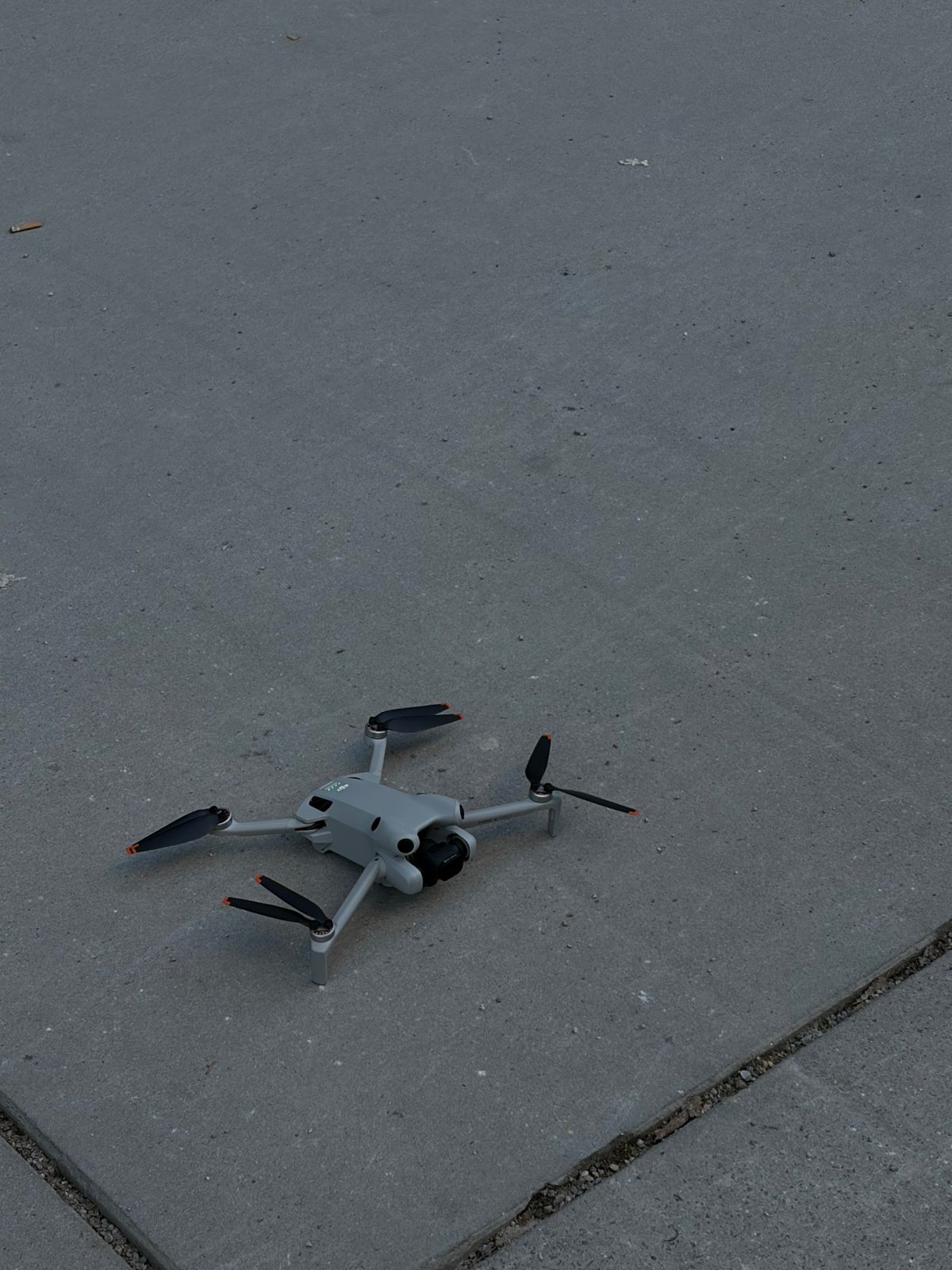
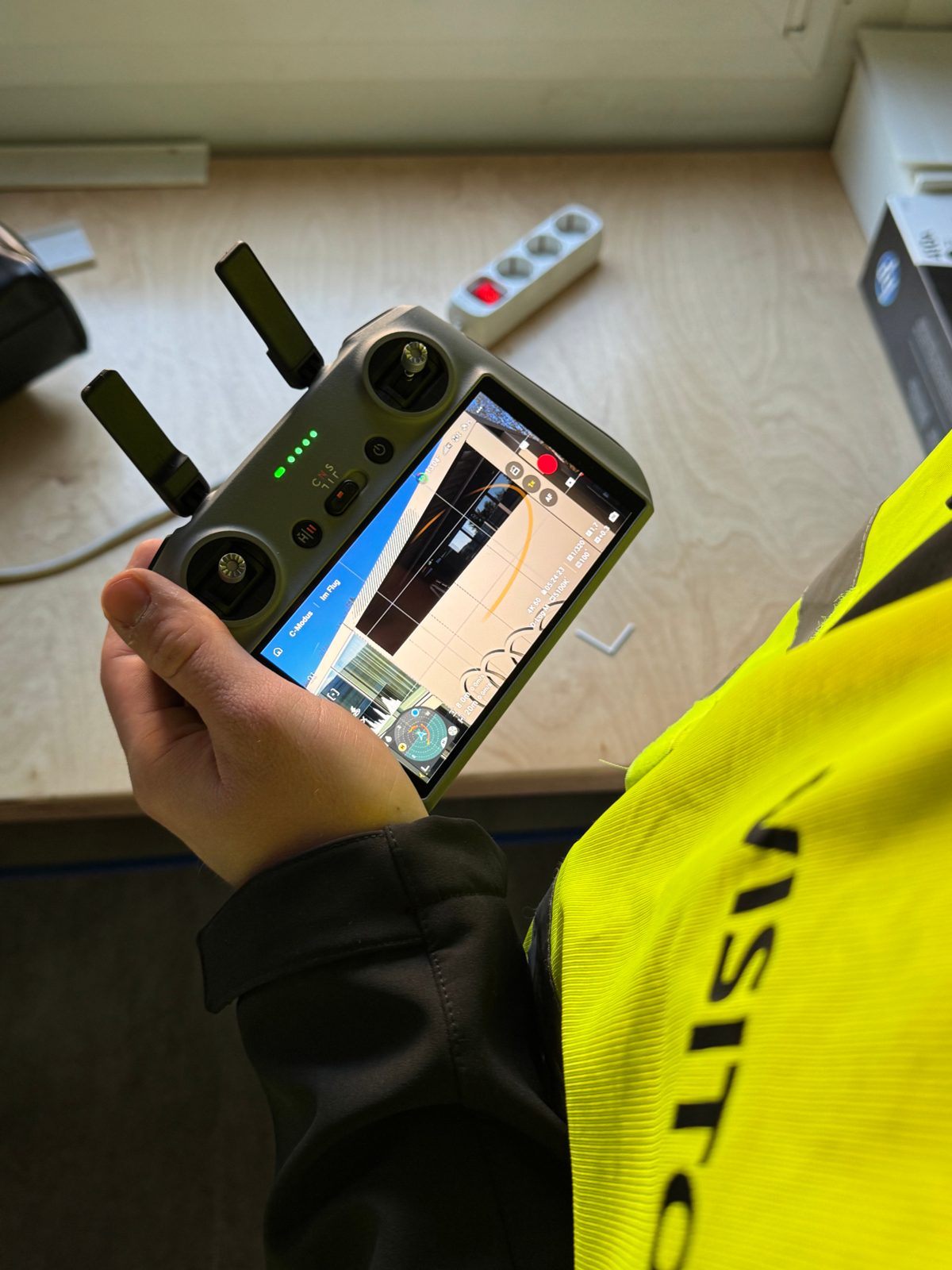
Stabilized drones are commonly used for aerial cinematography where smooth, predictable camera movement is the priority.
The camera is mounted on a gimbal that compensates for the drone's movements, allowing the image to remain relatively level even while the aircraft changes direction.
This makes stabilized drones particularly effective for:
- Architectural establishing shots
- Real estate films
- Landscape cinematography
- Smooth reveals
- Large-scale environmental shots
- Controlled camera movements
- Slow aerial transitions
- High-resolution commercial imagery
The visual result is often clean, precise and controlled.
For a luxury property, for example, a stabilized drone can slowly reveal the building from above while maintaining a consistent horizon and composition.
That restraint can be exactly what the production needs.
What is an FPV drone?
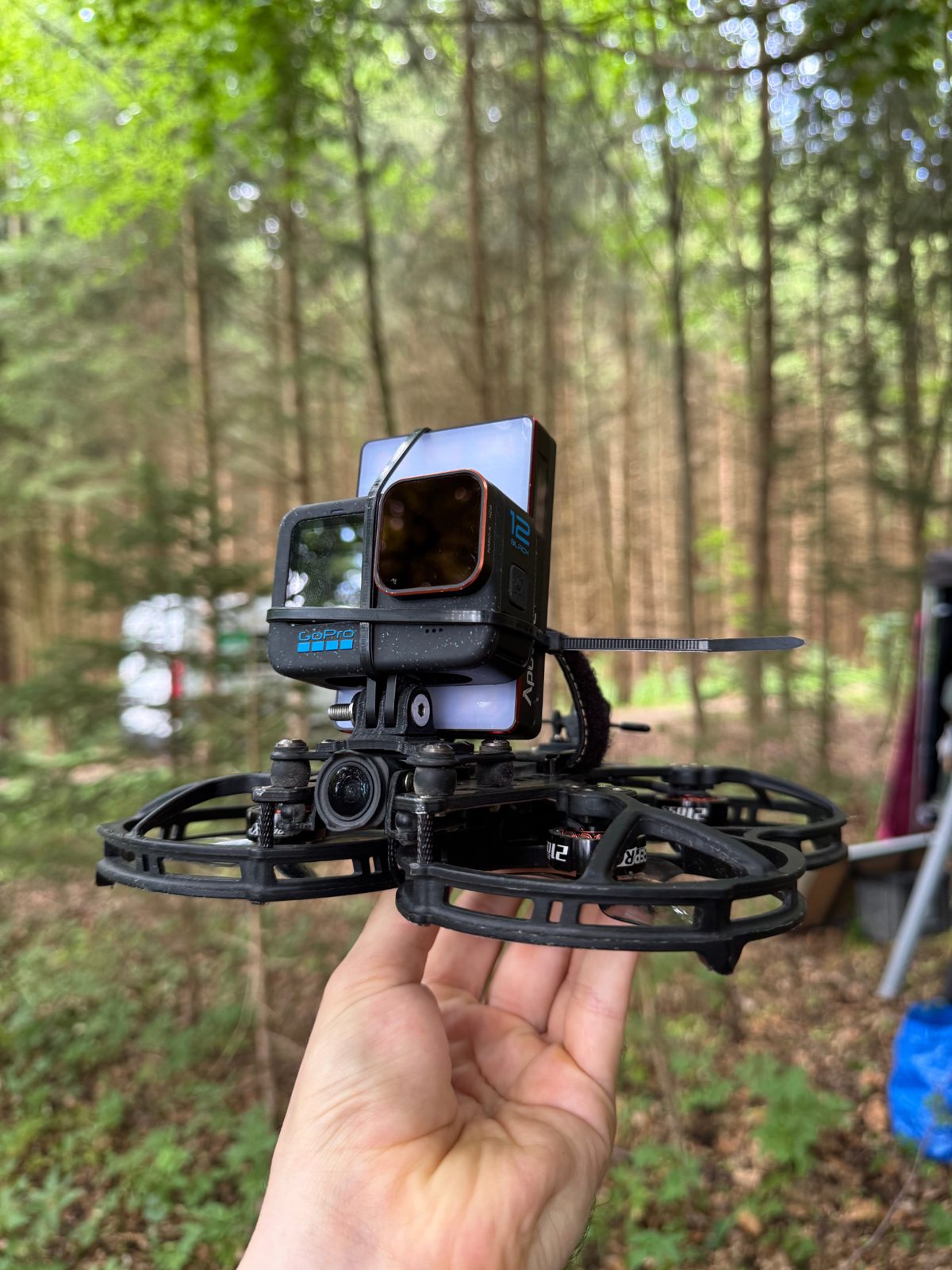
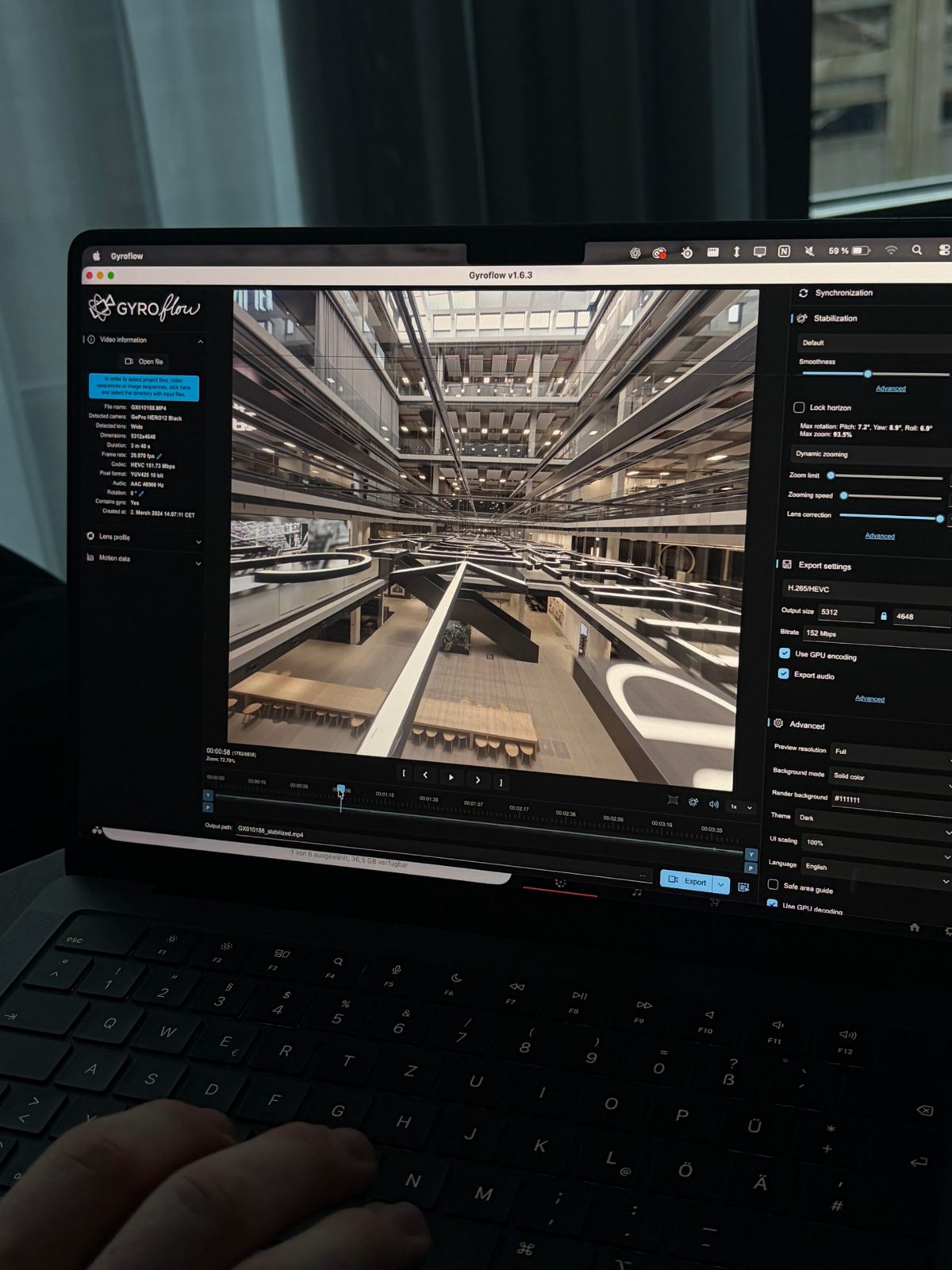
FPV stands for First Person View. FPV drones are controlled from the pilot's perspective through a live video feed from the aircraft.
Unlike a conventional stabilized drone, an FPV drone can use the aircraft's movement as part of the camera movement.
The result is a much greater range of possible trajectories.
An FPV drone can:
- Accelerate rapidly
- Fly close to structures
- Follow moving vehicles
- Move through interiors
- Change direction quickly
- Transition between indoor and outdoor environments
- Perform continuous one-take movements
- Create highly dynamic perspectives
This makes FPV particularly interesting for productions where the camera itself needs to become part of the action.
FPV vs. stabilized drone: a practical comparison
| FPV Drone | Stabilized Drone | |
|---|---|---|
| Movement | Dynamic and highly responsive | Smooth and controlled |
| Camera movement | Closely connected to aircraft movement | Stabilized independently via gimbal |
| Best for | Action, tracking, immersive sequences | Reveals, establishing shots, controlled aerials |
| Proximity | Particularly strong for close creative shots | Better suited to controlled distances |
| Indoor use | Strong potential with suitable aircraft | Limited depending on environment |
| High-speed tracking | Excellent potential | More limited |
| Smooth aerial reveals | Possible, but not its primary strength | Excellent |
| One-take sequences | Particularly suitable | Possible, depending on location |
| Camera options | From compact cameras to cinema-camera FPV systems | Broad range of stabilized systems |
| Visual character | Immersive, dynamic, energetic | Smooth, precise, cinematic |
The table is only a starting point. The actual result depends heavily on the aircraft, camera, pilot, environment and production design.
When should you use an FPV drone?
FPV is particularly valuable when movement itself is part of the story.
Automotive cinematography
Automotive productions are one of the clearest applications for FPV.
A drone can track a vehicle from unusual angles, move alongside it through corners or transition from a low road-level perspective to a wider environmental shot.
This can create a much stronger sense of speed and proximity than a conventional aerial establishing shot.
For high-speed automotive productions, however, the aircraft, camera configuration, location and vehicle movement must be planned as one system. Read more in our guide to High-Speed FPV Drone Tracking for Automotive Shoots.
Interior architecture
FPV drones can move through spaces rather than simply looking at them from above.
A single sequence can move through an entrance, travel down a corridor, transition into another room and finish outside the building.
This is particularly effective for:
- Hotels
- Offices
- Restaurants
- Showrooms
- Event spaces
- Luxury real estate
- Architectural projects
The viewer does not simply see the building.
They experience its spatial relationship.
One-take sequences
One of the strongest applications of FPV is the continuous shot.
Instead of cutting between separate rooms, perspectives or locations, the camera can physically connect them.
This can create a sense of scale and continuity that is difficult to reproduce with conventional camera movements.
Dynamic brand films
When movement and energy are part of a brand's identity, FPV can become more than an aerial camera.
The flight path itself can contribute to the storytelling.
This is especially relevant for automotive, sports, technology, lifestyle and experiential brands.
When should you use a stabilized drone?
A stabilized drone is often the better choice when the camera should feel invisible.
The viewer should notice the subject, not the complexity of the camera movement.
Architectural establishing shots
If the goal is to communicate the scale, location or design of a building, a controlled aerial movement can be extremely effective.
A slow approach, vertical reveal or lateral movement can give the viewer enough time to understand the architecture.
In these situations, aggressive FPV movement could actually distract from the subject.
Real estate
Real estate marketing often benefits from a clean and controlled visual language.
A stabilized drone can show:
- The relationship between a property and its surroundings
- Gardens and outdoor spaces
- Neighbourhood context
- Building architecture
- Access roads and surrounding infrastructure
The camera can move deliberately without making the flight itself the focus.
Landscape and location films
Large-scale landscapes often benefit from smooth aerial movements.
When mountains, coastlines, resorts or large developments are the subject, a stabilized camera can create a cinematic sense of scale without introducing unnecessary movement.
Precision and repetition
Some productions require a very specific framing that needs to be repeated consistently.
A stabilized platform can be advantageous when the camera needs to maintain a controlled horizon and predictable movement.
Can FPV drones produce smooth footage?
Yes, but "smooth" and "stabilized" are not necessarily the same thing.
Modern FPV systems can produce highly controlled footage, particularly when the pilot, aircraft configuration and camera system are properly matched.
However, FPV is fundamentally designed around a different type of movement.
The question should therefore not be:
Can an FPV drone look like a stabilized drone?
Instead:
Does the movement of an FPV drone improve the shot?
If the answer is yes, FPV may be the better creative choice.
If the desired result is a perfectly controlled aerial reveal, a stabilized platform may be more appropriate.
Can stabilized drones replace FPV drones?
Not entirely.
A stabilized drone can cover many aerial shots extremely well, but it does not provide the same flight characteristics as a dedicated FPV system.
For example, a production might require a sequence that starts with a vehicle driving through a tunnel, follows it out of the tunnel, drops close to the road and then transitions into a wider perspective.
A stabilized drone may be suitable for parts of that sequence.
An FPV drone could potentially execute the entire movement as one continuous camera path.
The difference is not necessarily image quality.
It is what the aircraft can physically do.
Can FPV drones replace stabilized drones?
Again, not entirely.
There are situations where the smooth, controlled movement of a stabilized drone is exactly what the production requires.
Consider a luxury hotel campaign.
The opening shot might slowly approach the building from above, reveal the surrounding landscape and settle into a carefully composed architectural frame.
The camera movement should feel effortless.
An FPV drone could technically perform a similar movement, but using FPV simply because it is available would not necessarily improve the result.
Sometimes the most cinematic decision is the least noticeable one.
Why not use both?
In many professional productions, the strongest approach is not choosing between FPV and stabilized drones.
It is combining them.
A production could use a stabilized drone for:
- Establishing shots
- Wide aerials
- Smooth reveals
- Environmental context
And FPV for:
- Dynamic tracking
- Interior transitions
- Close passes
- One-take sequences
- High-speed movement
This allows each platform to do what it does best.
For example, an automotive campaign could begin with a stabilized aerial shot establishing the landscape, transition to a ground-based camera for detail shots and then use FPV to follow the vehicle through a dynamic driving sequence.
The result feels like one production rather than a collection of drone shots.
What about camera quality?
The choice between FPV and stabilized drones is not necessarily a choice between low and high image quality.
Both platforms can carry increasingly capable cameras, depending on the aircraft and production requirements.
For FPV cinematography, compact camera systems are particularly interesting because reducing the camera payload can help preserve aircraft performance.
The GoPro MISSION 1 PRO ILS, for example, introduces an interchangeable Micro Four Thirds lens mount in a compact camera system and can therefore be considered for certain FPV configurations.
Larger cinema-camera setups can also be used on suitable FPV aircraft, including systems built around cameras such as the RED KOMODO or other professional cinema cameras.
Stabilized aerial platforms similarly range from compact systems to larger cinema-drone configurations.
The camera should therefore be selected alongside the aircraft, rather than treated as a separate decision.
How we decide which drone to use
At NextFlow Studios, we do not start a production by asking:
Should we use FPV?
We start with:
What does the shot need to do?
From there, we consider:
- The subject: What are we actually filming?
- The movement: Should the camera feel controlled, dynamic, immersive or almost invisible?
- The environment: Are we filming outdoors, indoors, around architecture, on a road or in a controlled production environment?
- The camera: What image quality, lens and recording format does the production require?
- The aircraft: Which platform can execute the intended movement while carrying the required camera setup?
- The production requirements: What permissions, safety measures, crew and logistics are necessary?
Only after these questions are answered do we decide which aerial platform makes the most sense.
FPV is a production tool, not a visual style
One of the biggest misconceptions about FPV cinematography is that every FPV shot needs to look fast.
It does not.
FPV can be aggressive and energetic, but it can also be subtle, controlled and immersive.
Likewise, stabilized drone footage does not automatically have to be slow or static.
The distinction is better understood through camera movement rather than speed.
A good aerial shot should support the story.
Sometimes that means flying at high speed alongside a vehicle.
Sometimes it means moving slowly through an architectural space.
And sometimes it means hovering almost imperceptibly while the subject does the moving.
The technology should serve the image.
So, which drone is right for your production?
There is no universal answer.
Choose FPV when the camera movement itself is important: dynamic tracking, immersive interiors, close proximity, complex trajectories or continuous one-take sequences.
Choose a stabilized drone when controlled movement, smooth reveals, architectural composition or environmental context are the priority.
And when the production requires both, use both.
The best aerial production is not the one that uses the most advanced drone.
It is the one in which the technology becomes almost invisible and the viewer simply sees the right image.
At NextFlow Studios, we work with both FPV and stabilized aerial systems and select the approach around the creative objective, location and production requirements.
If you are planning an architectural film, automotive campaign, commercial or brand production and are unsure which aerial approach is right for your project, get in touch with NextFlow Studios.
Frequently asked questions
What is the difference between FPV and a stabilized drone?
FPV drones connect the camera more directly to the aircraft's movement, allowing highly dynamic and complex flight paths. Stabilized drones use a gimbal to keep the camera controlled and level while the aircraft moves.
Is FPV better than a stabilized drone?
No. Each platform is suited to different types of shots. FPV is particularly strong for dynamic movement and immersive sequences, while stabilized drones are often better for smooth, controlled aerial cinematography.
Is FPV or a stabilized drone better for real estate?
It depends on the property and the desired visual style. Stabilized drones are often ideal for smooth architectural and environmental shots, while FPV can be particularly effective for immersive interior walkthroughs and continuous sequences.
Is FPV better for automotive filming?
FPV can be particularly effective for dynamic vehicle tracking because of its acceleration, manoeuvrability and ability to fly close to a moving vehicle. Stabilized drones can still be highly effective for establishing shots and controlled aerial coverage.
Can an FPV drone carry a cinema camera?
Yes, depending on the aircraft and camera configuration. Professional FPV systems can be built around compact cameras as well as larger cinema-camera systems. The camera, lens, mounting system and aircraft must be considered together.
Can FPV drones fly indoors?
Yes. Purpose-built FPV systems can be used for indoor cinematography where the aircraft, location, safety procedures and operating conditions are appropriate. Indoor FPV is particularly useful for creating continuous architectural walkthroughs.
Can you use FPV and stabilized drones in the same production?
Absolutely. Combining both systems can provide a broader range of aerial perspectives. A stabilized drone can handle controlled establishing shots while FPV captures dynamic or immersive sequences.
How do I know which drone is right for my production?
Start with the shot rather than the equipment. Consider the subject, desired movement, location, camera requirements and final deliverables. A professional production team can then determine which aircraft or combination of platforms best fits the project.
Planning an FPV production?
Let's define the shot first — then the camera, lens and aircraft to make it happen.
Get a free quote