RED Komodo on a Cinelifter: What You Need to Know
Flying a RED KOMODO on an FPV drone is very different from flying a lightweight action camera.
The camera itself is compact compared with many traditional cinema cameras, but once you add a lens, mounting system, batteries and the drone required to carry the payload, the entire aircraft becomes a very different tool.
A cinelifter is designed specifically for this kind of application: carrying professional cinema-camera systems while retaining the dynamic movement that makes FPV cinematography so powerful.
For productions that require cinema-camera image quality together with aerial movement, a RED KOMODO on a suitable cinelifter can be a highly capable combination. But it also comes with significant considerations around aircraft performance, flight planning, lens selection and production logistics.
What is a cinelifter?
A cinelifter is a larger FPV-style drone designed to carry professional cinema cameras and other production equipment.
Unlike a typical lightweight FPV drone, a cinelifter prioritises payload capacity and controlled movement.
Depending on the configuration, a cinelifter can carry cameras such as the RED KOMODO alongside professional lenses and accessories.
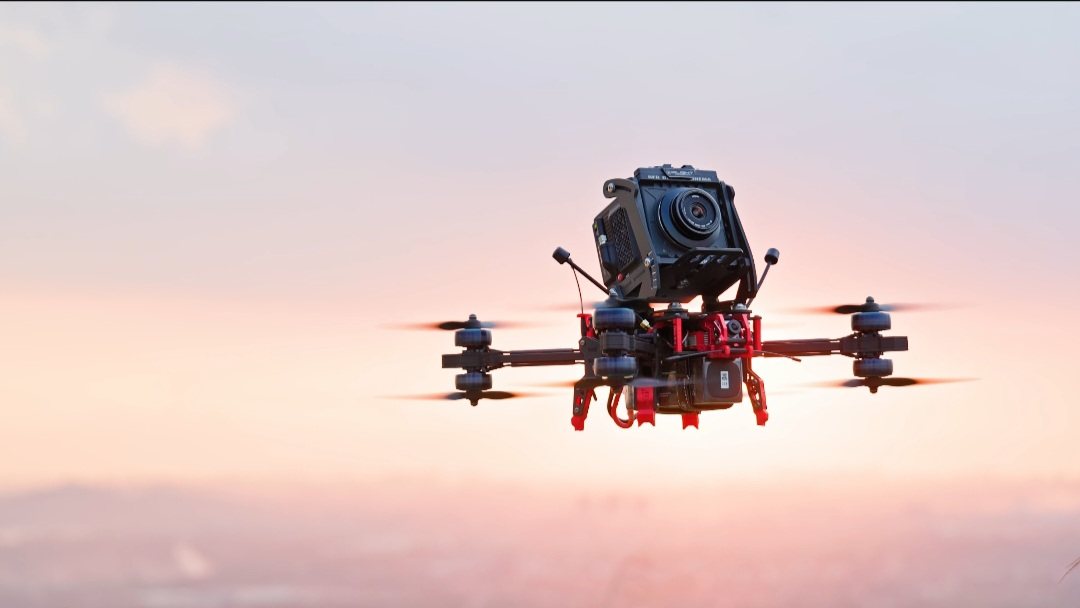
The exact configuration varies considerably between aircraft and production requirements. There is no single universal cinelifter design.
The aircraft may be configured around:
- Camera weight
- Lens selection
- Required flight time
- Desired speed
- Required manoeuvrability
- Battery configuration
- Mounting system
- Safety requirements
- Production environment
This is why a cinelifter should not simply be thought of as a “large FPV drone”.
It is better understood as a flying cinema-camera platform.
Why fly a RED KOMODO on an FPV drone?
Traditional aerial cinematography often relies on stabilised camera systems.
These are excellent for smooth aerial movement, but they are not designed to replicate the full range of movement available from an FPV aircraft.
A RED KOMODO mounted to a suitable cinelifter creates another possibility: bringing a professional cinema-camera system into an environment where the camera can move dynamically through three-dimensional space.
This can be particularly valuable when a production needs both:
cinema-camera image quality
and
FPV-style camera movement.
The combination can be useful for demanding commercial productions where aerial footage needs to integrate closely with footage captured by larger cinema-camera systems on the ground.
RED KOMODO: why is it interesting for FPV?
The RED KOMODO has several characteristics that make it relevant to aerial cinema applications.
Its compact cinema-camera form factor is considerably more suitable for aerial integration than many larger traditional cinema cameras.
It also provides a professional cinema workflow, including RAW recording, which can give productions substantial flexibility in post-production.
However, the camera specification is only one part of the equation.
A RED KOMODO does not become an FPV camera simply because it is mounted to a drone.
The aircraft, lens, mounting system, pilot and production workflow all need to be considered together.
The complete payload matters more than the camera
One of the most important considerations when building a RED KOMODO cinelifter is the total payload.
The camera body is only the beginning.
A realistic payload calculation may include:
- RED KOMODO body
- Lens
- Lens support
- Camera mounting system
- Battery
- Wireless transmission equipment
- Monitoring or control equipment
- Filters
- Protective components
- Additional accessories
A few hundred grams can make a meaningful difference when the complete system is flying at high speed or performing precise manoeuvres.
This is why professional cinelifter configuration starts with the complete camera package rather than the camera body alone.
Choosing the right lens
The lens can have a significant influence on both the image and the aircraft.
A wider lens can create a strong sense of proximity and movement, which is particularly useful for FPV cinematography.
A longer lens can create a different visual relationship between the camera and subject, but it can also make framing and aircraft movement more demanding.
Lens choice should therefore be made according to the shot.
For example, a vehicle tracking sequence may require a different focal length from an architectural interior flight.
The question is not:
Which lens looks most cinematic?
It is:
Which lens allows the aircraft to create the intended image?
How does a RED KOMODO cinelifter fly?
A cinelifter does not behave like a lightweight five-inch FPV drone.
The increased payload affects acceleration, braking, flight time and overall agility.
This does not necessarily make the aircraft less useful.
It simply means that the flight characteristics become part of the production design.
A cinelifter can still perform dynamic movements, but the pilot has to understand exactly how the aircraft responds to inputs and how much momentum it carries.
For professional cinematography, predictable movement is often more valuable than maximum speed.
The goal is not to make a heavy camera system behave like a racing drone.
The goal is to make the camera move precisely where the shot requires it to go.
What kind of shots can a RED KOMODO cinelifter capture?
The possibilities depend on the aircraft and production environment, but a cinelifter can be particularly useful for shots where a larger cinema-camera package is required.
Automotive tracking
A RED KOMODO cinelifter can be used for dynamic vehicle tracking where the production requires a cinema-camera workflow.
The aircraft can follow a vehicle through a planned route, maintain a close relationship with the subject and create perspectives that would be difficult to achieve with a conventional aerial platform.
This is particularly relevant for automotive commercials where the aerial footage needs to match the visual quality and colour workflow of the rest of the production.
Architectural cinematography
A cinelifter can also be used for larger-scale architectural shots.
Rather than relying solely on wide aerial establishing shots, the camera can move through or around a building with a more deliberate cinematic approach.
This can be especially useful when the production calls for a specific lens or camera system.
Dynamic exterior shots
Large outdoor environments can provide enough space for a cinelifter to demonstrate its movement capabilities.
The camera can travel alongside subjects, move between architectural elements or combine aerial movement with a controlled camera trajectory.
High-end commercial productions
Perhaps the most important application is not a specific type of subject.
It is the production where camera integration matters.
If a commercial is already being shot on a RED-based workflow, using a RED KOMODO on the aerial unit can simplify the visual relationship between the ground and aerial footage.
The aerial camera becomes part of the same cinematic language rather than looking like footage captured on a completely different system.
RED KOMODO vs. lightweight FPV cameras
A larger cinema-camera setup is not automatically better than a lightweight FPV system.
Each has different strengths.
| Production consideration | RED KOMODO on Cinelifter | Lightweight FPV Camera |
|---|---|---|
| Image workflow | Professional cinema workflow | More compact workflow |
| Camera weight | Higher | Lower |
| Aircraft size | Larger | Smaller |
| Agility | Lower than lightweight FPV | Higher |
| Flight time | Generally more limited | Generally more flexible |
| Lens choice | Broad cinema-lens options | Depends on camera |
| High-speed manoeuvres | More demanding | Better suited to extreme agility |
| Matching cinema cameras | Strong potential | Depends on camera |
| Production complexity | Higher | Lower |
The choice should be based on the final image rather than the equipment list.
If the production requires a particular cinema-camera workflow, the additional complexity may be justified.
If the shot requires maximum agility, a smaller camera configuration may be the better solution.
Does a RED KOMODO make an FPV shot more cinematic?
Not by itself.
This is an important distinction.
A cinema camera can provide a particular image, dynamic range and post-production workflow. But cinematic footage ultimately comes from the combination of:
camera + lens + movement + lighting + composition + timing + storytelling.
Putting a RED KOMODO on a drone does not automatically make a shot cinematic.
An incorrectly designed flight path with an expensive camera is still an incorrectly designed flight path.
The camera should therefore support the shot rather than become the reason for the shot.
The importance of the pilot
Flying a heavy cinema-camera drone requires a different skill set from operating a lightweight FPV drone.
The pilot needs to understand not only FPV flight but also how the payload changes the aircraft’s behaviour.
Acceleration, braking distance, momentum and battery consumption all need to be considered.
The pilot must also understand the camera’s framing and the intended movement.
In professional productions, the best results come from close coordination between:
- Director
- DoP
- FPV pilot
- Camera team
- Production
- Safety personnel
The pilot is not simply “flying the drone”.
They are executing a camera movement.
Can a RED KOMODO cinelifter fly indoors?
Potentially, but the environment becomes significantly more demanding.
A larger aircraft carrying a cinema camera requires substantially more space and careful planning than a compact indoor FPV system.
Indoor cinelifter work can make sense in sufficiently large controlled environments, particularly when the production requires a specific cinema-camera package.
For tighter spaces, a smaller cinewhoop or compact FPV configuration may be much more appropriate.
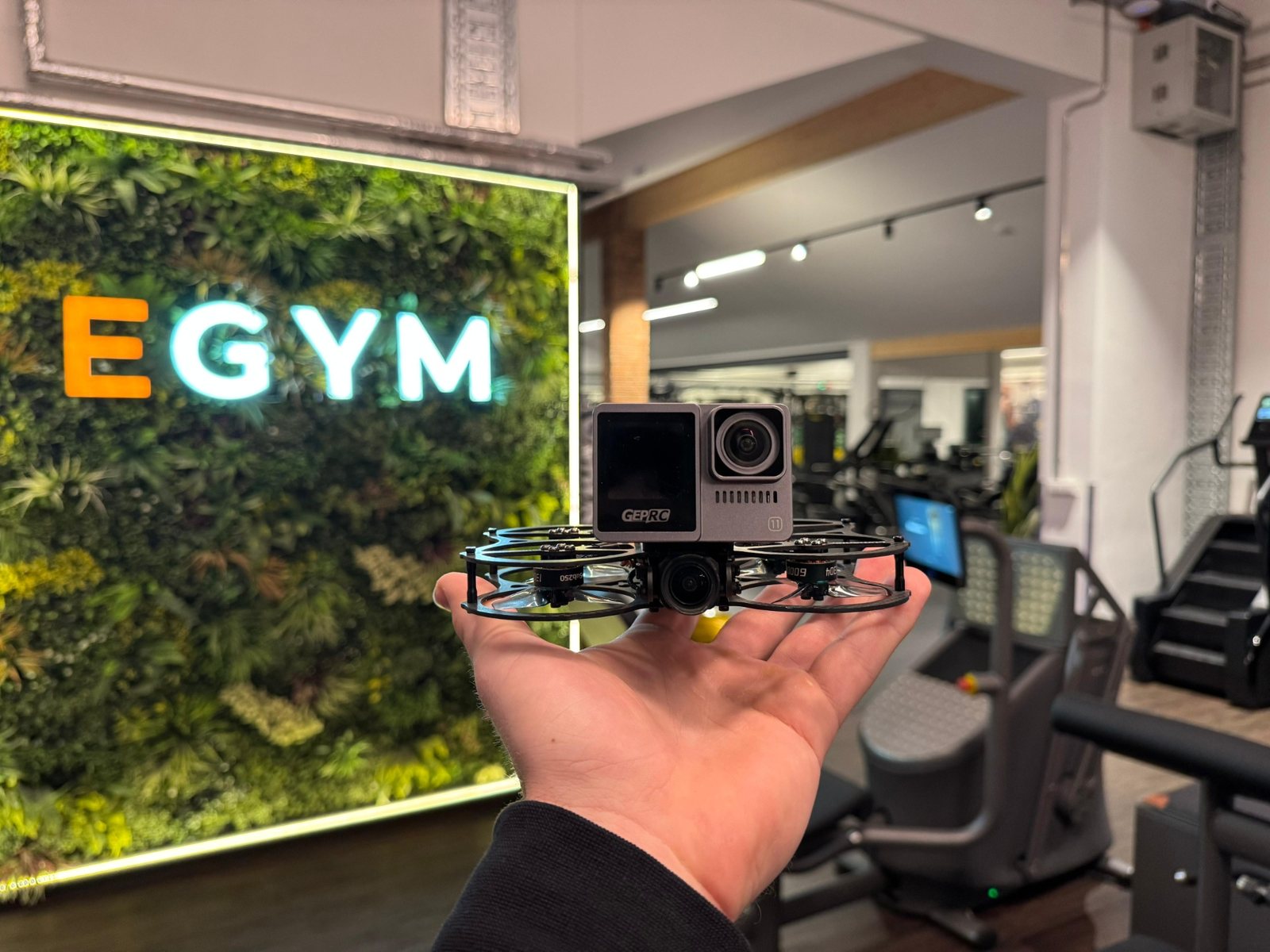
This is another example of why the aircraft should be selected around the shot.
Safety becomes more important as payload increases
The larger the aircraft and camera payload, the more seriously the operation needs to be planned.
A professional cinelifter production should consider:
- Aircraft configuration
- Payload weight
- Flight environment
- Emergency procedures
- Operating area
- People and equipment nearby
- Weather conditions
- Applicable aviation regulations
- Communication between departments
- Defined abort conditions
For commercial productions, flight permissions and operational requirements need to be assessed before the shooting day.
The exact requirements depend on the location, aircraft category, operation and jurisdiction.
A heavy cinema-camera drone should never be treated as simply a larger version of a consumer drone.
How we approach cinema-camera FPV at NextFlow
At NextFlow Studios, we do not select a camera first and then try to force the aircraft to accommodate it.
We work backwards from the shot.
First, we determine:
What does the viewer need to see?
Then:
How does the camera need to move?
Then:
Which camera and lens create the required image?
And finally:
Which aircraft can execute that movement with the required payload?
This approach allows us to consider different configurations depending on the project.
A RED KOMODO cinelifter may be the right tool for one production.
A smaller FPV system may be better for another.
A stabilized aerial platform may be the best solution for a third.
The objective is never to use the most impressive equipment.
It is to use the equipment that gives the production the right image.
Is a RED KOMODO cinelifter right for your production?
A RED KOMODO on a cinelifter can be a powerful combination for productions that need professional cinema-camera footage together with dynamic aerial movement.
It is particularly interesting for:
- Automotive commercials
- High-end brand films
- Architectural cinematography
- Large-scale commercial productions
- Productions requiring a cinema-camera workflow across ground and aerial footage
But it comes with additional aircraft size, payload and production requirements.
For some shots, a smaller camera will produce a better result simply because it allows the aircraft to move more freely.
For others, the RED KOMODO’s image and workflow may justify the larger platform.
The best cinema drone is not the one carrying the largest camera. It is the one capable of creating the image the production actually needs.
At NextFlow Studios, we design aerial camera systems around the production, from compact FPV configurations to cinema-camera cinelifters and stabilized aerial platforms.
If you are planning an automotive commercial, architectural film or high-end brand production and need to determine which aerial camera setup makes sense, contact NextFlow Studios.
Frequently asked questions
What is a cinelifter?
A cinelifter is a larger FPV-style drone designed to carry professional cinema cameras and other production equipment. Unlike lightweight FPV drones, cinelifters prioritise payload capacity while retaining dynamic aerial movement.
Can you fly a RED KOMODO on an FPV drone?
Yes. The RED KOMODO can be integrated into suitable cinelifter configurations. The complete payload, including the camera, lens and accessories, must be considered when selecting and configuring the aircraft.
How heavy is a RED KOMODO cinelifter setup?
There is no universal weight because the final payload depends on the camera configuration, lens, mounting system, batteries and aircraft. The complete system should be calculated before selecting the aircraft.
Is RED KOMODO good for FPV cinematography?
The RED KOMODO can be a strong option for FPV cinematography when a production requires its particular cinema-camera workflow and image characteristics. Its suitability depends on the aircraft and the intended shot.
Can a RED KOMODO cinelifter fly fast?
A suitable cinelifter can achieve significant speeds, but a heavy cinema-camera configuration will generally behave differently from a lightweight FPV drone. Acceleration, braking, manoeuvrability and flight time all need to be considered.
Is a RED KOMODO better than a GoPro MISSION 1 PRO ILS for FPV?
Neither is universally better. The RED KOMODO offers a different cinema-camera workflow and payload profile, while the compact MISSION 1 PRO ILS can provide greater flexibility for lighter FPV configurations. The right choice depends on the production and shot.
Can a cinelifter be used for automotive filming?
Yes. Cinelifters can be particularly useful for automotive productions where a larger cinema-camera package is required for dynamic vehicle tracking and the aerial footage needs to integrate closely with the rest of the production.
Can a RED KOMODO cinelifter be used indoors?
Potentially, but the aircraft size, payload and operating environment make indoor cinelifter work significantly more demanding. For smaller spaces, a compact FPV configuration is often more practical.
Planning an FPV production?
Let's define the shot first — then the camera, lens and aircraft to make it happen.
Get a free quote