Blackmagic Micro Studio Camera 4K G2 on an FPV Drone
Putting a cinema camera on an FPV drone is always a balance between image quality and flight performance.
The Blackmagic Micro Studio Camera 4K G2 is an interesting option for aerial cinematography because its compact form factor and Micro Four Thirds mount make it possible to combine a professional camera workflow with a comparatively lightweight FPV setup.
For productions that want more control over lenses and image capture than a typical action camera can provide, the camera can be an attractive option for cinema drone applications.
But as with any camera flown on an FPV drone, the camera itself is only one part of the equation. The lens, aircraft, payload, flight characteristics and intended shot all need to work together.
What is the Blackmagic Micro Studio Camera 4K G2?
The Blackmagic Micro Studio Camera 4K G2 is a compact digital cinema camera built around a Micro Four Thirds lens mount.
Its small form factor makes it particularly interesting for applications where camera size and weight matter, including gimbal systems, compact camera rigs and FPV drones.
The camera offers features associated with professional production workflows, including:
- 4K recording
- Micro Four Thirds lens compatibility
- Blackmagic RAW recording
- 10-bit ProRes recording
- 13 stops of dynamic range
- Dual native ISO
- Built-in colour science designed around Blackmagic's post-production ecosystem
- Compact camera body suitable for specialised rigs
For aerial production, its physical dimensions are just as relevant as its recording specifications.
A camera that can deliver a professional image while remaining relatively compact gives an FPV crew more flexibility when designing the aircraft around the shot.
Why is the Blackmagic Micro Studio Camera 4K G2 interesting for FPV?
Traditional cinema cameras can become difficult to integrate into an FPV system once the complete payload is considered.
The camera body is only part of the weight.
The lens, mounting hardware, battery solution and additional accessories all contribute to the final aircraft configuration.
The Micro Studio Camera 4K G2 provides an interesting middle ground.
It is more production-oriented than a typical action camera while remaining small enough to be considered for compact cinema-FPV applications.
This can be particularly valuable when the production needs:
- A professional cinema workflow
- Interchangeable lenses
- Greater control over the image
- RAW recording
- A compact camera package
- The ability to match footage with other Blackmagic cameras
The important distinction is that the camera does not simply make an FPV drone "cinematic."
It gives the production another tool for creating the intended image.
Micro Four Thirds lenses on an FPV drone
One of the biggest advantages of the camera is its Micro Four Thirds mount.
An interchangeable-lens system gives the cinematographer significantly more control over the visual character of the shot than a fixed-lens action camera.
For FPV cinematography, lens selection can affect:
- Field of view
- Perceived speed
- Subject distance
- Background compression
- Depth of field
- Camera weight
- Overall aircraft performance
A wide lens can make an FPV flight feel faster and more immersive because objects move more dramatically through the frame.
A narrower lens can create a more compressed perspective and place greater emphasis on the subject.
The lens therefore needs to be selected together with the flight path.
How lens choice affects the aircraft
There is an important practical consideration when using interchangeable lenses on an FPV drone.
A lens may be optically ideal but physically unsuitable for the aircraft.
A larger lens adds weight and can change the centre of gravity. It can also increase the overall dimensions of the camera package.
For that reason, the complete camera configuration should be considered before the aircraft is selected.
A professional setup may need to balance:
camera body + lens + mounting + battery + aircraft + flight requirements.
This is especially important for dynamic flights where acceleration, braking and rapid direction changes are part of the shot.
Blackmagic RAW from an FPV drone
One of the major reasons to consider the Blackmagic Micro Studio Camera 4K G2 for professional aerial cinematography is its integration into a Blackmagic production workflow.
Blackmagic RAW provides flexibility in post-production, allowing the production team to retain significant control over the captured image.
For commercial productions, this can be useful when aerial footage needs to be integrated with footage from other cameras.
Colour matching becomes particularly important when an FPV sequence appears directly alongside conventional cinema-camera footage.
The objective is not for the aerial footage to look like it came from a drone.
It should look like it belongs to the same film.
Can the Blackmagic Micro Studio Camera 4K G2 be used for commercial FPV productions?
Yes, provided the complete setup is appropriate for the production.
The camera can be particularly interesting for:
Automotive cinematography
Automotive productions often require dynamic camera movement while maintaining a consistent professional image.
A compact Blackmagic camera setup can provide an alternative to larger cinema-camera configurations when the aircraft needs to remain relatively agile.
This can be useful for vehicle tracking, road sequences and controlled dynamic movements.
Architecture
FPV architecture films can combine the camera's interchangeable-lens capabilities with the ability of an FPV aircraft to move through complex spaces.
The camera can travel through entrances, corridors and rooms or transition between interior and exterior environments.
Commercials and brand films
Brand productions often require aerial footage to match the visual language of the wider film.
A compact cinema camera can provide more control over the image than a conventional action-camera setup while maintaining the advantages of an FPV aircraft.
Event and experiential spaces
Large venues, installations and event spaces can benefit from continuous FPV movements.
The camera can move through the environment and connect different parts of a space within one sequence.
In these applications, the aircraft's movement and the camera's image characteristics need to be considered together.
Blackmagic Micro Studio Camera 4K G2 vs. RED KOMODO on an FPV drone
Both cameras can be considered for professional FPV cinematography, but they occupy different positions within a production.
The RED KOMODO is a more demanding camera payload and is often paired with larger cinelifter configurations.
The Blackmagic Micro Studio Camera 4K G2 offers a more compact alternative.
| Blackmagic Micro Studio Camera 4K G2 | RED KOMODO | |
|---|---|---|
| Camera class | Compact cinema camera | Compact cinema camera |
| Lens mount | Micro Four Thirds | Canon RF |
| RAW | Blackmagic RAW | REDCODE RAW |
| Aircraft requirements | Potentially lighter | Generally more demanding |
| FPV agility | Strong potential with suitable setup | More limited by total payload |
| Lens flexibility | Broad MFT ecosystem | Broad RF / adapted lens options |
| Best use | Compact cinema-FPV setups | Larger cinema-camera cinelifters |
| Production workflow | Blackmagic ecosystem | RED ecosystem |
Neither camera is automatically the better choice.
The decision should be based on the required image, lens, aircraft and production workflow.
Blackmagic Micro Studio Camera 4K G2 vs. an action camera
The difference becomes even more interesting when comparing the Blackmagic camera with a conventional action camera.
An action camera offers simplicity, low weight and excellent practicality.
The Blackmagic system introduces a different level of control.
The production can select a lens, use a professional recording workflow and integrate the aerial footage more closely into a larger cinema production.
This does come with additional complexity.
A larger camera and lens combination can reduce flight performance, require a larger aircraft and increase production requirements.
The right choice therefore depends on what the shot actually needs.
What kind of FPV drone is required?
The aircraft should be selected around the complete payload.
A compact camera configuration may be suitable for a smaller cinewhoop or compact FPV system, while a heavier lens and additional equipment may require a larger aircraft.
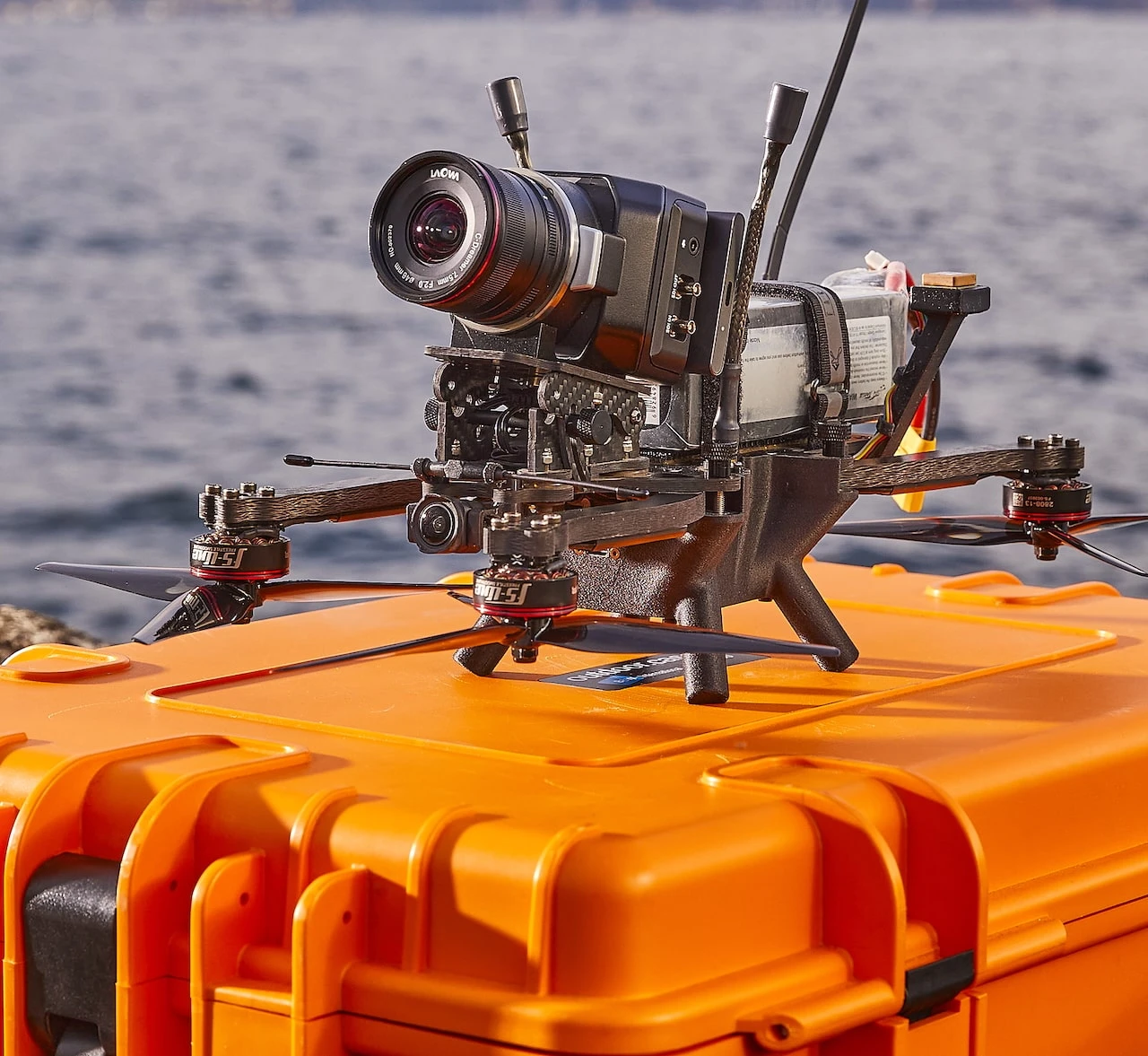
The most important factors include:
- Total payload
- Desired flight time
- Required acceleration
- Maximum operating speed
- Manoeuvrability
- Indoor or outdoor environment
- Camera mounting
- Flight path
- Safety requirements
For a slow architectural sequence, the aircraft may not need extreme performance.
For high-speed automotive tracking, the requirements can be very different.
This is why there is no single "best FPV drone" for the Blackmagic Micro Studio Camera 4K G2.
Is the camera suitable for indoor FPV filming?
Its compact form factor can make it an interesting option for controlled indoor productions.
Indoor FPV filming places particular demands on the aircraft and pilot because there is often limited space for correction.
The camera configuration should therefore remain as compact as possible without compromising the intended image.
This can make the Micro Studio Camera 4K G2 interesting for:
- Hotels
- Offices
- Showrooms
- Restaurants
- Event venues
- Architectural interiors
- Brand spaces
The objective should not simply be to fly through a building.
The flight should reveal something about the space.
What makes a professional cinema-FPV setup different?
The difference between mounting a camera on a drone and building a professional cinema-FPV system is the level of integration.
A professional setup considers the entire chain:
Concept → Shot Design → Camera → Lens → Aircraft → Flight → Post Production
Each decision affects the next.
For example, choosing a heavier cinema lens may require a different aircraft.
That aircraft may change the flight characteristics.
The changed flight characteristics may require a different shot design.
And the final recording format needs to integrate into the post-production workflow.
The equipment cannot be treated independently.
How we approach cinema cameras at NextFlow Studios
At NextFlow Studios, we work across a range of aerial camera systems rather than building every production around one specific camera.
Depending on the project, this can include compact FPV cameras, cinema-camera FPV systems, cinelifters and stabilized aerial platforms.
Our approach is simple:
Start with the shot. Then build the system around it.
If a production requires maximum agility, a lightweight camera may be the better choice.
If the footage needs to match a larger cinema production, a camera such as the Blackmagic Micro Studio Camera 4K G2 or RED KOMODO may make more sense.
And if the shot is better served by controlled aerial movement, a stabilized system may be the right tool.
The camera is part of the production strategy, not the production strategy itself.
Is the Blackmagic Micro Studio Camera 4K G2 right for your FPV production?
The Blackmagic Micro Studio Camera 4K G2 occupies an interesting position between lightweight FPV cameras and larger cinema-camera systems.
Its compact form factor, Micro Four Thirds mount and Blackmagic RAW workflow make it a potentially valuable option for professional FPV productions where image control and aircraft performance both matter.
It will not be the right camera for every shot.
Sometimes a lighter system will allow the aircraft to fly more dynamically.
Sometimes a larger cinema camera will provide the exact workflow a production requires.
And sometimes a stabilized aerial platform will be the better choice altogether.
The best camera is the one that allows the production to create the right image without compromising the shot.
If you are planning an automotive film, architectural production, commercial or brand campaign and want to explore which aerial camera setup is right for your project, contact NextFlow Studios.
About NextFlow Studios
NextFlow Studios is a Munich-based production studio creating premium visual content for commercial, architectural, automotive and brand productions in Germany and worldwide.
Our work goes beyond traditional drone filming.
We combine FPV and aerial cinematography with professional videography and photography to create visual content around the needs of each production.
Our aerial capabilities range from compact indoor FPV systems and dynamic outdoor FPV drones to cinema-camera configurations and stabilized aerial platforms. Depending on the project, we can integrate cameras such as the Blackmagic Micro Studio Camera 4K G2, RED KOMODO and other professional camera systems.
But aerial cinematography is only one part of what we do.
Our production capabilities also include:
- Aerial Cinematography – FPV, cinema drones, stabilized aerial systems and specialised aerial camera setups
- Videography – commercial films, brand content, architectural films and production projects
- Photography – professional architectural, commercial and brand photography
- Production Planning – concept development, shot planning, location coordination and aerial production logistics
- Drone Operations – flight planning, pilots, permissions and production coordination
Based in Munich, Germany, we work with local clients as well as agencies, production companies and brands bringing projects to Germany from abroad.
For international productions, we can act as a local production partner while also supporting projects outside Germany through our international production network.
The result is a production approach that does not start with a drone.
It starts with the image, the story and the purpose of the content.
Whether a project needs a dynamic FPV flight through a building, a cinema-camera automotive sequence, controlled aerial cinematography, professional videography or photography, we build the production around the final result.
Frequently asked questions
Can the Blackmagic Micro Studio Camera 4K G2 be used on an FPV drone?
Yes. Its compact form factor and Micro Four Thirds mount make it suitable for consideration in specialised FPV and cinema-drone configurations. The complete camera and lens payload must be matched to the aircraft.
Is the Blackmagic Micro Studio Camera 4K G2 good for aerial cinematography?
It can be a strong option for aerial productions that require an interchangeable lens, professional recording formats and a compact camera system. Its suitability depends on the aircraft, lens and intended shot.
Can the Blackmagic Micro Studio Camera 4K G2 record RAW?
Yes. The camera supports Blackmagic RAW, providing a professional RAW workflow for productions that require greater flexibility in post-production.
What lenses can you use on the Blackmagic Micro Studio Camera 4K G2?
The camera uses a Micro Four Thirds mount and can therefore use compatible MFT lenses. For FPV applications, lens weight, dimensions and focus requirements are particularly important.
Is the Blackmagic Micro Studio Camera 4K G2 better than the RED KOMODO for FPV?
Neither camera is universally better. The Blackmagic camera offers a compact MFT-based configuration, while the RED KOMODO provides a different cinema-camera platform and workflow. The right choice depends on the production and aircraft.
Can the Blackmagic Micro Studio Camera 4K G2 be used for automotive FPV filming?
Yes. Its compact configuration can be useful for automotive FPV productions where the production needs a professional cinema workflow while retaining a relatively agile aircraft.
Can the Blackmagic Micro Studio Camera 4K G2 be used for indoor FPV?
Potentially, particularly in sufficiently large and controlled environments. The aircraft, camera configuration, location and operating conditions all need to be evaluated before filming.
What is the advantage of using a cinema camera instead of an action camera on an FPV drone?
A cinema camera can provide greater control over lenses, recording formats, image settings and post-production workflow. The trade-off is additional weight, complexity and potentially reduced aircraft performance.
Planning an FPV production?
Let's define the shot first — then the camera, lens and aircraft to make it happen.
Get a free quote