Choosing the Right FPV Drone for a Commercial Shoot
Choosing the right FPV drone for a commercial shoot is not simply a matter of selecting the fastest or largest aircraft. The right setup depends on the shot, camera system, environment, flight path and production requirements.
A compact cinewhoop may be ideal for flying through an interior, while an open-prop freestyle platform offers greater agility for dynamic outdoor sequences. When a production requires a cinema camera, a specialised cinelifter may be necessary. Professional FPV production starts by defining the image – and selecting the aircraft around it.
Why the Choice of FPV Drone Matters
FPV drones are often grouped together as if they were interchangeable tools. In practice, different aircraft are designed around different priorities.
Some prioritise compact dimensions and controlled movement. Others are built for speed, agility, longer flight distances or carrying heavier camera systems.
Choosing the wrong platform can affect more than the final image. It can influence:
- The camera and lens combinations available
- The achievable flight path and movement
- Flight duration and battery requirements
- The ability to operate in confined environments
- Wind resistance and outdoor performance
- Safety considerations and operational planning
For commercial productions, the objective is not to use the most impressive drone. It is to use the platform that delivers the required shot reliably.
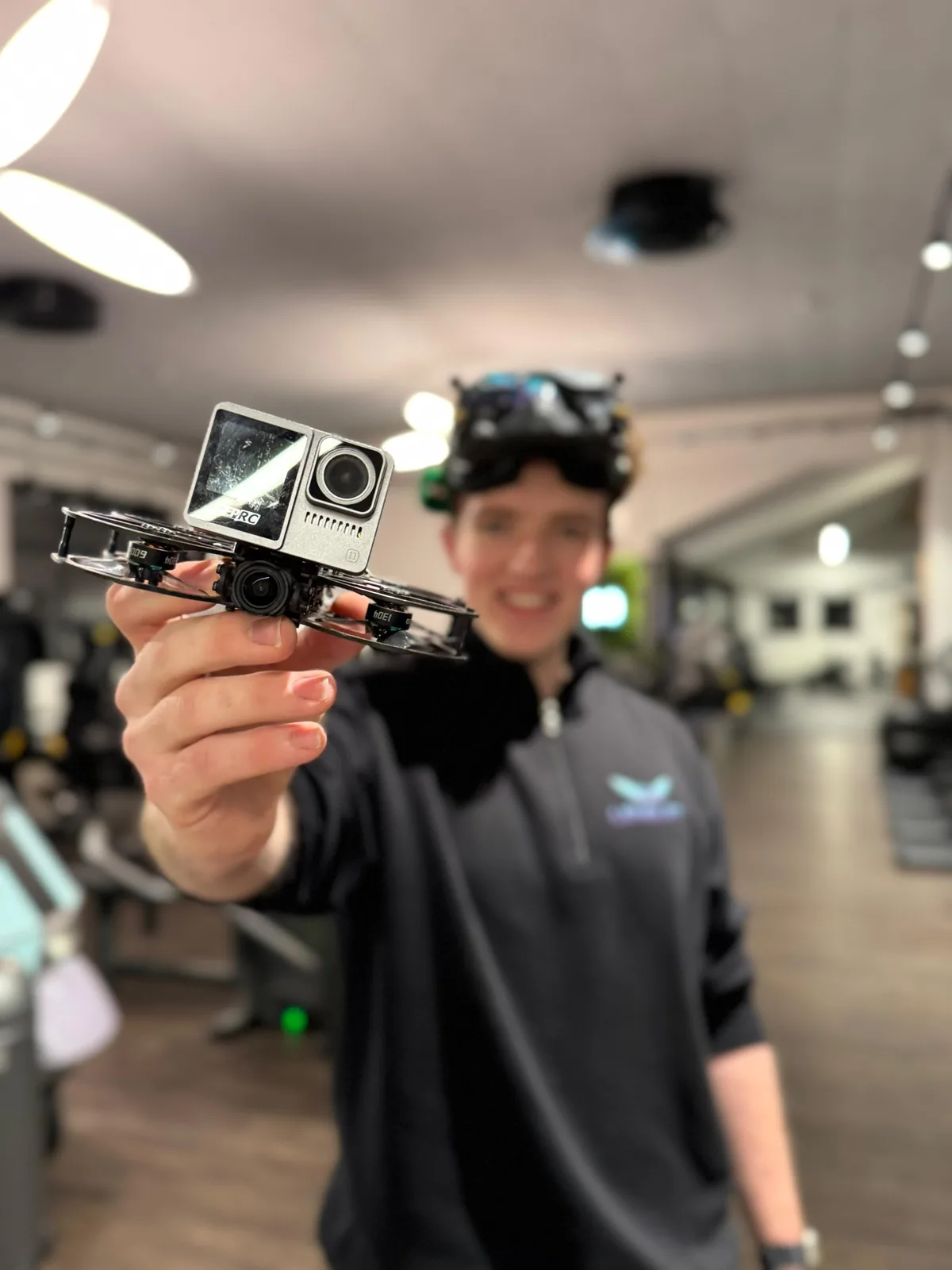
1. Compact Cinewhoops: Precision in Confined Spaces
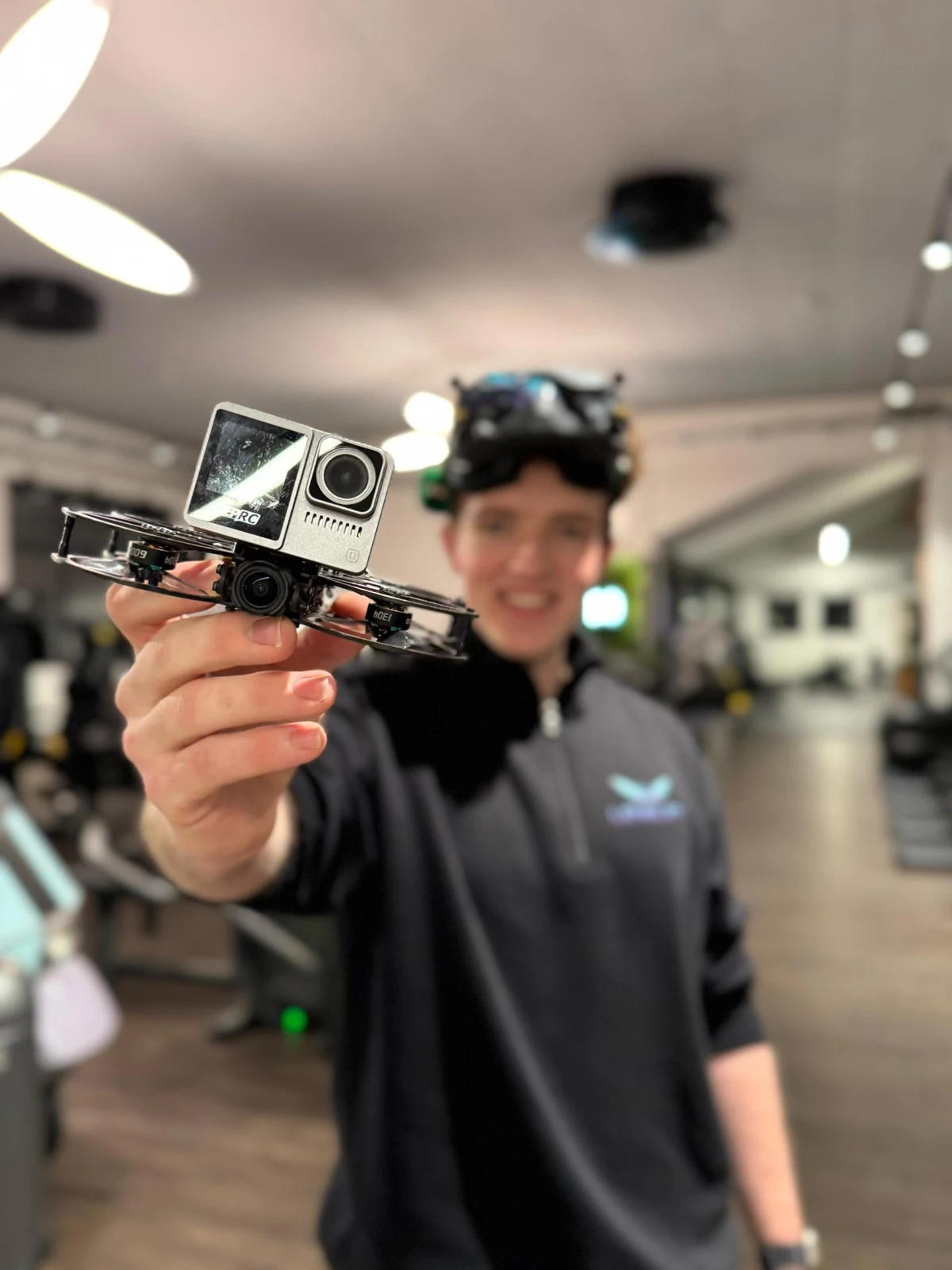
Compact cinewhoops are designed for controlled flight in relatively confined environments. Their smaller dimensions make them particularly useful for interior sequences, architectural walkthroughs and locations where larger aircraft would be impractical.
Many cinewhoops feature protective propeller ducts. These can help reduce the risk of direct propeller contact, but they do not make an aircraft harmless or automatically suitable for flying close to people. Proper separation, risk assessment and controlled operating conditions remain essential.
Typical applications include:
- Interior architecture and real estate
- Hotels, restaurants and hospitality spaces
- Offices and commercial interiors
- Industrial walkthroughs
- Close-proximity movements through doors and corridors
- Controlled one-take sequences
The main advantage is manoeuvrability in tight spaces. The trade-off is generally a more limited payload capacity compared with larger platforms.
For productions that require a compact camera, a cinewhoop can be an effective choice. However, the complete camera package – including lens, mounting, recording media and accessories – must be considered before selecting the aircraft.
2. 5-Inch FPV Drones: Agility and Dynamic Movement
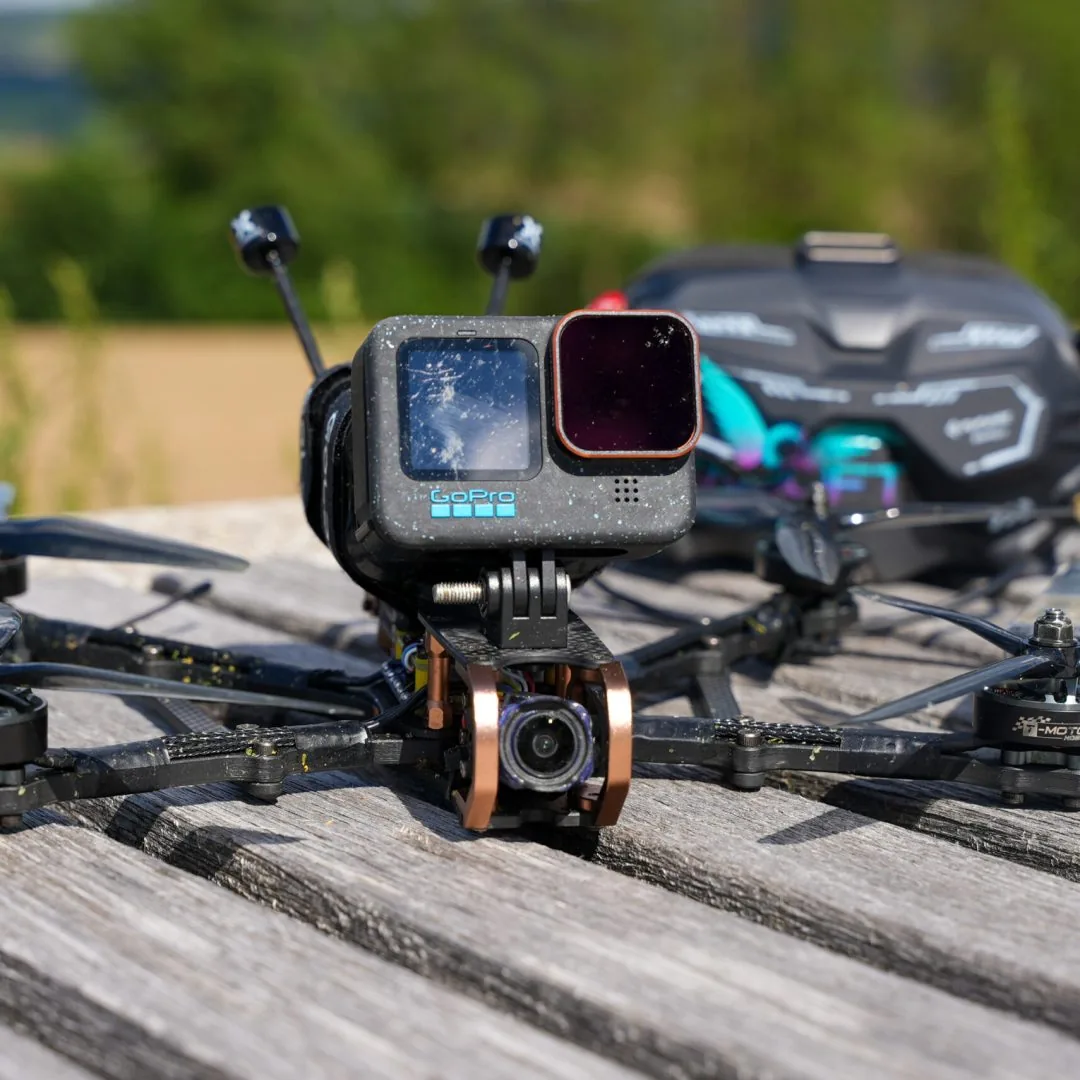
The 5-inch FPV category is widely associated with agile, responsive flight. These platforms can be suitable for dynamic outdoor sequences where fast direction changes, acceleration and close tracking movements are required.
Their applications can include:
- Automotive tracking
- Sports and action sequences
- Outdoor brand campaigns
- Dynamic location reveals
- Follow shots and tracking movements
- Fast transitions between subjects and environments
Compared with compact cinewhoops, open-prop platforms typically offer a different balance of agility, power and aerodynamic characteristics.
However, the category is broad. A lightweight freestyle build and a production-oriented platform carrying a dedicated camera are not necessarily comparable, even if both use 5-inch propellers.
For commercial work, the actual aircraft configuration matters more than the frame size alone.
3. 7-Inch and Long-Range Platforms: Distance and Endurance
Larger long-range platforms are designed around different operational requirements. Depending on their configuration, they can offer greater endurance and support longer-distance flight paths.
They can be useful for productions involving:
- Large outdoor locations
- Extended landscape movements
- Long tracking sequences
- Wide establishing shots
- Locations where the aircraft needs to cover greater distances
However, a larger frame does not automatically guarantee longer flight time or better performance. Battery capacity, aircraft weight, motor efficiency, payload and flight conditions all influence the result.
Long-range platforms also require careful consideration of the operating environment, visibility, communications and applicable flight regulations.
For a commercial production, the relevant question is not simply how far a drone can fly. It is whether the planned movement can be executed safely and consistently under the actual production conditions.
4. Cinelifters: Bringing Cinema Cameras Into the Air
When a production requires a dedicated cinema camera, a conventional compact FPV drone may no longer be sufficient.
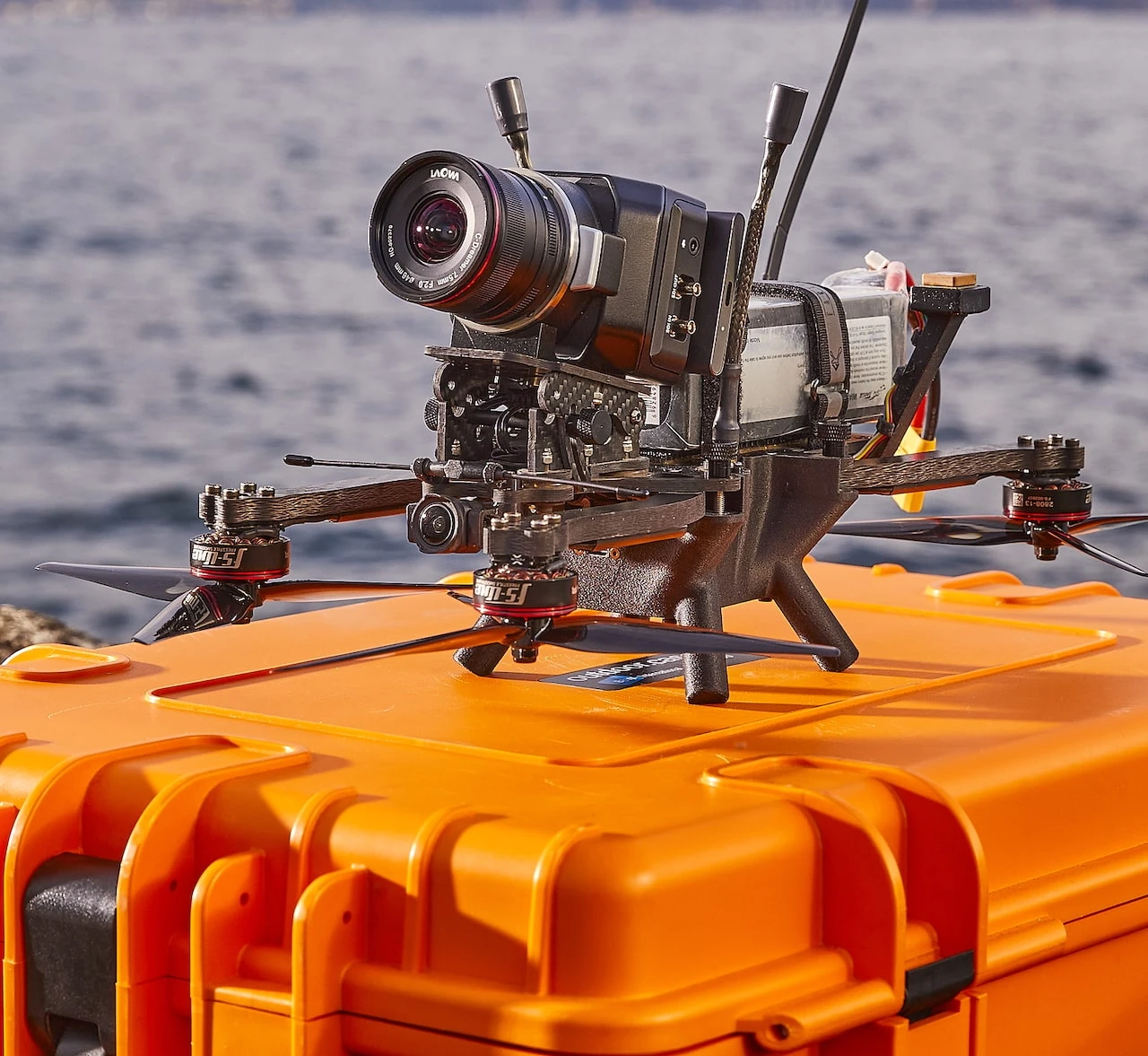
Cinelifters are purpose-built platforms designed to carry heavier camera payloads. Depending on the aircraft, this can include cameras such as the RED KOMODO, Sony FX6 or other cinema-oriented systems.
They open up a different level of creative possibilities:
- Higher-end commercial cinematography
- Automotive campaigns requiring dedicated camera systems
- Large architectural environments
- Complex tracking sequences
- Productions requiring specific cinema-camera workflows
- Shots where lens selection and image characteristics are critical
The key consideration is the complete payload.
A camera body alone does not represent the actual weight of a filming setup. Lenses, mounting systems, power solutions, recording media and additional accessories all contribute to the total load.
A heavier camera also affects flight characteristics, acceleration, braking, endurance and the aircraft's ability to perform precise movements.
Cinelifters therefore require a more specialised approach to both aircraft configuration and flight planning.
5. Specialised Custom Builds: When Standard Platforms Are Not Enough
Not every commercial shot fits neatly into an existing drone category.
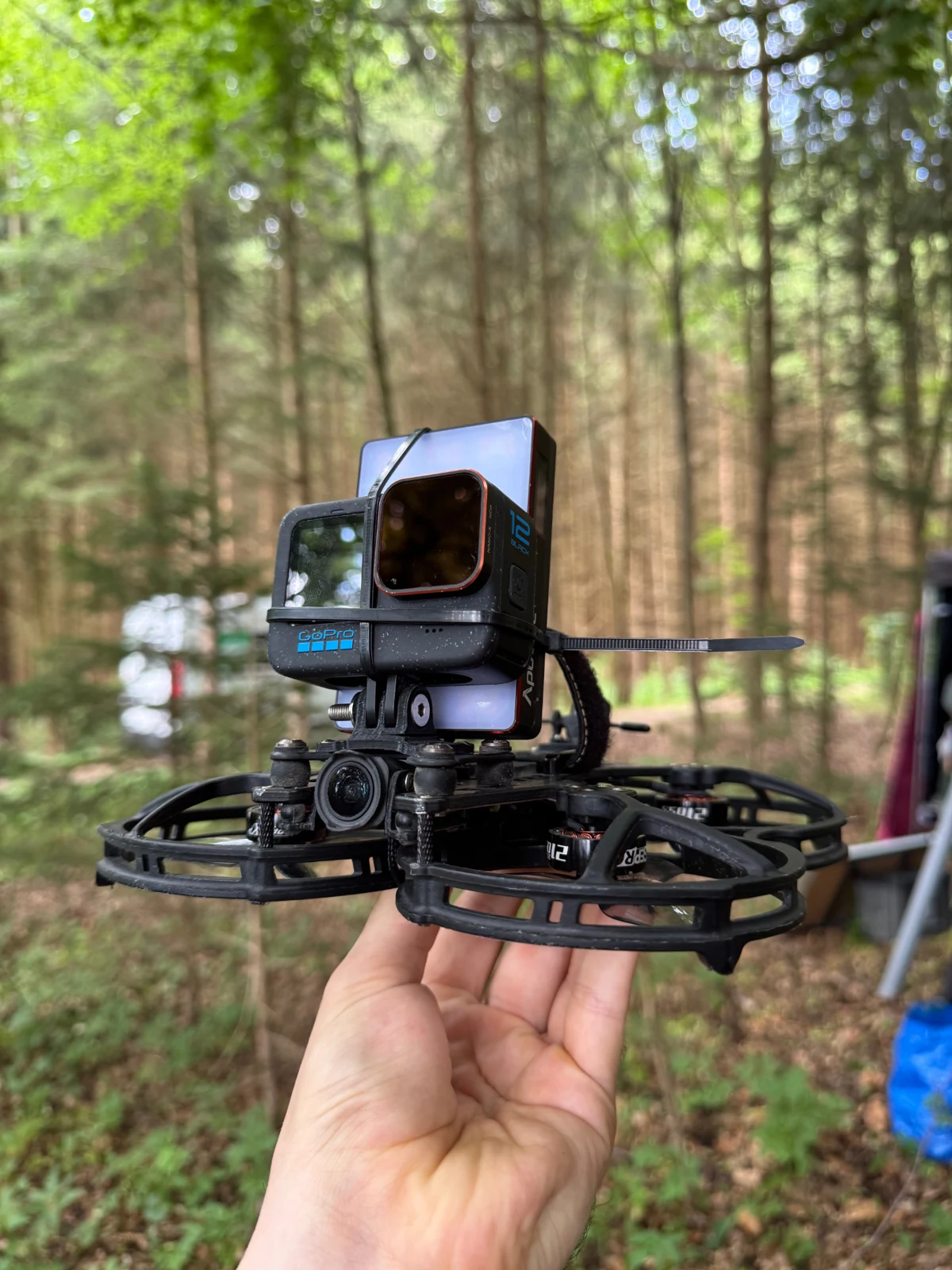
Some productions require a particular combination of dimensions, camera weight, flight characteristics and mounting options. In these situations, a specialised custom build may be the most suitable solution.
Examples include:
- Compact aircraft carrying a specific camera configuration
- Custom camera mounting and orientation
- Setups designed around a particular lens
- Aircraft optimised for a specific tracking movement
- Specialised indoor or outdoor applications
This is particularly relevant when a production has a clearly defined visual concept that cannot easily be achieved with an off-the-shelf configuration.
The aircraft should serve the creative objective, not the other way around.
Comparing FPV Drone Categories
The following overview illustrates the typical differences between common FPV platforms. Actual capabilities depend on the individual build, payload and operating conditions.
| Platform | Main Strength | Typical Applications | Main Consideration |
|---|---|---|---|
| Compact cinewhoop | Manoeuvrability in confined spaces | Interiors, architecture, walkthroughs | Limited payload |
| 5-inch FPV | Agility and dynamic movement | Automotive, sports, outdoor campaigns | Configuration-dependent payload |
| 7-inch / long-range | Longer-distance operation | Landscapes, large locations, extended tracking | Operational complexity |
| Cinelifter | Heavy camera payloads | Cinema commercials, automotive, high-end productions | Weight and flight characteristics |
| Custom build | Specific production requirements | Specialised camera and movement setups | Requires individual engineering |
Frame size is only one part of the equation. Two aircraft within the same category can have substantially different capabilities.
How to Choose the Right FPV Drone for Your Production
Selecting the right platform becomes easier when the production requirements are defined first.
1. Start With the Shot, Not the Drone
The first question should always be:
What should the viewer see?
A slow movement through an architectural interior requires a different approach from a high-speed automotive tracking sequence.
Consider:
- Where does the shot begin and end?
- How close does the aircraft need to get to the subject?
- Is the movement slow, controlled or dynamic?
- Does the shot require a continuous one-take movement?
- Are there obstacles, narrow passages or changing elevations?
Once the movement is understood, the appropriate aircraft category becomes easier to identify.
2. Define the Camera Requirements
The desired image determines the camera requirements, which in turn influence the aircraft.
A compact action or cinema-oriented camera may be sufficient for certain productions. Other projects may require a larger sensor, specific recording formats, interchangeable lenses or a particular colour workflow.
The camera decision should consider:
- Sensor size and image quality
- Resolution and frame rates
- Dynamic range and colour profile
- Lens selection and field of view
- Recording format
- Total camera package weight
A camera that looks suitable on paper may not be practical for a particular FPV platform once the complete setup is assembled.
3. Consider the Environment
The same drone can behave very differently depending on where it is used.
Important factors include:
- Indoor or outdoor operation
- Wind conditions
- Available space
- Obstacles and flight corridors
- Surface characteristics
- Lighting conditions
- Access restrictions
- Operating permissions and safety requirements
A drone selected for a spacious outdoor location may be unsuitable for a narrow interior passage, even if it carries the preferred camera.
4. Balance Image Quality and Flight Performance
There is often a trade-off between camera capabilities and aircraft performance.
A heavier camera package can reduce available flight time and influence how quickly the aircraft can change direction.
The production team needs to balance:
- Movement speed
- Flight precision
- Camera payload
- Battery endurance
- Environmental conditions
- Operational safety
There is rarely one aircraft that performs equally well across all these requirements.
5. Plan Around the Entire Production
The aircraft is only one part of the setup.
A professional FPV production may involve multiple drones, camera configurations, pilots, camera operators, safety personnel and ground-based equipment.
For a demanding commercial shoot, bringing several aircraft can be more effective than trying to make one platform perform every task.
A compact cinewhoop for interiors and a larger cinelifter for cinema-camera sequences, for example, can complement each other within the same production.
Explore the wider planning process in What Goes Into a Professional FPV Drone Production?
Why Professional FPV Productions Often Use Multiple Drones
A common misconception is that one versatile FPV drone should be capable of handling an entire commercial shoot.
In reality, different shots often require fundamentally different aircraft characteristics.
Consider a commercial production in a modern automotive facility:
- A compact cinewhoop captures controlled movements through the showroom.
- A more agile platform follows the vehicle through a larger open space.
- A cinema-camera cinelifter captures a dedicated high-end tracking sequence.
Each aircraft serves a specific creative purpose.
Using multiple platforms can improve the quality and efficiency of a production because each setup is configured for the task it performs best.
It also provides flexibility when the original concept changes or the location introduces additional constraints.
What Should You Tell Your FPV Production Team?
You do not need to know which drone should be used before contacting a production team. That is part of the technical planning process.
However, providing a few key details helps determine the right approach.
1. Location
Share the location, available floor plans, access restrictions and relevant environmental conditions.
2. Visual References
Show examples of the movements, camera perspectives and overall visual style you want to achieve.
3. Camera Requirements
If your production requires a specific camera, lens or recording format, communicate this early.
4. Subjects and Movement
Explain what needs to be filmed: a vehicle, a building, a production process, people or a particular environment.
5. Intended Usage
A social media campaign, cinema commercial, corporate film and architectural presentation may have very different image requirements.
With this information, the production team can recommend the appropriate aircraft, camera configuration and operational approach.
The NextFlow Approach: Building the Aircraft Around the Image
At NextFlow Studios, we approach FPV production from the visual objective backwards.
Rather than selecting a drone first and adapting the creative concept around it, we consider the desired image, movement, camera system and environment before deciding on the aircraft configuration.
Our capabilities range from compact indoor FPV systems to outdoor platforms, specialised camera builds and cinema-camera cinelifters.
This flexibility is particularly valuable for productions that combine different environments or require several visual styles within one project.
A commercial shoot may involve dynamic FPV movements, controlled architectural cinematography, conventional ground-based videography and professional photography. These elements should work together as part of one coherent visual production.
The objective is not to use FPV everywhere. It is to identify where FPV creates genuine visual value – and where another camera platform is the better choice.
For a comparison with conventional aerial systems, read FPV vs. Stabilized Drone: Which Is Right for Your Production?
Conclusion: The Best FPV Drone Is the One That Delivers the Shot
Choosing the right FPV drone for a commercial shoot requires more than comparing frame sizes or technical specifications.
The aircraft must match the intended movement, camera package, environment and operational requirements.
Compact cinewhoops, agile outdoor platforms, long-range builds, cinelifters and specialised custom aircraft each serve different purposes. Understanding these differences is essential for achieving the intended result.
For brands, agencies and production companies, the most important consideration is not which drone looks the most impressive on paper.
It is whether the production team can deliver the image the project actually needs.
About NextFlow Studios
NextFlow Studios is a Munich-based production studio creating premium visual content for commercial, architectural, automotive and brand productions in Germany and worldwide.
Our work goes beyond traditional drone filming. We combine FPV and aerial cinematography with professional videography and photography, creating visual content around the specific needs of each production.
Our aerial capabilities range from compact indoor FPV systems and dynamic outdoor FPV drones to cinema-camera configurations and stabilised aerial platforms. Depending on the project, we build the aerial setup around the required image, movement and production environment.
Our services include:
- Aerial Cinematography – FPV, cinema drones, stabilised aerial systems and specialised aerial camera setups
- Videography – commercial films, brand content, architectural films and production projects
- Photography – professional architectural, commercial and brand photography
- Production Planning – concept development, shot planning, location coordination and aerial production logistics
- Drone Operations – flight planning, pilots, permissions and production coordination
Based in Munich, Germany, NextFlow Studios works with local clients as well as agencies, production companies and brands bringing projects to Germany from abroad. We also support productions worldwide, depending on the project's requirements.
This means a project does not need to be treated as a standalone drone shoot. We can contribute to the wider visual production – from aerial cinematography and FPV to videography and photography.
Whether the project requires a dynamic FPV sequence, cinema-camera aerial footage, architectural cinematography, automotive tracking or a complete visual production, our approach remains the same:
Start with the image. Build the production around it.
If you are planning a production in Munich, Germany or elsewhere in the world, contact NextFlow Studios.
Frequently asked questions
What is the best FPV drone for commercial filming?
There is no universal best FPV drone. Compact cinewhoops are often suitable for indoor filming, agile 5-inch platforms for dynamic outdoor movements, and cinelifters for heavier cinema-camera systems. The right choice depends on the shot, environment and camera requirements.
What is the difference between a cinewhoop and a cinelifter?
A cinewhoop is generally a compact FPV drone designed for controlled filming, often with protective propeller ducts. A cinelifter is a larger platform designed to carry heavier camera payloads, including dedicated cinema cameras.
Can FPV drones carry professional cinema cameras?
Yes. Specialised cinelifters can carry camera systems such as the RED KOMODO or Sony FX6, depending on the aircraft's payload capacity and configuration. The complete camera package must be considered, not just the camera body.
Are cinewhoops safer than open-prop FPV drones?
Protective ducts can help reduce the risk of direct propeller contact, but they do not eliminate the risks associated with drone operations. Safe operation still requires suitable separation, risk assessment, trained pilots and appropriate operating conditions.
Which FPV drone is best for indoor filming?
Compact cinewhoops are often a suitable choice because of their smaller dimensions and manoeuvrability. The exact aircraft depends on the available space, camera payload, flight path and operating environment.
How many FPV drones are needed for a commercial production?
That depends on the number and variety of required shots. A simple production may only require one platform, while a larger commercial shoot may benefit from several aircraft configured for different environments and camera systems.
Does a larger FPV drone always carry a better camera?
No. Frame size alone does not determine camera quality or payload capability. The motors, frame design, battery, mounting system and complete aircraft configuration all influence what a drone can carry and how it flies.
Planning an FPV production?
Let's define the shot first — then the camera, lens and aircraft to make it happen.
Get a free quote