What Goes Into a Professional FPV Drone Production?
A professional FPV drone production is much more than putting a camera on a fast drone and flying it through a location.
Behind every successful FPV sequence is a combination of creative direction, technical preparation, flight planning, camera operation and precise coordination. The drone may be the most visible part of the production, but it is only one element of a much larger process.
Whether the goal is to follow a performance car, fly through an architectural space, capture an industrial facility or create a continuous one-take sequence, the quality of the final footage depends on how well every part of the production works together.
A professional FPV production starts with the desired image – not with the drone.
What is a professional FPV drone production?
FPV stands for First Person View. Unlike conventional camera drones, FPV drones are typically controlled from the pilot’s perspective through a live video feed transmitted from the aircraft.
This allows pilots to perform highly dynamic movements, navigate through complex environments and capture perspectives that are difficult to achieve with conventional aerial platforms.
In professional cinematography, however, FPV is not simply about speed or acrobatic flying.
It is a specialised camera movement technique.
An FPV production combines:
- Aerial cinematography and camera movement
- Purpose-built aircraft and camera systems
- Creative shot planning
- Experienced FPV pilots
- Camera and lens selection
- Location and flight planning
- Production coordination and safety
- Professional post-production
The objective is to use the aircraft as a moving camera platform to create images that support the story, brand or message of a production.
1. Understanding the creative objective
Every production should begin with a simple question:
What should the viewer experience?
A client might initially request an FPV drone video because they have seen a dynamic sequence online. But the actual objective could be very different.
An automotive brand may want to communicate performance and precision. An architecture firm may want to showcase the spatial connection between different areas of a building. A manufacturer may want to demonstrate the scale and complexity of its production facilities.
Each objective requires a different visual approach.
Before selecting any equipment, the production team should establish:
- What is the subject?
- Who is the intended audience?
- What should the viewer understand or feel?
- Which locations or subjects need to be shown?
- What is the intended final format?
- Where will the footage be used?
This is where the difference between simply providing a drone pilot and producing a complete visual sequence becomes apparent.
The technology should support the creative objective, not dictate it.
2. Developing the shot concept
Once the objective is clear, the next step is translating it into specific camera movements and visual sequences.
An FPV shot can serve several different purposes.
Establishing a location
A flight can introduce a building, property or facility by revealing its exterior, surroundings and architectural character.
Connecting different spaces
One of FPV’s strongest applications is moving continuously between different environments.
For example:
Exterior → entrance → reception → corridor → main interior → architectural detail
This can create a connected visual experience that would otherwise require multiple individual camera setups.
Following a moving subject
Automotive productions frequently use FPV to follow vehicles through roads, buildings or controlled environments.
The camera can move alongside the vehicle, approach from different angles or transition between perspectives.
Creating dynamic transitions
FPV can connect scenes through doorways, around structures or across different environments.
Instead of cutting between separate shots, the camera movement itself can become the transition.
Revealing scale and detail
Industrial facilities, commercial buildings and large architectural spaces can benefit from a combination of wider movements and closer visual details.
The strongest sequences are usually those in which every movement has a purpose.
3. Choosing the right drone
Not every FPV drone is designed for the same application.
Aircraft differ in size, payload capacity, flight characteristics, camera compatibility and manoeuvrability.
Selecting the right platform is therefore one of the most important production decisions.
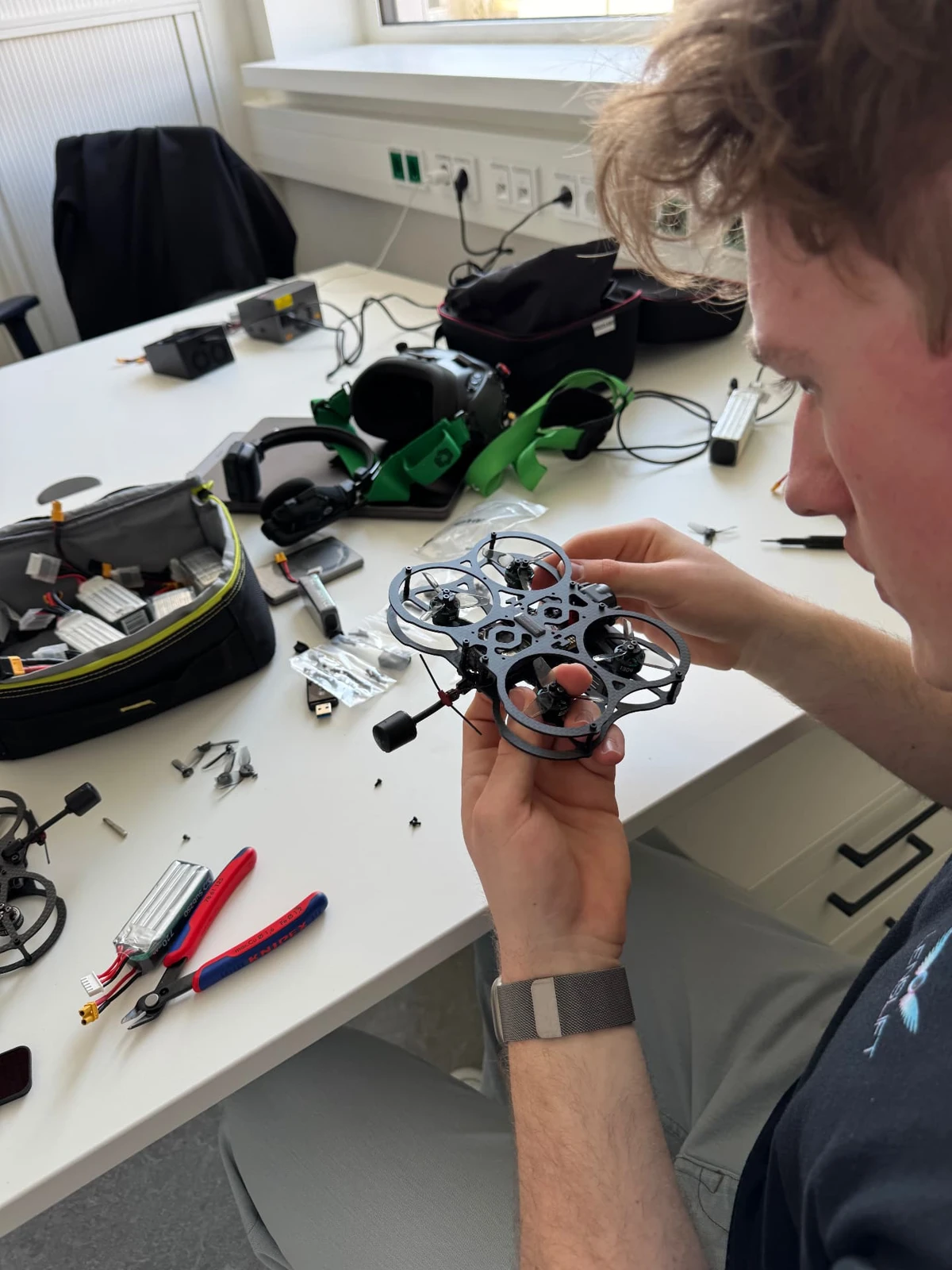
Cinewhoop
Typical application: Indoor filming and confined environments
Cinewhoops are relatively compact FPV drones, often featuring protective propeller ducts.
They are particularly useful for flying through interiors, around people in controlled conditions and through relatively narrow spaces.
Their compact dimensions make them suitable for shots where a larger aircraft would be impractical.
Freestyle and lightweight FPV drones
Typical application: Dynamic movement and agile outdoor sequences
These aircraft are designed for responsive movement and can be useful when the shot requires rapid changes in direction, acceleration or close subject tracking.
Depending on the configuration, they can carry compact camera systems.
Cinelifters and heavy-lift FPV drones
Typical application: Professional cinema cameras and demanding commercial productions
Cinelifters are purpose-built aircraft designed to carry larger camera payloads.
They can support professional cinema-camera systems such as the RED KOMODO or Sony FX6, depending on the aircraft configuration.
Their size and payload capacity make them particularly relevant for high-end automotive, commercial and architectural productions.
Specialised camera platforms
Not every project requires a traditional heavy-lift system.
Compact interchangeable-lens cameras such as the GoPro MISSION 1 PRO ILS introduce additional possibilities for productions that require a relatively small camera package without relying exclusively on conventional action cameras.
The important consideration is always the complete system: camera, lens, mounting hardware, transmission equipment and aircraft.
The right drone is determined by the shot, the environment and the required camera system.
For a comparison of aerial platforms, see FPV vs. Stabilized Drone: Which Is Right for Your Production?.
4. Selecting the camera and lens
The aircraft determines how the camera moves. The camera and lens determine how the world is captured.
Professional FPV productions can use a range of camera systems, from compact action cameras to specialised cinema-camera configurations.
Common options include:
- GoPro MISSION 1 PRO ILS
- RED KOMODO
- Sony FX6
- Blackmagic Micro Studio Camera 4K G2
- Compact action cameras and dedicated recording systems
Each has different characteristics.
A larger cinema camera may provide a particular sensor format, recording workflow or lens ecosystem that is important to the wider production.
A smaller camera can reduce payload and make more agile aircraft configurations possible.
Lens selection is equally important.
Wide-angle lenses are frequently used in FPV cinematography because they emphasise movement and allow the drone to operate relatively close to subjects.
Longer focal lengths can create a more compressed perspective and a different visual style, but they also require more precise control of the aircraft’s position.
The decision should account for:
- Sensor format
- Field of view
- Focal length
- Depth of field
- Lens weight
- Focus requirements
- Recording format
- Final delivery resolution
The camera setup should always be selected in relation to the intended shot.
Explore our RED KOMODO, Sony FX6 and Blackmagic FPV camera comparison and the production requirements of each camera system.
5. Planning the location and flight path
A visually interesting location is not automatically suitable for FPV filming.
Before production, the team needs to understand the physical environment and identify possible flight paths.
This can include:
- Entrances and exits
- Doorways and corridors
- Ceiling heights
- Obstacles and narrow passages
- Reflective surfaces
- Lighting conditions
- Wind and weather exposure
- Areas accessible to the production team
- Potential emergency landing areas
For an indoor production, even small architectural details can influence the flight.
Glass surfaces, hanging lights, narrow door frames and reflective floors can all create additional challenges.
For outdoor productions, wind, surrounding structures, people, vehicles and environmental conditions become particularly relevant.
A good flight path is not necessarily the most complicated one.
It is the one that creates the desired image while remaining repeatable and operationally manageable.
6. Storyboarding and shot planning
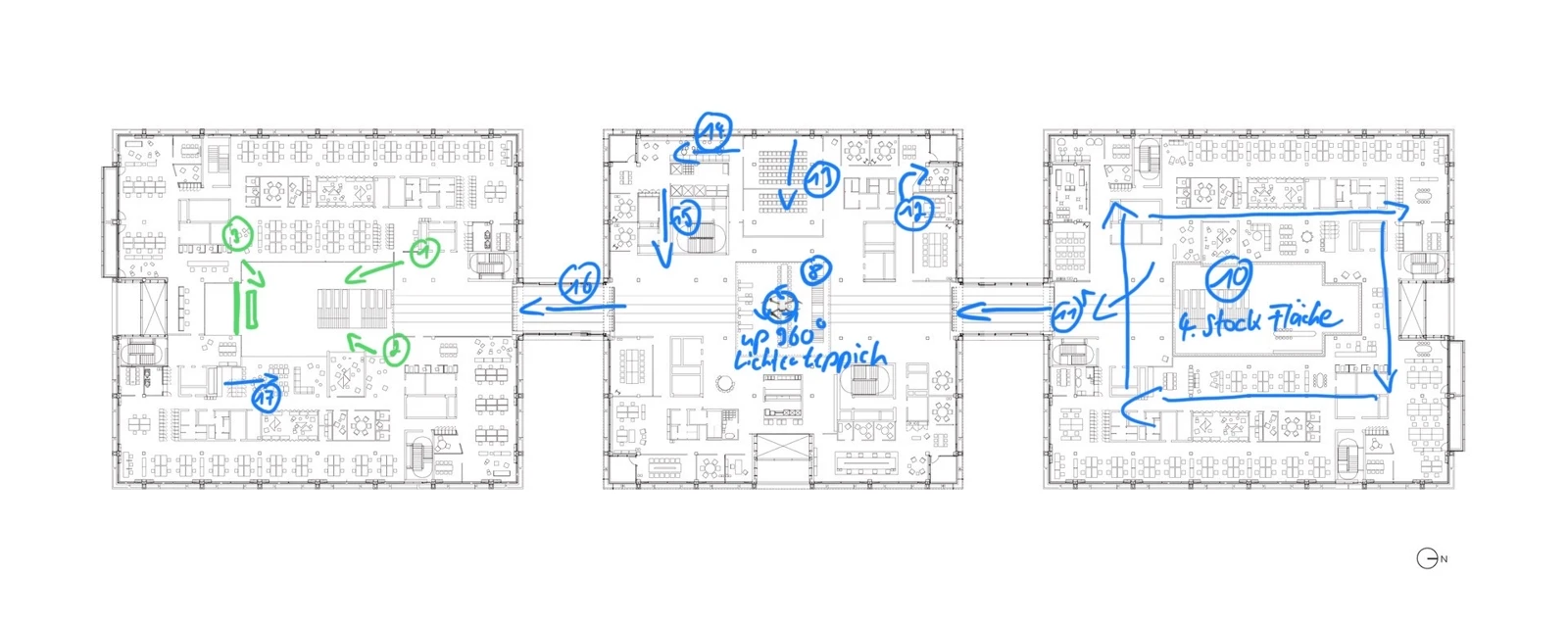
Once the location has been assessed, the production team can develop a more detailed shot plan.
Depending on the project, this might include a storyboard, reference footage, floor plans, annotated photographs or a simple sequence of planned movements.
A shot plan should establish:
- Starting position
- Direction of movement
- Camera orientation
- Subject interaction
- Key visual moments
- Ending position
- Required transitions
For a one-take sequence, this becomes particularly important.
The pilot needs to understand not only where the flight begins and ends, but also how every movement connects.
If the sequence involves people, vehicles or other moving subjects, their timing and positions need to be coordinated with the flight.
This is why professional FPV productions often involve several departments working together.
7. The team behind a professional FPV production
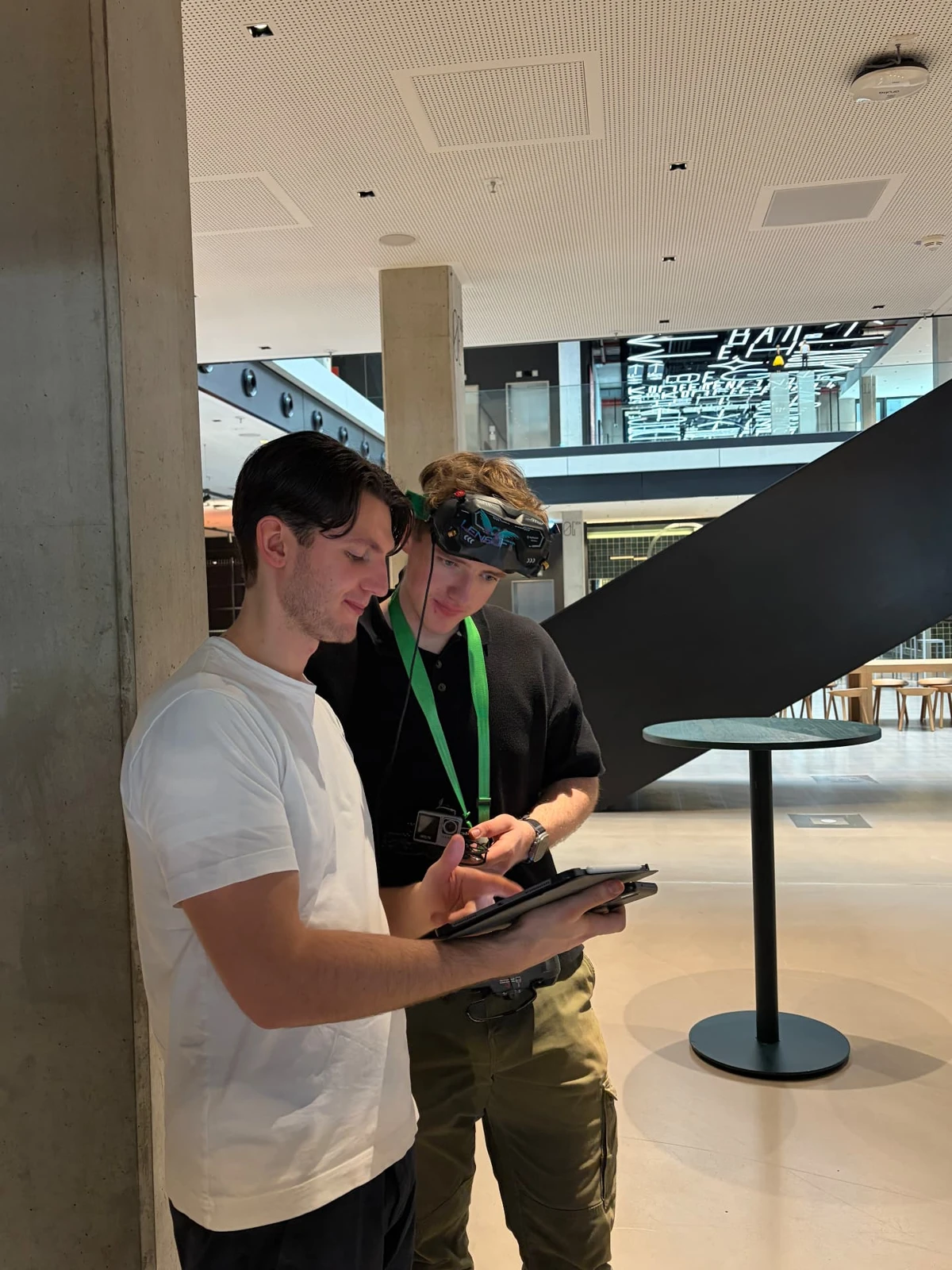
A professional FPV shoot is not necessarily a one-person operation.
The required crew depends on the complexity of the project, camera system and production environment.
A typical setup can include:
FPV pilot
The pilot is responsible for controlling the aircraft and executing the planned movements.
This requires more than general drone experience. Professional cinematography demands precise control, repeatable movements and an understanding of how camera movement translates into the final image.
Camera operator
Depending on the camera system, a dedicated camera operator may control framing, focus, exposure or other camera functions.
For more complex cinema-camera setups, separating piloting and camera operation can provide significant creative advantages.
Director or creative lead
The director ensures that the sequence supports the overall visual concept and production objective.
Production coordinator
The coordinator manages timing, location access, crew communication and coordination with other departments.
Safety personnel and additional crew
Depending on the environment and operation, additional personnel may be required to manage access restrictions, monitor the flight area or support safety procedures.
Not every project requires every role.
The important point is that crew size should reflect the actual production requirements rather than being fixed in advance.
8. Safety, permissions and operational preparation
Safety is an essential part of professional drone production.
The fact that a drone is being used for cinematography does not remove the legal and operational requirements associated with its flight.
In Germany and across Europe, drone operations are subject to applicable aviation regulations, operational categories, geographical restrictions and other requirements.
The exact obligations depend on the aircraft, operation, location and surrounding environment.
Professional preparation may involve:
- Checking the applicable drone category
- Verifying aircraft and operator requirements
- Assessing the intended flight area
- Identifying nearby people and infrastructure
- Reviewing airspace restrictions
- Obtaining required authorisations
- Coordinating with property owners and location managers
- Establishing operational and emergency procedures
For more complex productions, the flight should be assessed as part of the wider production risk management process.
Indoor operations also require careful planning. Although certain indoor flights may fall outside the scope of EU aviation rules, they still involve real operational risks and should be planned accordingly.
A professional production does not treat safety as an administrative step at the end.
It is part of the planning from the beginning.
9. Production day: preparation, testing and execution
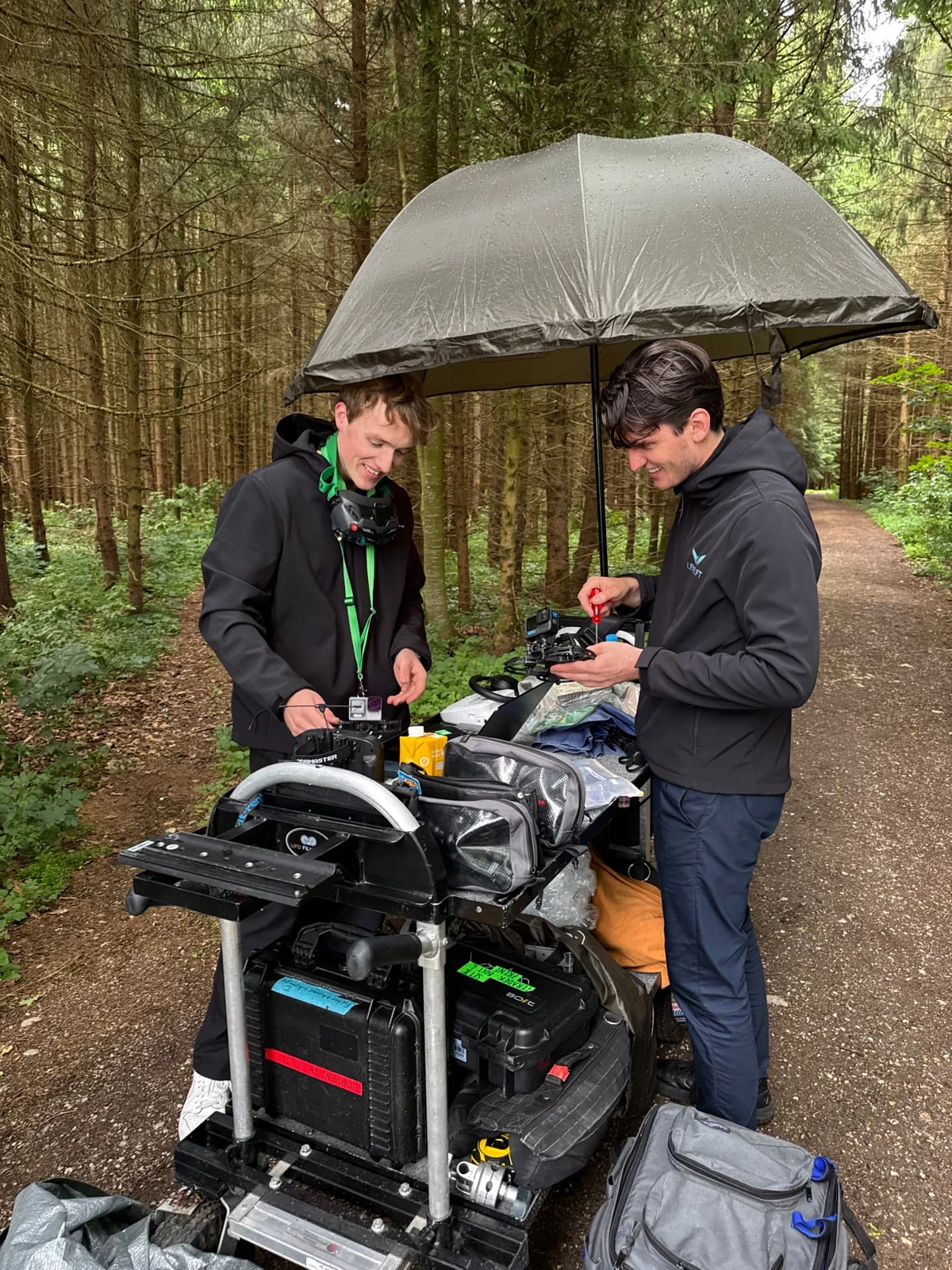
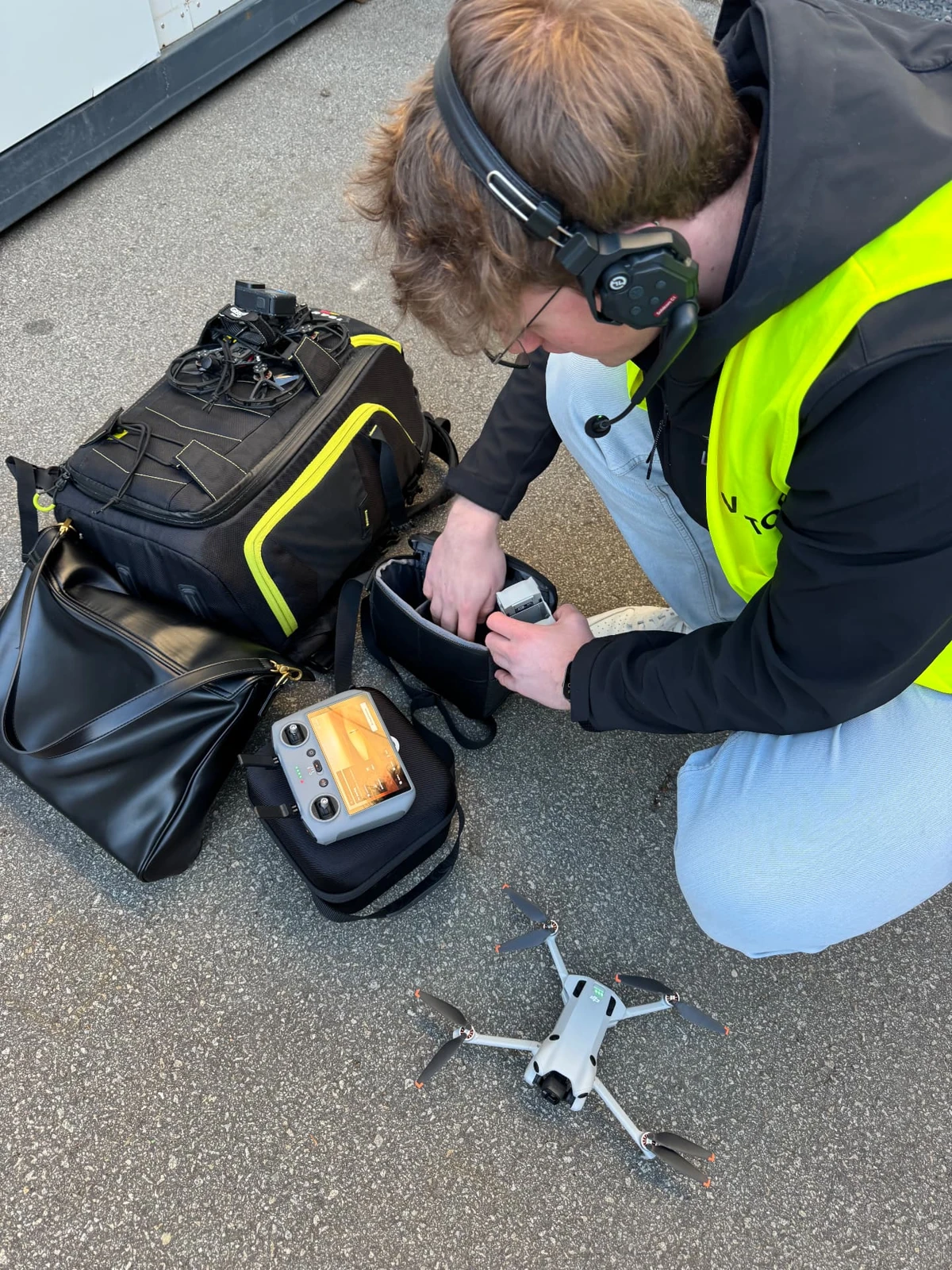
When the production day arrives, the team should already have a clear understanding of the planned sequence.
However, a flight plan is not a guarantee that every shot will work exactly as expected.
The actual environment may differ from the initial assessment. Lighting conditions may change, vehicles may need additional coordination, or a movement may need to be adjusted after the first test flight.
A typical production day can involve:
Technical preparation
The aircraft, batteries, camera, lens, transmission system and recording media are checked.
The camera setup is configured for the intended recording format and exposure requirements.
Location preparation
The flight area is checked again, access is coordinated and the relevant people are briefed.
Test flights
Before attempting the final sequence, the pilot may perform test flights to assess the route, camera position and movement.
Shot execution
The planned sequence is recorded, with adjustments made where necessary.
Footage review
Where the production setup allows it, footage is reviewed during the shoot to verify framing, exposure, focus and technical quality.
The number of takes depends on the complexity of the shot and the available production time.
A simple exterior movement may require relatively little preparation.
A continuous indoor sequence involving several rooms, people and precise transitions can require significantly more time.
This is one reason why professional FPV productions should not be planned solely around the expected duration of the final video.
10. Post-production: turning footage into the final film
The production does not end when the drone lands.
Raw footage needs to be reviewed, selected and integrated into the wider editing process.
Depending on the project, post-production can include:
- Footage selection
- Colour correction and grading
- Stabilisation where appropriate
- Speed adjustments
- Slow-motion editing
- Sound design
- Music
- Transitions
- Visual effects
- Format adaptations
- Final exports
The recording format and camera system influence the available post-production options.
RAW footage from a cinema camera, for example, follows a different workflow from compressed H.265 footage recorded by a compact camera.
The final delivery requirements should therefore influence camera selection before the shoot.
A professional production also considers how the footage will be used.
A brand campaign may require a cinematic master film, shorter social-media edits, vertical versions and additional individual sequences.
Planning these deliverables early can prevent unnecessary compromises later.
11. What determines the cost of a professional FPV production?
There is no universal price for an FPV drone shoot.
The cost depends on the production requirements rather than simply the number of minutes spent flying.
Important factors include:
- Creative concept and preparation
- Number and complexity of planned shots
- Aircraft and camera systems
- Required crew
- Location and travel
- Permissions and operational preparation
- Production duration
- Post-production requirements
- Usage and licensing requirements
A straightforward outdoor sequence with a compact FPV system is fundamentally different from a multi-camera commercial production involving cinema cameras, vehicles, several locations and complex coordination.
It is therefore more useful to define the desired production outcome before discussing the budget.
This allows the production team to recommend an appropriate technical setup and crew rather than building a quote around an arbitrary number of flying hours.
12. What should you prepare before hiring an FPV production company?
A client does not need to understand drone technology to commission a successful FPV production.
However, a few details can make the initial planning significantly more efficient.
Ideally, the production team should receive:
- A description of the project
- The location or locations
- Reference videos or visual inspiration
- The intended use of the footage
- The desired delivery formats
- Any relevant production dates
- Information about people, vehicles or other moving subjects
- Any known location or access restrictions
Reference videos are particularly useful.
They help communicate the intended movement, pacing and visual style without requiring the client to describe technical details.
From there, the production company can translate the creative direction into a practical production concept.
How we approach professional FPV productions at NextFlow Studios
At NextFlow Studios, we approach FPV as part of a complete visual production.
Our process begins by understanding what the final image needs to communicate. We then develop the appropriate camera movement, select the camera and aircraft, assess the environment and plan the production around the specific requirements.
Our work combines aerial cinematography with professional videography and photography.
This allows us to approach projects beyond individual drone sequences – from a focused FPV shot to a broader commercial or architectural production.
Depending on the project, our team can support:
- Creative concept development
- FPV and aerial camera planning
- Indoor and outdoor drone operations
- Cinema-camera configurations
- Videography and photography
- Production coordination
- Post-production and final delivery
We work with different aircraft and camera configurations rather than relying on a single universal setup.
A compact indoor FPV drone, a high-speed outdoor system and a cinema-camera cinelifter each have their place.
The right combination depends on the intended result.
Our philosophy is simple: Start with the image. Build the production around it.
Conclusion: What makes an FPV production professional?
A professional FPV production is not defined by how fast a drone flies, how expensive the camera is or how complicated the flight path looks.
It is defined by how effectively every part of the production contributes to the final result.
That includes the creative concept, camera system, aircraft, pilot, location assessment, flight planning, safety procedures, production coordination and post-production.
When these elements work together, FPV becomes more than an unusual camera angle.
It becomes a powerful cinematographic tool that can connect spaces, follow subjects and create perspectives that conventional camera systems struggle to achieve.
The drone is only the platform.
The image is the reason for the production.
About NextFlow Studios
NextFlow Studios is a Munich-based production studio creating premium visual content for commercial, architectural, automotive and brand productions in Germany and worldwide.
Our work goes beyond traditional drone filming. We combine FPV and aerial cinematography with professional videography and photography, creating visual content around the specific needs of each production.
Our aerial capabilities range from compact indoor FPV systems and dynamic outdoor FPV drones to cinema-camera configurations and stabilized aerial platforms. Depending on the project, we build the aerial setup around the required image, movement and production environment.
Our services include:
- Aerial Cinematography – FPV, cinema drones, stabilized aerial systems and specialised aerial camera setups
- Videography – commercial films, brand content, architectural films and production projects
- Photography – professional architectural, commercial and brand photography
- Production Planning – concept development, shot planning, location coordination and aerial production logistics
- Drone Operations – flight planning, pilots, permissions and production coordination
Based in Munich, Germany, NextFlow Studios works with local clients as well as agencies, production companies and brands bringing projects to Germany from abroad. We also support productions worldwide, depending on the project’s requirements.
This means a project does not need to be treated as a standalone drone shoot. We can contribute to the wider visual production – from aerial cinematography and FPV to videography and photography.
Whether the project requires a dynamic FPV sequence, cinema-camera aerial footage, architectural cinematography, automotive tracking or a complete visual production, our approach remains the same:
Start with the image. Build the production around it.
If you are planning a production in Munich, Germany or elsewhere in the world, contact NextFlow Studios.
Frequently asked questions
What is included in a professional FPV drone production?
A professional FPV production can include creative planning, camera and aircraft selection, location assessment, flight planning, pilots, camera operators, production coordination, safety preparation, filming and post-production. The exact scope depends on the project.
How long does a professional FPV drone shoot take?
It depends on the complexity of the shots, location, camera system and coordination required. A simple exterior sequence may be completed relatively quickly, while a complex indoor one-take or automotive production can require a full production day or longer.
How many people are needed for an FPV production?
A simple shoot may require only a pilot and a small supporting crew. More complex productions can involve a camera operator, director, production coordinator and additional safety personnel. Crew size should reflect the actual requirements.
Can FPV drones be used indoors?
Yes. Compact FPV systems, particularly cinewhoops, are frequently used for indoor cinematography. The aircraft, flight path and operating procedures must be selected according to the environment and applicable requirements.
Which camera is used for professional FPV filming?
There is no single standard camera. Depending on the project, professional FPV productions can use compact cameras such as the GoPro MISSION 1 PRO ILS, or cinema cameras such as the RED KOMODO, Sony FX6 and Blackmagic Micro Studio Camera 4K G2.
How much does professional FPV drone filming cost?
The price depends on preparation, crew, equipment, location, production duration, permissions, post-production and usage requirements. A meaningful estimate requires an understanding of the intended production outcome.
Do I need to plan the flight path before the shoot?
Not necessarily as a client. The production team should develop the technical flight plan. However, providing reference videos, location information and the desired visual result helps the team prepare effectively.
Can FPV footage be combined with conventional videography and photography?
Absolutely. Combining FPV, stabilized aerial footage, ground-based videography and photography can create a more complete visual production. This is particularly useful for commercial, architectural, automotive and brand projects.
Planning an FPV production?
Let's define the shot first — then the camera, lens and aircraft to make it happen.
Get a free quote