RED Komodo vs Sony FX6 vs Blackmagic Micro Studio Camera 4K G2: Which Camera Is Right for FPV?
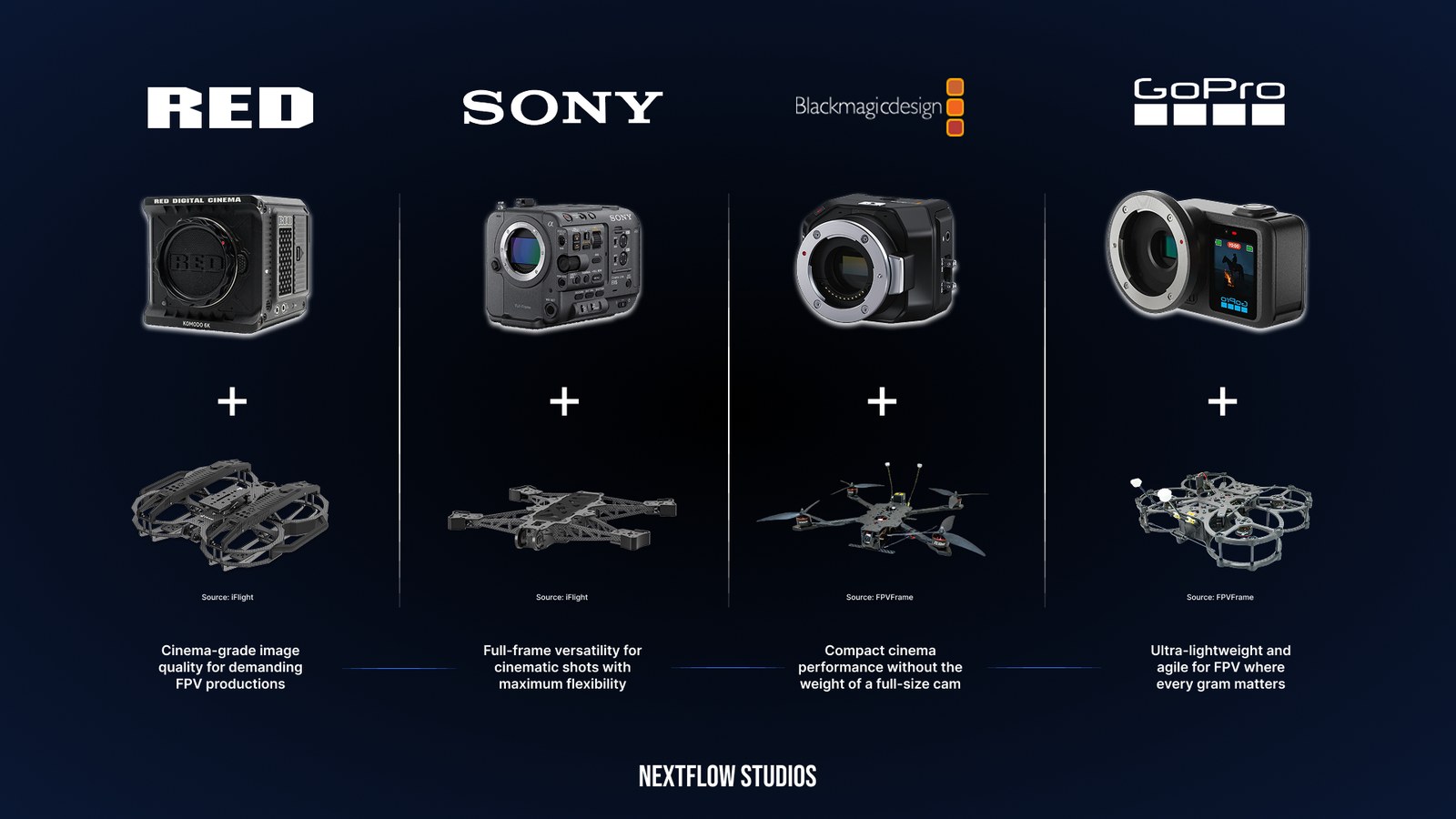
Choosing a cinema camera for an FPV drone is not simply a question of which camera produces the best image.
The RED KOMODO, Sony FX6, Blackmagic Micro Studio Camera 4K G2 and GoPro MISSION 1 PRO ILS all offer very different combinations of image quality, sensor format, recording workflow, lens compatibility and payload.
For FPV production, those differences matter.
The right camera is the one that delivers the required image while still allowing the aircraft to perform the shot.
RED KOMODO vs Sony FX6 vs Blackmagic Micro Studio Camera 4K G2 vs GoPro MISSION 1 PRO ILS
At a glance, the four cameras occupy very different positions:
| Camera | Sensor | Key strength for FPV | Main limitation |
|---|---|---|---|
| RED KOMODO 6K | Super 35 Global Shutter | REDCODE RAW, global shutter, high-end cinema workflow | Larger/heavier production setup |
| Sony FX6 | Full-frame | Low-light performance, 4K 120p, variable ND | Higher payload than compact systems |
| Blackmagic Micro Studio Camera 4K G2 | Four Thirds | Compact BRAW system and relatively small camera body | 4K maximum resolution and 60p |
| GoPro MISSION 1 PRO ILS | 1-inch | Extremely low weight, 8K, MFT lenses | Smaller sensor and more limited lens control |
The specifications alone do not determine the winner.
The production does.
RED KOMODO: The cinema-first option
The RED KOMODO 6K is built around a 19.9 MP Super 35 global-shutter sensor and records REDCODE RAW. RED specifies more than 16 stops of dynamic range and a native RF lens mount. It can record up to 6K at 40 fps, 5K at 48 fps and 4K at 60 fps.
For FPV, the global shutter is particularly interesting.
Why global shutter matters
With a fast-moving camera platform, the entire image can experience significant movement during exposure.
A global shutter captures the frame at the same moment rather than progressively scanning across the sensor.
This can be valuable when filming:
- High-speed vehicles
- Fast lateral movement
- Rotating objects
- Rapid camera manoeuvres
- Close-proximity tracking
The result is a camera that can be particularly well suited to demanding movement.
REDCODE RAW
Another major advantage is the RED workflow.
For productions already working with RED cameras, the KOMODO can make aerial footage easier to integrate into the wider production pipeline.
The important point is that the camera is not being selected because it is a "drone camera".
It is being selected because the production needs what the camera provides.
Where the KOMODO makes sense
The RED KOMODO is particularly compelling for:
- High-end commercials
- Automotive cinematography
- Cinema productions
- High-speed FPV
- Productions requiring REDCODE RAW
- Projects where aerial footage needs to match a RED-based camera package
For these applications, the additional payload can be justified.
For payload, lenses and aircraft requirements in detail, read our guide to flying a RED KOMODO on a cinelifter.
Sony FX6: The full-frame production camera
The Sony FX6 takes a different approach.
It uses a full-frame sensor, offers more than 15 stops of latitude, 4K recording at up to 120 fps and an integrated electronically variable ND filter. The camera body weighs approximately 890 g before adding the lens and other equipment.
That makes it a remarkably capable camera for aerial cinematography.
Why the FX6 stands out
The biggest advantage is versatility.
The FX6 combines:
- Full-frame imaging
- High sensitivity
- 4K 120p
- E-mount lens compatibility
- Variable ND
- Professional cinema controls
- Sony's S-Cinetone and S-Log3 workflows
For a production that needs aerial footage to integrate with other Sony Cinema Line cameras, this can be a major advantage.
The variable ND advantage
For an FPV camera, exposure control can be particularly difficult.
You cannot simply stop the aircraft and change an ND filter when the lighting changes.
The FX6's electronically variable ND provides a significant operational advantage because exposure can be adjusted without changing the physical lens or aperture.
Where the FX6 makes sense
The FX6 is particularly attractive for:
- Automotive productions
- Commercial films
- Architecture
- Larger interiors
- Low-light environments
- Productions already using Sony cameras
- Projects requiring 4K 120p
Its main disadvantage is straightforward:
It requires a larger aircraft than a compact FPV camera.
Learn more in our article Sony FX6 on an FPV Drone: When Does It Make Sense?
Blackmagic Micro Studio Camera 4K G2: The compact cinema workflow
The Blackmagic Micro Studio Camera 4K G2 sits somewhere between a traditional cinema camera and a specialised compact production camera.
It uses a Four Thirds sensor, an active MFT mount and provides 13 stops of dynamic range. It records Blackmagic RAW to external USB-C drives and supports Ultra HD up to 60 fps. Blackmagic also specifies dual native ISO.
For FPV, its physical format is one of its most important characteristics.
Why the Blackmagic is interesting for drones
The camera was designed around the idea of putting a capable imaging system into a very small body.
That is exactly the type of design philosophy that works well for aerial cinematography.
Compared with a larger cinema-camera body, the Blackmagic can reduce the burden placed on the aircraft while still providing a professional RAW workflow.
Blackmagic RAW
For productions using DaVinci Resolve, Blackmagic RAW can be a particularly attractive workflow.
The camera can therefore make sense when the production wants:
- RAW flexibility
- A compact camera
- MFT lenses
- Professional colour grading
- Integration with a Blackmagic/Resolve workflow
The trade-off
The camera does not provide the same resolution or frame-rate range as the Sony FX6 or GoPro MISSION 1 PRO ILS.
Its maximum recording resolution is Ultra HD, with frame rates up to 60 fps.
That is not necessarily a disadvantage.
If the final delivery is 4K and the shot does not require extreme slow motion, the smaller and simpler system may actually be more appropriate.
Read more about the setup in Blackmagic Micro Studio Camera 4K G2 on an FPV Drone.
GoPro MISSION 1 PRO ILS: The new lightweight option
The MISSION 1 PRO ILS changes the comparison considerably.
It weighs just 197 g, uses a 1-inch sensor and has a native Micro Four Thirds lens mount. It can record up to 8K60 and 4K240, including Open Gate modes up to 8K30 and 4K120. It also supports 10-bit GP-Log2 and bit rates up to 240 Mbps.
That is an extraordinary specification for an FPV camera of this size.
Why the weight matters
The difference between 197 g and approximately 890 g before the lens is enormous.
Every gram saved at camera level can affect:
- Aircraft size
- Motor requirements
- Battery requirements
- Flight time
- Acceleration
- Agility
- Indoor suitability
- Safety margins
This is where the MISSION 1 PRO ILS becomes particularly interesting.
It may allow productions to achieve a much more compact camera-and-aircraft combination without immediately moving into a heavy-lift cinelifter configuration.
But it is not simply a miniature FX6
The MISSION 1 PRO ILS uses a 1-inch sensor rather than full-frame or Super 35.
It also has no autofocus and uses manual focus and manual/fixed aperture MFT lenses. GoPro provides Focus Assist and Focus Peaking to support this workflow.
This means it should not be evaluated simply by looking at its 8K specification.
It is a fundamentally different camera.
Explore the camera in detail in GoPro MISSION 1 PRO ILS for FPV Drone Cinematography.
The most important comparison: image vs aircraft
When comparing cinema cameras for FPV, it is tempting to build a specification table and select the camera with the highest number.
That is the wrong approach.
Consider two hypothetical productions.
Production A: Automotive commercial
The shot follows a performance car at high speed.
The production already uses RED cameras.
The shot needs RAW footage, a specific lens and precise high-speed movement.
In this case, the additional payload of a RED KOMODO may be completely justified.
Production B: Indoor architectural film
The camera needs to fly through a relatively narrow interior, make several direction changes and move close to architectural details.
A large cinelifter carrying an FX6 may make the shot unnecessarily difficult.
A much smaller camera could be the better production choice.
The camera cannot be separated from the aircraft.
Sensor size: does bigger always mean better?
Not necessarily.
The four cameras use different sensor formats:
- Sony FX6: Full-frame
- RED KOMODO: Super 35
- Blackmagic Micro Studio 4K G2: Four Thirds
- GoPro MISSION 1 PRO ILS: 1-inch
Sensor size affects field of view, depth of field, low-light performance and lens selection.
But it does not determine whether a shot will look good.
A smaller sensor can be the better choice when the camera needs to be significantly smaller.
For FPV, this trade-off is particularly important.
A camera that is theoretically superior but forces the aircraft to become too large for the intended environment may produce a worse result simply because the shot becomes impossible or overly constrained.
Lens choice changes everything
The camera body is only half of the equation.
The lens influences:
- Field of view
- Perspective
- Depth of field
- Weight
- Balance
- Aerodynamic profile
- Required distance from the subject
This is particularly important when comparing cameras with different mounts.
Sony FX6
The E-mount provides access to a large range of lenses.
RED KOMODO
The RF mount provides access to Canon RF lenses and compatible adapted lens systems.
Blackmagic Micro Studio Camera 4K G2
The active MFT mount provides a broad range of compact Micro Four Thirds lenses.
GoPro MISSION 1 PRO ILS
The native MFT mount is particularly interesting given the camera's 197 g body.
However, GoPro specifies that the camera does not have electronic lens contacts, meaning compatible lenses need manual focus and manual or fixed aperture control.
That makes lens selection part of the operating concept rather than simply a matter of choosing a familiar autofocus lens.
What about slow motion?
Frame rate can also influence the decision.
The four cameras occupy very different positions.
| Camera | Key high-frame-rate capability |
|---|---|
| RED KOMODO | Up to 60 fps in 4K |
| Sony FX6 | Up to 120 fps in 4K |
| Blackmagic Micro Studio 4K G2 | Up to 60 fps in Ultra HD |
| MISSION 1 PRO ILS | Up to 240 fps in 4K |
The MISSION 1 PRO ILS therefore has an enormous numerical advantage in frame rate.
But again, frame rate is not everything.
Resolution, sensor performance, motion rendering, compression, lens characteristics and the final delivery format all matter.
A 120 fps shot from a larger cinema camera may be preferable to a 240 fps shot simply because the production needs the particular image characteristics of the larger camera.
Which camera is best for automotive FPV?
There is no universal answer.
RED KOMODO
Strong choice when:
- Global shutter matters
- REDCODE RAW is required
- The production already uses RED
- High-end commercial image integration is important
Sony FX6
Strong choice when:
- Full-frame imaging is desired
- Low-light performance matters
- 4K 120p is required
- Variable ND is valuable
- The production uses Sony cameras
Blackmagic Micro Studio Camera 4K G2
Strong choice when:
- A compact cinema system is needed
- BRAW is important
- The production uses DaVinci Resolve
- 4K60 is sufficient
- Aircraft weight should remain relatively low
GoPro MISSION 1 PRO ILS
Strong choice when:
- Aircraft size matters
- High frame rates are important
- 8K or Open Gate capture is useful
- MFT lens flexibility is desired
- The shot benefits from a lightweight camera
Which camera is best for indoor FPV?
This is where the comparison becomes particularly interesting.
For indoor FPV, camera weight and overall aircraft dimensions become increasingly important.
A large cinema-camera setup may provide a beautiful image, but it also requires a larger aircraft.
That aircraft needs more space.
More space means fewer possible flight paths.
A compact system can therefore create shots that a larger system simply cannot perform.
For this reason, the Blackmagic Micro Studio Camera 4K G2 and MISSION 1 PRO ILS can be particularly interesting for indoor productions.
The FX6 and KOMODO remain viable when the environment is sufficiently large and the required image justifies the larger setup.
Not every shot needs FPV at all — see FPV vs. Stabilized Drone: Which Is Right for Your Production?
Which camera gives the best image quality?
This is probably the most difficult question to answer because "image quality" is not one specification.
If by image quality you mean maximum production flexibility, different cameras have different strengths.
- RED KOMODO offers a high-end RAW workflow and global shutter.
- Sony FX6 offers full-frame imaging, high sensitivity, 15+ stops of latitude and professional exposure control.
- Blackmagic Micro Studio Camera 4K G2 offers a compact BRAW workflow and 13 stops of dynamic range.
- MISSION 1 PRO ILS combines a 1-inch sensor with 8K, 10-bit GP-Log2 and an extremely small 197 g body.
So the better question is:
Which image characteristics matter for this production?
The production workflow matters as much as the camera
Camera choice should also consider what happens after the flight.
A commercial production may involve:
- Multiple camera systems
- Colour grading
- RAW workflows
- VFX
- Slow motion
- Reframing
- Vertical and horizontal deliverables
- Client revisions
- Broadcast or cinema delivery
A camera should therefore fit the production's post-production workflow.
A technically impressive camera that creates unnecessary workflow complications may not be the best production choice.
There is no "best FPV cinema camera"
This comparison ultimately leads to a simple conclusion.
The RED KOMODO, Sony FX6, Blackmagic Micro Studio Camera 4K G2 and GoPro MISSION 1 PRO ILS are not four versions of the same camera.
They represent four different approaches.
- RED KOMODO prioritises a high-end cinema workflow and global shutter.
- Sony FX6 prioritises full-frame cinema performance and operational flexibility.
- Blackmagic Micro Studio Camera 4K G2 prioritises a compact body and BRAW workflow.
- MISSION 1 PRO ILS prioritises an extremely small camera package while bringing interchangeable lenses, 8K and professional recording features into a 197 g body.
The best choice depends on the production.
How we choose cameras for FPV productions at NextFlow Studios
At NextFlow Studios, we do not start with:
"Which camera should we fly?"
We start with:
"What should the final shot look like?"
From there, we consider:
- Movement – How does the camera need to move?
- Environment – Where does the aircraft need to operate?
- Subject – What are we filming?
- Lens – What perspective does the shot require?
- Camera – Which system delivers the required image?
- Aircraft – What platform can carry it without compromising the shot?
- Production – What safety, permissions and crew requirements follow from the setup?
This can result in a completely different camera choice for two visually similar projects.
Sometimes the right answer is a RED KOMODO.
Sometimes it is an FX6.
Sometimes the smaller Blackmagic or MISSION system makes much more sense.
And sometimes the best production combines multiple camera platforms.
Conclusion: Which cinema camera should you use on an FPV drone?
There is no universal winner between the RED KOMODO, Sony FX6, Blackmagic Micro Studio Camera 4K G2 and GoPro MISSION 1 PRO ILS.
Each solves a different problem.
If the production prioritises RAW cinema workflow and global shutter, the RED KOMODO is a compelling option.
If it requires full-frame imaging, high sensitivity, 4K 120p and variable ND, the Sony FX6 is particularly capable.
If the priority is a compact camera with Blackmagic RAW, the Micro Studio Camera 4K G2 offers an interesting balance.
And if weight, agility and compact aircraft size are critical while still requiring interchangeable lenses and high-resolution capture, the MISSION 1 PRO ILS changes what is possible.
The most important specification is therefore not written on the camera box.
It is the shot.
Start with the image. Build the production around it.
About NextFlow Studios
NextFlow Studios is a Munich-based production studio creating premium visual content for commercial, architectural, automotive and brand productions in Germany and worldwide.
Our work goes beyond traditional drone filming. We combine FPV and aerial cinematography with professional videography and photography, creating visual content around the specific needs of each production.
Our aerial capabilities range from compact indoor FPV systems and dynamic outdoor FPV drones to cinema-camera configurations and stabilized aerial platforms. Depending on the project, we work with different professional camera systems and build the aerial setup around the required image, movement and production environment.
Our services include:
- Aerial Cinematography – FPV, cinema drones, stabilized aerial systems and specialised aerial camera setups
- Videography – commercial films, brand content, architectural films and production projects
- Photography – professional architectural, commercial and brand photography
- Production Planning – concept development, shot planning, location coordination and aerial production logistics
- Drone Operations – flight planning, pilots, permissions and production coordination
Based in Munich, Germany, NextFlow Studios works with local clients as well as agencies, production companies and brands bringing projects to Germany from abroad. We also support productions worldwide, depending on the project's requirements.
This means a project does not need to be treated as a standalone drone shoot. We can contribute to the wider visual production – from aerial cinematography and FPV to videography and photography.
Whether the project requires a dynamic FPV sequence, cinema-camera aerial footage, architectural cinematography, automotive tracking or a complete visual production, our approach remains the same:
Start with the image. Build the production around it.
If you are planning a production in Munich, Germany or elsewhere in the world, contact NextFlow Studios.
Frequently asked questions
What is the best cinema camera for an FPV drone?
There is no universal best camera. RED KOMODO, Sony FX6, Blackmagic Micro Studio Camera 4K G2 and GoPro MISSION 1 PRO ILS each have different strengths. The correct choice depends on the required image, lens, aircraft size, movement and production workflow.
Is the Sony FX6 better than the RED KOMODO for FPV?
Not universally. The FX6 offers full-frame imaging, 4K 120p and variable ND, while the KOMODO offers a Super 35 global-shutter sensor and REDCODE RAW. The better choice depends on the production requirements.
Is the Blackmagic Micro Studio Camera 4K G2 good for FPV drones?
Yes. Its compact form factor, MFT mount, 13 stops of dynamic range and Blackmagic RAW workflow make it an interesting option for cinema FPV, particularly when aircraft weight is important.
Is the GoPro MISSION 1 PRO ILS a cinema camera?
GoPro positions the MISSION 1 PRO ILS as an ultra-compact interchangeable-lens cinema camera. It combines a 1-inch sensor, MFT mount, 8K capture, 10-bit GP-Log2 and a 197 g body.
Which camera is best for indoor FPV?
The best choice depends on the size of the location and the required image. Smaller systems such as the Blackmagic Micro Studio Camera 4K G2 and MISSION 1 PRO ILS can provide significant advantages when aircraft size and manoeuvrability are critical.
Does a heavier cinema camera produce better FPV footage?
Not necessarily. A heavier camera may provide advantages in sensor size, image quality or production workflow, but it also requires a larger aircraft. If that aircraft prevents the required movement, the theoretically superior camera may produce the worse result.
Can one FPV drone carry all of these cameras?
Not necessarily. Different cameras and lenses create different payload requirements. A production aircraft should be selected around the complete camera and lens configuration rather than assuming that one drone is suitable for every cinema-camera setup.
Planning an FPV production?
Let's define the shot first — then the camera, lens and aircraft to make it happen.
Get a free quote