Sony FX6 on an FPV Drone: When Does It Make Sense?
Putting a Sony FX6 on an FPV drone is not simply a matter of attaching a larger camera to a bigger aircraft.
The Sony FX6 combines a full-frame sensor, professional cinema features, interchangeable E-mount lenses, high frame rates and a compact body. Sony itself positions the camera for applications ranging from handheld production to drone filming.
But does that automatically make it the right camera for FPV?
Not necessarily.
The real question is whether the image quality, lens flexibility and production capabilities of the FX6 justify the additional weight, aircraft requirements and operational complexity.
For certain commercial productions, the answer is absolutely yes.
What makes the Sony FX6 interesting for FPV?
The FX6 sits in an interesting position between compact mirrorless cameras and larger cinema-camera systems.
It features a full-frame Exmor R CMOS sensor, BIONZ XR processing, 4K recording up to 120 fps and an electronically variable ND filter. Sony also specifies more than 15 stops of dynamic range and high sensitivity, making the camera particularly attractive when lighting conditions are difficult.
For aerial cinematography, several of these characteristics are especially relevant.
Full-frame image quality
A full-frame sensor provides significant flexibility when choosing lenses and controlling depth of field.
That can matter when an aerial shot needs to feel visually consistent with footage captured on the ground using other cinema cameras.
Instead of treating the aerial sequence as a separate visual language, the FX6 can help integrate it into the wider production.
High frame rates
The FX6 supports 4K recording at up to 120 fps, opening up slow-motion applications for automotive, sports, architecture and commercial productions.
For FPV, this can be particularly useful when a shot combines speed and controlled movement.
A vehicle passing through an environment at high speed, for example, can be captured with enough temporal resolution to create a controlled slow-motion sequence in post-production.
Electronic variable ND filter
One of the less obvious advantages of the FX6 is its integrated electronic variable ND filter.
For conventional cinematography, this provides exposure control without constantly changing physical filters or compromising the chosen shutter angle and aperture.
On an FPV platform, this can become even more valuable.
Changing filters in the air is obviously not an option. A camera system that can electronically adapt exposure gives the cinematographer considerably more flexibility when moving between different lighting conditions.
The biggest challenge: weight
The FX6 itself weighs approximately 890 grams without the additional production accessories and lens.
And this is where the discussion becomes more complicated.
The camera is only one part of the payload.
An actual aerial setup may also include:
- Lens
- Camera mounting system
- FPV transmission system
- Power solution
- Recording media
- Protective elements
- Additional mounting hardware
The total payload can therefore become significantly heavier than the camera specification alone suggests.
This changes the aircraft.
A drone capable of carrying a professional cinema camera is not simply a larger version of a standard FPV drone. The propulsion system, frame, batteries, flight controller configuration and overall flight characteristics all need to be designed around the payload.
The camera determines the aircraft just as much as the aircraft determines the camera.
What type of FPV drone is required?
For an FX6, the relevant category is generally a cinelifter or heavy-lift FPV platform rather than a lightweight freestyle or conventional cinewhoop.
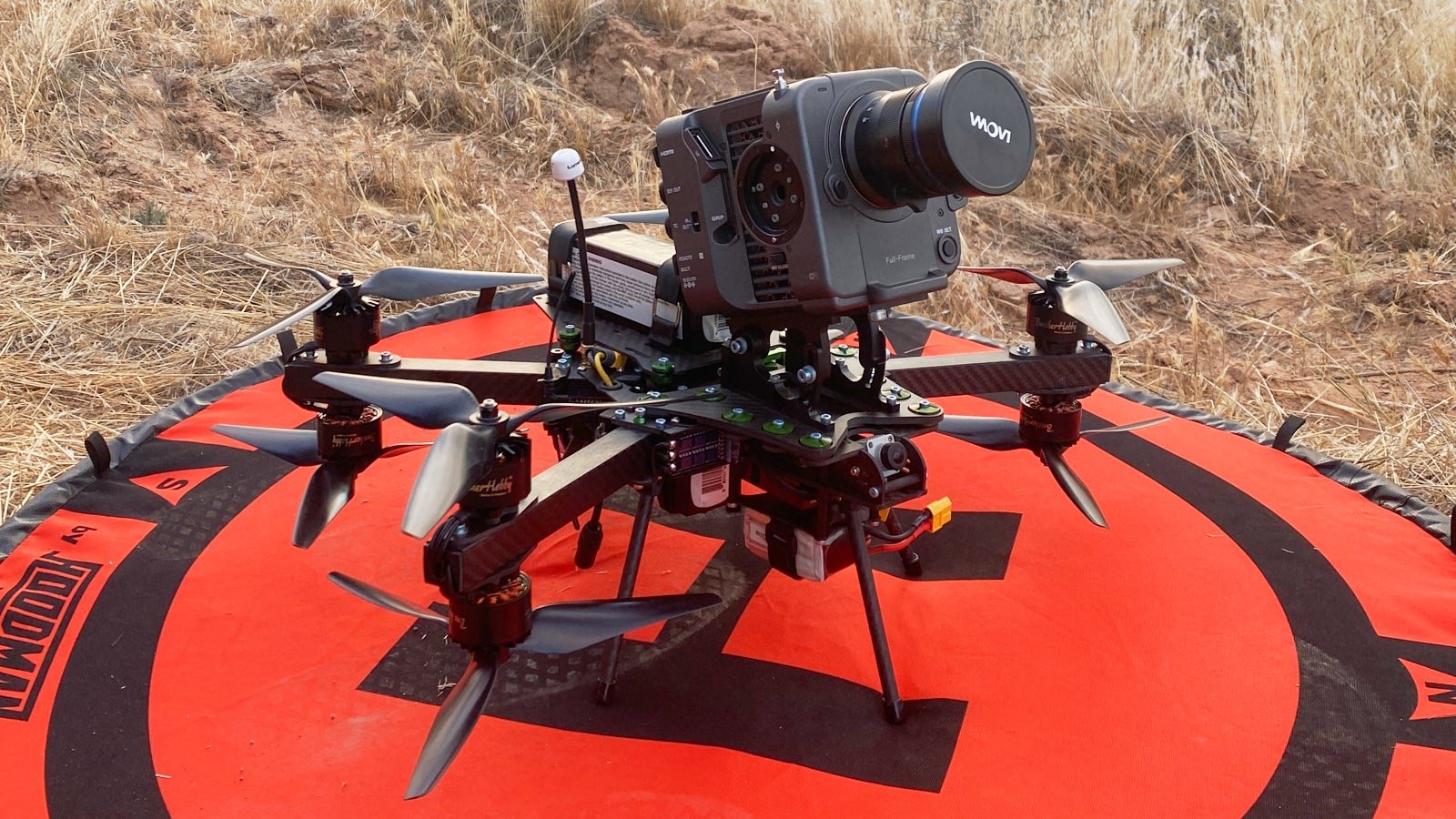
The exact configuration depends on the required flight characteristics.
A production might prioritise:
- Maximum payload
- Acceleration
- Flight time
- Stability
- High-speed tracking
- Indoor manoeuvrability
- Wind resistance
- Camera orientation
- Redundancy and operational safety
There is no single “FX6 drone”.
The correct platform depends on the shot.
A slow architectural flight through a large building requires a very different aircraft from a high-speed automotive tracking sequence.
Sony FX6 with different lenses
The FX6 uses Sony's E-mount, giving productions access to a broad range of compatible lenses. Sony specifically highlights its compatibility with the E-mount ecosystem as part of the camera's flexibility.
But putting a lens on a drone is fundamentally different from putting the same lens on a tripod.
Every additional gram matters.
A lightweight wide-angle lens might be ideal for an aggressive FPV flight through a confined environment.
A larger cinema zoom may provide greater framing flexibility, but could substantially increase the payload and change the flight characteristics.
Lens selection therefore becomes part of aircraft selection.
Wide-angle lenses
Wide lenses are often a natural choice for FPV because they emphasise movement and allow the drone to fly relatively close to subjects.
They can be particularly effective for:
- Architecture
- Interior spaces
- Automotive tracking
- Industrial environments
- Dynamic brand films
Longer focal lengths
Longer lenses create a very different visual language.
They can compress distance and make a vehicle or subject appear closer to the environment behind it.
However, the increased focal length also makes movement more visually sensitive.
Small changes in drone position can produce significant changes in framing.
This makes lens selection a creative and operational decision at the same time.
When does the FX6 make sense on an FPV drone?
The FX6 becomes particularly interesting when the aerial footage needs to integrate into a larger professional production.
For example:
1. Automotive productions
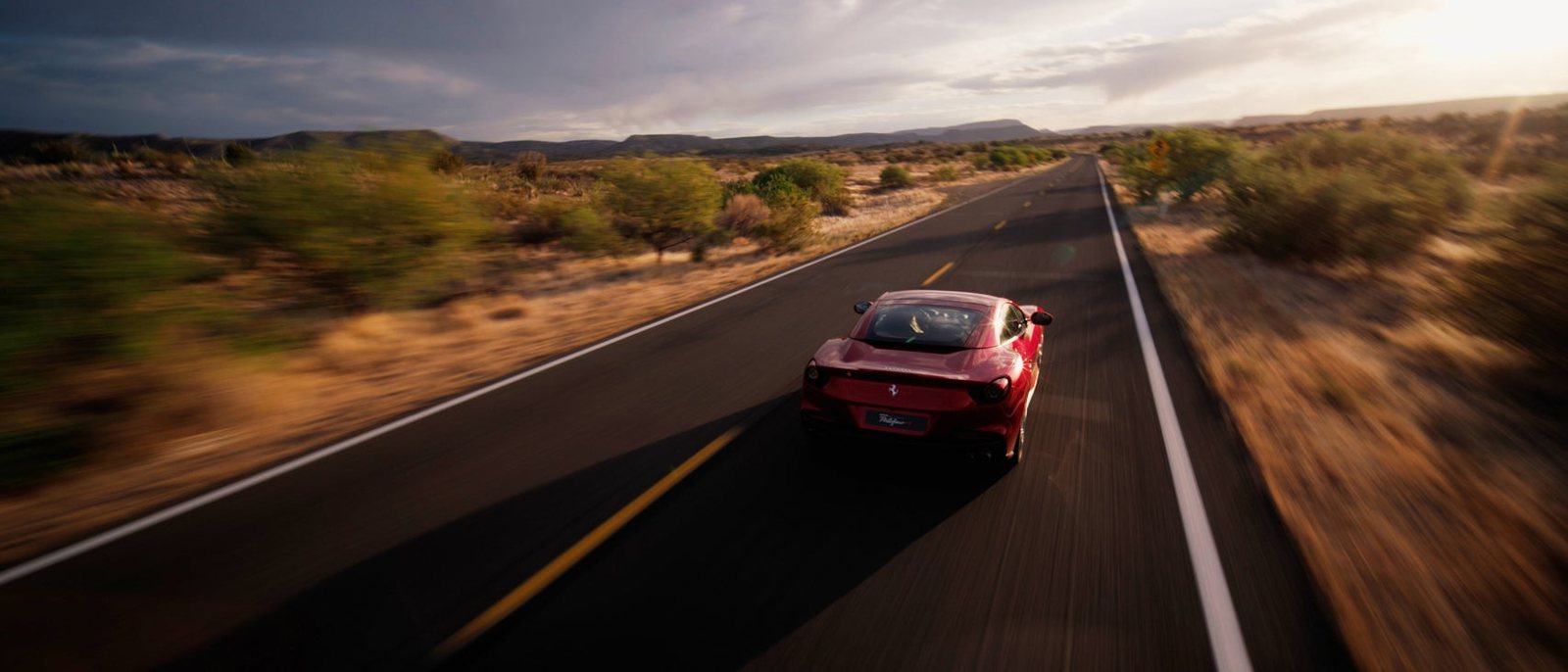
Automotive is one of the strongest use cases.
A commercial might combine:
- Ground-based cinema cameras
- Tracking vehicles
- Stabilized aerial cameras
- FPV drones
- High-speed tracking shots
Using an FX6 on an FPV platform can help maintain a consistent full-frame cinematic look while introducing the movement capabilities of FPV.
For high-speed sequences, the combination of a relatively compact cinema camera and a purpose-built heavy-lift FPV aircraft can create shots that would be difficult to achieve with conventional aerial systems.
2. High-end commercials
Brand campaigns often require footage that fits into an established cinematic workflow.
If the production already uses Sony Cinema Line cameras, the FX6 can be a logical aerial option.
The goal is not simply to capture “drone footage”.
The goal is to capture footage that can sit naturally alongside the rest of the campaign.
3. Architecture and real estate
The FX6 can also make sense when an architectural production requires more than a conventional aerial overview.
A carefully planned FPV sequence can move:
exterior → entrance → interior → architectural detail → transition → exterior
while maintaining a consistent visual language.
For premium architecture, hospitality or real-estate productions, this can turn the drone from a simple establishing-camera into an actual storytelling tool.
4. Large interiors
Indoor FPV is particularly interesting because the aircraft can navigate through spaces that would be difficult to cover with larger conventional aerial platforms.
The FX6's compact body helps here, although the complete drone remains considerably larger than a lightweight cinewhoop.
The environment therefore has to be considered carefully.
Ceiling height, corridors, obstacles, people, reflective surfaces and available flight paths all influence whether an FX6 setup is appropriate.
When does the FX6 not make sense?
A professional camera is not automatically better for every FPV shot.
If the final content is primarily intended for social media, a compact camera may provide more than enough image quality while dramatically simplifying the aircraft.
Similarly, if the shot requires extremely tight indoor manoeuvres, a heavy-lift FX6 platform may simply be the wrong tool.
There is also little value in carrying a large cinema camera when the final shot does not benefit from its additional capabilities.
In those cases, a smaller system can be the better production decision.
The best camera is the one that provides the required image without compromising the shot.
Sony FX6 vs RED KOMODO vs Blackmagic Micro Studio Camera 4K G2
The FX6 is not the only cinema-camera option for FPV.
Different cameras solve different production problems.
| Camera | Main advantage for FPV | Typical consideration |
|---|---|---|
| Sony FX6 | Full-frame sensor, high sensitivity, 4K 120p, variable ND, compact cinema body | Payload and aircraft complexity |
| RED KOMODO | Compact cinema-camera platform and high-end production workflow | Lens and overall payload requirements |
| Blackmagic Micro Studio Camera 4K G2 | Compact MFT system, BRAW workflow and relatively flexible lens options | Different sensor/image characteristics and production workflow |
| GoPro MISSION 1 PRO ILS | Much smaller camera package with MFT lens compatibility | Different positioning and workflow compared with full cinema cameras |
There is no universal winner.
A production requiring maximum low-light capability and full-frame aesthetics may favour the FX6.
A production built around a specific RED workflow may favour the KOMODO.
A compact BRAW workflow may make the Blackmagic system more attractive.
And a production prioritising aircraft size and agility may favour a significantly smaller camera.
What about image stabilisation?
One important consideration is that the FX6 itself is not a replacement for a gimbal.
An FPV drone introduces its own movement characteristics.
Depending on the aircraft and camera mounting system, the production may intentionally use the drone's movement as part of the shot, or use additional mechanical/electronic stabilisation to achieve a smoother result.
This distinction is important.
There is a difference between:
fast movement
and
uncontrolled movement.
Professional FPV cinematography is not about making the camera move as much as possible.
It is about controlling the movement precisely enough that the viewer focuses on the subject rather than the aircraft.
Why the pilot matters even more with a cinema camera
A larger and more expensive camera setup increases the consequences of poor flight control.
The pilot is no longer simply flying a drone.
They are operating a moving camera system with:
- A specific lens
- A specific field of view
- A specific camera orientation
- A specific exposure
- A specific subject
- A specific flight path
- A specific timing requirement
The pilot therefore becomes part of the cinematography process.
For a complex commercial shot, the team may need to coordinate the pilot, camera operator, director, vehicle driver, ground crew and safety team.
The drone is only one part of the production.
Planning an FX6 FPV production
A professional shoot should begin with the shot rather than the equipment.
A typical planning process might look like this:
1. Define the final image
What should the viewer see?
What should the camera feel like?
How fast should the movement be?
2. Select the lens
The lens determines the field of view, perspective and required distance from the subject.
3. Determine the aircraft
Only after the camera and lens are defined should the aircraft be selected.
4. Plan the flight path
The team determines:
- Entry and exit points
- Maximum speed
- Obstacles
- Emergency routes
- Subject movement
- Camera orientation
- Required take length
5. Plan the production environment
For commercial work, this also includes location permissions, flight planning, safety procedures and coordination with other production departments.
6. Build and test the complete system
The actual flight system should be tested as a complete unit.
The camera, lens, aircraft, power system and transmission equipment all contribute to the final flight characteristics.
Does a Sony FX6 make an FPV shot more cinematic?
Not by itself.
This is perhaps the most important point.
A Sony FX6 can provide an extremely capable cinema image. But a cinematic image still depends on:
composition + lighting + lens + movement + timing + subject + post-production.
Putting a cinema camera on a drone does not automatically create cinematic footage.
The aircraft has to move with intention.
The lens has to support the composition.
The exposure has to remain controlled.
And the entire shot has to serve the story.
That is why professional FPV production starts with the image rather than the equipment.
Our approach to cinema cameras on FPV drones
At NextFlow Studios, we do not approach a project by deciding on a camera first and then looking for a way to fly it.
We work in the opposite direction.
What does the final shot need to look like?
From there, we determine:
- The required movement
- The environment
- The lens
- The camera
- The aircraft
- The production and safety requirements
A Sony FX6 can be an excellent choice for an FPV production when its capabilities solve a real requirement.
But if a smaller camera can achieve the same result more efficiently, we would rather use the smaller system.
The objective is not to fly the biggest camera possible.
The objective is to capture the right image.
Conclusion: Is the Sony FX6 a good camera for FPV drones?
Yes – but only for the right production.
The Sony FX6 combines a compact cinema-camera body with a full-frame sensor, high sensitivity, 4K 120p recording, professional colour workflows, fast autofocus and an integrated electronic variable ND filter. These characteristics make it a highly capable option for aerial cinematography.
Its main limitation is not image quality.
It is the complete payload and the aircraft required to carry it.
For high-end automotive films, commercial productions, architectural cinematography and other projects where aerial footage needs to integrate into a professional cinema workflow, the FX6 can make a lot of sense.
For smaller, tighter or highly agile FPV productions, a lighter camera may be the better choice.
The right question is therefore not:
“Can you put a Sony FX6 on an FPV drone?”
You can.
The better question is:
“Does the shot justify putting a Sony FX6 in the air?”
That is where professional aerial cinematography begins.
About NextFlow Studios
NextFlow Studios is a Munich-based production studio creating premium visual content for commercial, architectural, automotive and brand productions in Germany and worldwide.
Our work goes beyond traditional drone filming. We combine FPV and aerial cinematography with professional videography and photography, creating visual content around the specific needs of each production.
Our aerial capabilities range from compact indoor FPV systems and dynamic outdoor FPV drones to cinema-camera configurations and stabilized aerial platforms. Depending on the project, we work with different professional camera systems and build the aerial setup around the required image, movement and production environment.
Our services include:
- Aerial Cinematography – FPV, cinema drones, stabilized aerial systems and specialised aerial camera setups
- Videography – commercial films, brand content, architectural films and production projects
- Photography – professional architectural, commercial and brand photography
- Production Planning – concept development, shot planning, location coordination and aerial production logistics
- Drone Operations – flight planning, pilots, permissions and production coordination
Based in Munich, Germany, NextFlow Studios works with local clients as well as agencies, production companies and brands bringing projects to Germany from abroad. We also support productions worldwide, depending on the project's requirements.
This means a project does not need to be treated as a standalone drone shoot. We can contribute to the wider visual production – from aerial cinematography and FPV to videography and photography.
Whether the project requires a dynamic FPV sequence, cinema-camera aerial footage, architectural cinematography, automotive tracking or a complete visual production, our approach remains the same:
Start with the image. Build the production around it.
If you are planning a production in Munich, Germany or elsewhere in the world, contact NextFlow Studios.
Frequently asked questions
Can you put a Sony FX6 on an FPV drone?
Yes. Sony itself describes the FX6 as suitable for drone applications. However, because the FX6 weighs approximately 890 g before adding a lens and other equipment, it generally requires a purpose-built heavy-lift FPV or cinelifter platform rather than a lightweight FPV drone.
Is the Sony FX6 too heavy for an FPV drone?
Not necessarily. The FX6 is relatively compact for a professional full-frame cinema camera, but the complete payload can become substantially heavier once a lens, mounting system, transmission and other equipment are added. The aircraft must therefore be designed around the complete system.
What lens should you use on a Sony FX6 FPV drone?
There is no universal answer. Wide-angle lenses are often useful for dynamic FPV movement, while longer focal lengths can create a more compressed and controlled perspective. Lens choice should be based on the shot first and the aircraft second.
Is the Sony FX6 better than a RED KOMODO for FPV?
Neither camera is universally better. The FX6 offers a full-frame sensor, high sensitivity, 4K 120p and an integrated electronic variable ND filter, while the RED KOMODO may be preferable for productions built around a RED workflow. The correct choice depends on the required image and production setup.
Is a Sony FX6 good for automotive FPV?
Yes. The FX6 can be particularly useful for automotive productions where full-frame image quality, high frame rates and integration with professional cinema workflows are important. The aircraft and flight plan still need to be designed around the vehicle, speed, environment and required shot.
Is the Sony FX6 suitable for indoor FPV?
It can be, particularly in sufficiently large environments. However, the complete heavy-lift aircraft is significantly larger than a compact indoor FPV system. For tight interiors, a smaller camera and aircraft may provide a much better production solution.
Does using a Sony FX6 automatically make FPV footage cinematic?
No. The camera is only one part of the image. Cinematic FPV footage depends on composition, lens selection, lighting, movement, timing, subject interaction and post-production. The camera should support the shot rather than define it.
Planning an FPV production?
Let's define the shot first — then the camera, lens and aircraft to make it happen.
Get a free quote