Cinelifter vs Cinewhoop: Which FPV Drone Should You Use?
Cinewhoops and cinelifters are two very different types of FPV drones, each designed for specific filming requirements. While cinewhoops are typically compact platforms for controlled movements in confined environments, cinelifters are built to carry heavier camera systems, including professional cinema cameras.
Choosing between them depends primarily on the intended shot, camera package, filming environment and required flight characteristics. Neither platform is universally better. The right choice is the one that delivers the image your production needs.
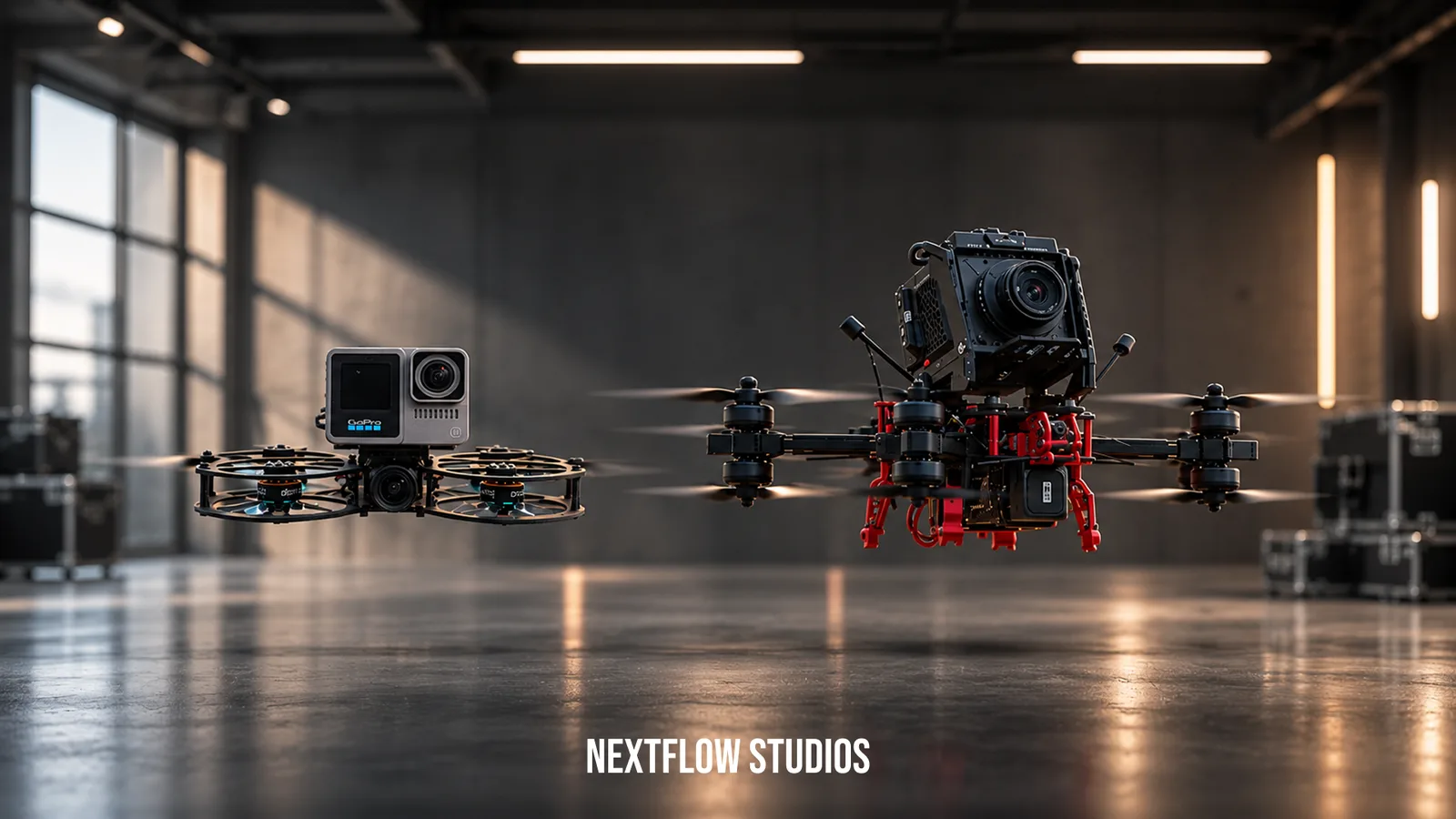
What Is a Cinewhoop?
A cinewhoop is a compact FPV drone designed primarily for filming. Many models feature protective propeller ducts, which surround the propellers and can help reduce the risk of direct propeller contact.
Their compact dimensions and manoeuvrability make them particularly useful for flying through confined spaces and capturing controlled movements close to architectural features or other subjects.
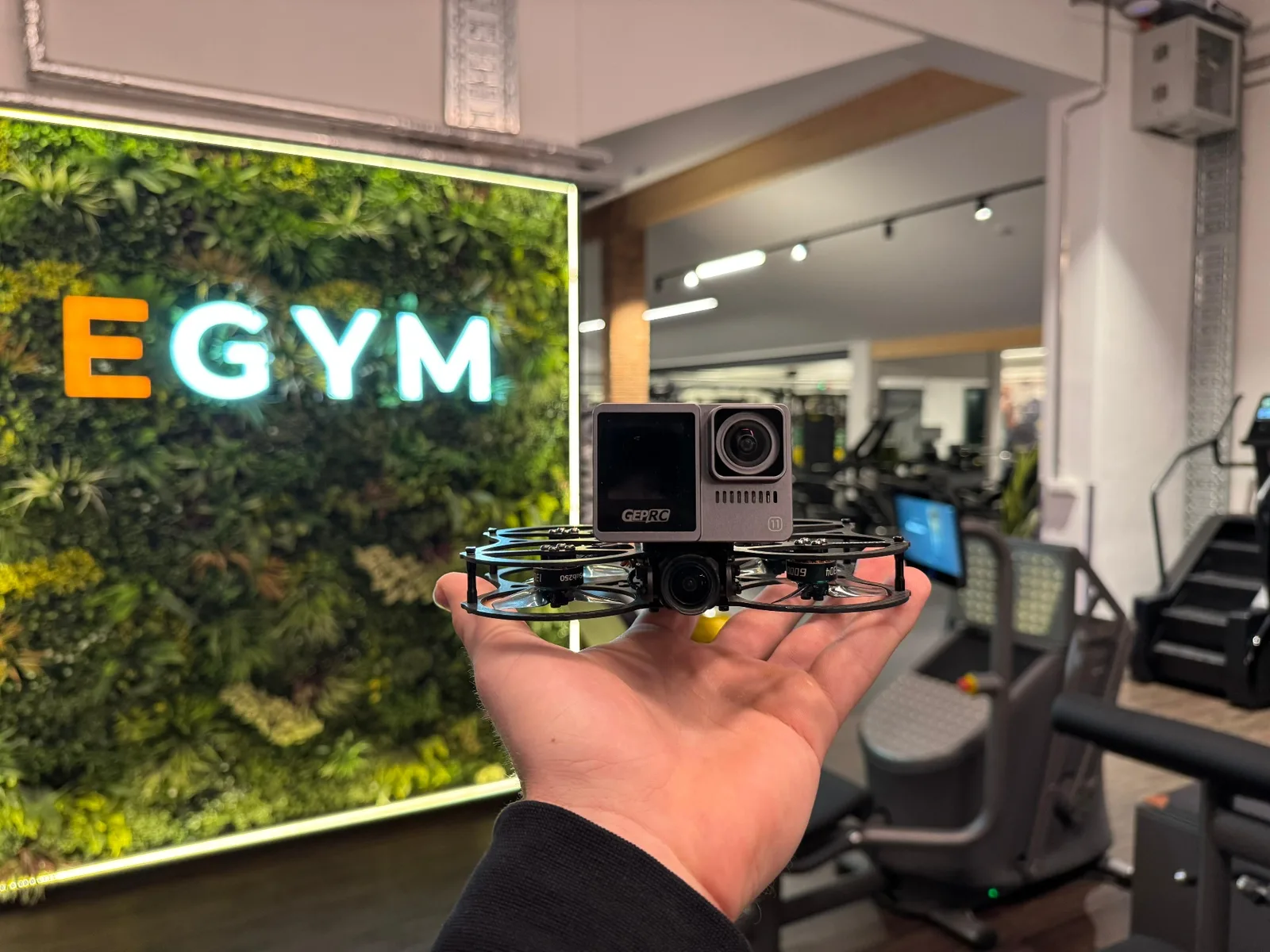
Typical cinewhoop applications include:
- Indoor architectural filming
- Real estate and property walkthroughs
- Hotels, restaurants and hospitality spaces
- Office and commercial interiors
- Close-proximity movements through doorways and corridors
- Controlled one-take sequences
Cinewhoops are generally configured around relatively lightweight camera systems. Depending on the aircraft, this may include action cameras or compact cinema-oriented cameras.
The main advantage is their ability to access spaces that would be difficult to film with larger platforms.
However, their payload capacity is limited compared with dedicated heavy-lift systems. Adding a heavier camera can significantly change the aircraft's handling, endurance and overall performance.
What Is a Cinelifter?
A cinelifter is a specialised FPV drone designed to carry heavier professional camera systems.
Unlike a typical compact cinewhoop, a cinelifter is built around the requirements of a larger camera payload. Its frame, motors, power system and mounting configuration are selected to support the intended camera package.
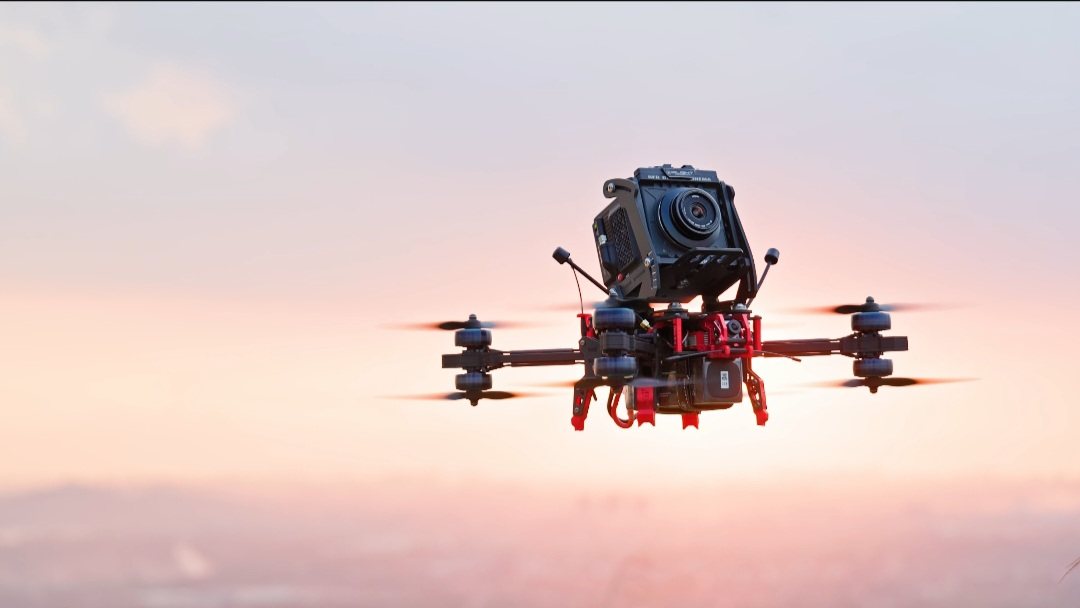
Depending on the aircraft, a cinelifter may carry systems such as:
- RED KOMODO
- Sony FX6
- Blackmagic cinema cameras
- Other compact professional cinema-camera configurations
The actual compatibility depends on the individual build and complete payload weight.
Cinelifters are particularly relevant for productions where camera quality, lens selection and integration into an established cinema workflow are important.
Typical applications include:
- Automotive commercials
- High-end brand campaigns
- Professional architectural films
- Large interior environments
- Cinema-style tracking sequences
- Productions requiring specific camera and lens combinations
The defining characteristic of a cinelifter is not simply its size. It is the aircraft's ability to carry and operate with a substantially heavier camera system while maintaining the flight characteristics required for the shot.
Cinewhoop vs Cinelifter: The Main Differences
Although both platforms use FPV flight characteristics to create immersive camera movements, their priorities are different.
| Category | Cinewhoop | Cinelifter |
|---|---|---|
| Primary purpose | Compact filming | Heavy cinema-camera filming |
| Typical environment | Indoor and confined spaces | Larger indoor and outdoor environments |
| Camera setup | Lightweight cameras | Professional cinema cameras |
| Payload capacity | Generally limited | Designed for heavier payloads |
| Manoeuvrability | Compact and agile | Depends on size and payload |
| Flight characteristics | Often suited to controlled, close movements | Tuned around camera weight and required movement |
| Typical applications | Architecture, interiors, walkthroughs | Automotive, commercials, cinema production |
These are general distinctions rather than fixed technical specifications. Both categories cover a wide range of aircraft, and individual builds can differ considerably.
1. Camera Payload: The Most Important Difference
The camera system is often the deciding factor when choosing between a cinewhoop and a cinelifter.
A compact cinewhoop may be perfectly suitable when the production requires a lightweight camera and a relatively small aircraft.
However, professional productions sometimes require more than a compact camera can offer.
A dedicated cinema camera may provide:
- A larger sensor
- Greater flexibility in lens selection
- Specific recording formats and codecs
- Integration into an established post-production workflow
- Particular image characteristics required by the production
This is where a cinelifter becomes relevant.
For example, carrying a RED KOMODO or Sony FX6 requires a platform designed around the complete camera configuration. The camera body is only one part of the payload. Lens, mounting system, power supply, recording media and other accessories must also be included. Read more in RED Komodo on a Cinelifter: What You Need to Know.
A camera that appears relatively compact on the ground can become a substantial payload once configured for aerial use.
The important distinction: A cinewhoop is generally selected around compactness and manoeuvrability. A cinelifter is selected around the camera system and the ability to carry it effectively.
2. Indoor vs Outdoor Filming
The filming environment has a major influence on the choice of aircraft.
When a Cinewhoop Makes More Sense
Cinewhoops are often the preferred option for smaller indoor environments.
Their compact dimensions allow pilots to navigate:
- Narrow corridors
- Doorways
- Smaller rooms
- Interior transitions
- Spaces with limited manoeuvring room
This makes them particularly useful for architectural and hospitality productions where the viewer should experience a space from an immersive perspective.
For example, a continuous flight through a hotel lobby, restaurant or office can reveal the layout and atmosphere of a location in a way that conventional camera movements may not replicate.
When a Cinelifter Makes More Sense
A cinelifter is generally more suitable when the production requires a larger camera system or when the environment provides sufficient space for a larger aircraft.
Potential applications include:
- Automotive tracking in controlled locations
- Large industrial facilities
- Expansive architectural environments
- Outdoor commercial productions
- Cinema-camera movements across larger spaces
However, a cinelifter is not automatically an outdoor-only platform. Some specialised builds can operate indoors where the dimensions, payload, flight path and safety conditions allow it.
The important consideration is whether the aircraft can operate appropriately within the available environment.
3. Image Quality and Creative Flexibility
The camera system has a direct influence on the visual result.
A lightweight camera can deliver excellent footage and may be entirely sufficient for social media, digital campaigns and many commercial applications.
However, when a production requires a specific cinema-camera workflow, interchangeable lenses or particular image characteristics, a cinelifter may offer more flexibility.
Consider an automotive commercial.
A compact cinewhoop might be used to capture an immersive movement through a vehicle interior or a close transition around the car.
A cinelifter carrying a dedicated cinema camera could capture a separate tracking sequence with a more specialised lens and recording setup.
Both shots can be valuable within the same campaign. They simply serve different creative purposes.
It is also important to recognise that a larger camera does not automatically produce a better shot. Lighting, lens choice, camera settings, movement, exposure and post-production all contribute to the final image.
The camera should be selected according to the visual requirements, not solely its technical specifications.
4. Flight Characteristics and Movement
Cinewhoops and cinelifters also differ in how they are configured to fly.
A compact cinewhoop is typically designed for controlled movements in relatively tight environments. Its smaller form factor can make it suitable for precise navigation and transitions.
A cinelifter has to account for a much larger camera payload. This influences its acceleration, braking, turning behaviour and overall handling.
Depending on its configuration, a cinelifter can still deliver dynamic FPV movements. However, its flight characteristics are closely connected to the weight and dimensions of the camera package.
This is particularly relevant for automotive productions.
A high-speed tracking sequence requires a different aircraft configuration from a slow, controlled movement through an architectural interior.
The production team needs to consider:
- Required acceleration and top speed
- Braking distance and turning radius
- Camera weight and mounting position
- Desired movement smoothness
- Available flight space
- Battery endurance
The goal is to find the right balance between the aircraft's capabilities and the movement required by the shot.
5. Safety and Operational Considerations
The choice between a cinewhoop and a cinelifter also affects production planning.
Cinewhoops are often perceived as safer because of their protective propeller ducts. While these can help reduce the risk of direct propeller contact, they do not eliminate the hazards associated with flying a drone.
A larger cinelifter generally introduces additional considerations due to its mass, dimensions and camera payload.
For both platforms, a professional production requires:
- A suitable risk assessment
- Defined flight paths and operating boundaries
- Appropriate separation from people
- Consideration of obstacles and emergency procedures
- Qualified and experienced personnel
- Compliance with applicable flight permissions and regulations
The aircraft should never be selected independently of the location and operating conditions.
In particular, flying close to people or through occupied interiors requires careful assessment. A compact cinewhoop is not automatically suitable simply because it is smaller.
For a closer look at planning, crew and safety, read What Goes Into a Professional FPV Drone Production?.
Can a Cinewhoop Carry a Cinema Camera?
This is a common question, particularly as camera systems become smaller and lighter.
The answer depends on the aircraft and the complete camera package.
Some compact FPV platforms can carry lightweight cinema-oriented cameras. However, carrying a professional cinema camera with a lens and accessories is a different requirement.
A cinewhoop's available thrust, frame dimensions, mounting options and power system all impose practical limits.
Even if a camera can technically be lifted, that does not mean the aircraft will deliver the required handling, flight time or reliability.
For heavier camera configurations, a cinelifter is generally the more appropriate starting point.
The important distinction is between simply carrying a camera and carrying it in a way that supports professional production requirements.
Why Professional Productions Often Use Both
The choice between a cinewhoop and a cinelifter does not always have to be an either-or decision.
Larger commercial productions often benefit from combining different aircraft within the same project.
Imagine a production for a premium automotive brand:
Scene 1 – Interior
A compact cinewhoop moves through the vehicle interior, capturing an immersive perspective and controlled transitions.
Scene 2 – Showroom
The aircraft continues through the surrounding architecture, revealing the showroom and its design.
Scene 3 – Exterior
A larger FPV platform captures the vehicle moving through a controlled outdoor environment.
Scene 4 – Cinema-camera sequence
A cinelifter equipped with a dedicated cinema camera captures a tracking shot with the required lens and recording workflow.
The result is a more varied visual language, with each aircraft selected for its specific role.
Trying to capture every scene with one drone could introduce unnecessary compromises.
Which One Should You Choose?
The decision becomes relatively straightforward when the primary production requirement is clear.
| Your Production Requires... | Recommended Starting Point |
|---|---|
| Flying through smaller interior spaces | Compact cinewhoop |
| Controlled architectural walkthroughs | Cinewhoop |
| Dynamic movements in open environments | Suitable open-prop FPV platform |
| Lightweight camera configuration | Cinewhoop or compact FPV platform |
| Dedicated cinema camera and lens | Cinelifter |
| High-end automotive tracking | Cinelifter or specialised FPV platform |
| Multiple different shot types | Combination of aircraft |
These recommendations are starting points, not universal rules. A production team should always assess the exact camera package, location and flight requirements before finalising the setup.
For a broader overview including 5-inch and long-range platforms, see Choosing the Right FPV Drone for a Commercial Shoot.
Conclusion: Choose the Platform Around the Production
Cinewhoops and cinelifters are not competing versions of the same drone. They are specialised tools designed around different production requirements.
A cinewhoop offers compact dimensions and manoeuvrability, making it particularly useful for controlled indoor filming and immersive movements through confined spaces.
A cinelifter provides the ability to carry heavier professional camera systems, opening up creative possibilities for cinema-style aerial cinematography, automotive productions and high-end commercial work.
For many productions, the most effective approach is not choosing one over the other, but understanding where each platform adds value.
Ultimately, the aircraft should never dictate the creative concept. The desired image should determine the aircraft.
If you are also weighing conventional aerial systems, read FPV vs. Stabilized Drone: Which Is Right for Your Production?.
About NextFlow Studios
NextFlow Studios is a Munich-based production studio creating premium visual content for commercial, architectural, automotive and brand productions in Germany and worldwide.
Our work goes beyond traditional drone filming. We combine FPV and aerial cinematography with professional videography and photography, creating visual content around the specific needs of each production.
Our aerial capabilities range from compact indoor FPV systems and dynamic outdoor FPV drones to cinema-camera configurations and stabilised aerial platforms. Depending on the project, we build the aerial setup around the required image, movement and production environment.
Our services include:
- Aerial Cinematography – FPV, cinema drones, stabilised aerial systems and specialised aerial camera setups
- Videography – commercial films, brand content, architectural films and production projects
- Photography – professional architectural, commercial and brand photography
- Production Planning – concept development, shot planning, location coordination and aerial production logistics
- Drone Operations – flight planning, pilots, permissions and production coordination
Based in Munich, Germany, NextFlow Studios works with local clients as well as agencies, production companies and brands bringing projects to Germany from abroad. We also support productions worldwide, depending on the project's requirements.
This means a project does not need to be treated as a standalone drone shoot. We can contribute to the wider visual production – from aerial cinematography and FPV to videography and photography.
Whether the project requires a dynamic FPV sequence, cinema-camera aerial footage, architectural cinematography, automotive tracking or a complete visual production, our approach remains the same:
Start with the image. Build the production around it.
If you are planning a production in Munich, Germany or elsewhere in the world, contact NextFlow Studios.
Frequently asked questions
What is the main difference between a cinewhoop and a cinelifter?
A cinewhoop is generally a compact FPV drone designed for filming in confined spaces, often with protective propeller ducts. A cinelifter is designed to carry heavier professional camera systems, including dedicated cinema cameras.
Is a cinewhoop better for indoor filming?
In many cases, yes. Its compact dimensions and manoeuvrability make it suitable for controlled indoor movements. The specific aircraft must still be assessed against the available space, camera payload and operating conditions.
Can a cinelifter fly indoors?
Yes, some cinelifters can operate indoors if the environment provides sufficient space and the aircraft is suitable for the intended flight. Its dimensions, weight and payload require careful operational planning.
Can a cinewhoop carry a RED KOMODO or Sony FX6?
A typical compact cinewhoop is not designed for the weight of a complete RED KOMODO or Sony FX6 camera package. A suitable cinelifter is generally the more appropriate platform for these systems.
Are cinelifters faster than cinewhoops?
Not necessarily. Speed depends on the individual aircraft, its power system, payload and configuration. A cinelifter is primarily designed around carrying heavier camera equipment, not simply achieving higher speed.
Are cinewhoops safer than cinelifters?
Cinewhoops often have protective propeller ducts and a smaller form factor, which can help reduce certain risks. However, neither platform is inherently safe in every environment. Both require appropriate risk assessment and professional operation.
Should a commercial production use both platforms?
It can be beneficial when the project includes different environments, camera requirements or types of movement. A cinewhoop can handle compact interior sequences while a cinelifter captures dedicated cinema-camera shots.
How do I know which FPV drone my production needs?
Start by defining the desired shots, filming location, camera requirements and intended use of the footage. An experienced FPV production team can then recommend the aircraft and camera configuration that best match the project.
Planning an FPV production?
Let's define the shot first — then the camera, lens and aircraft to make it happen.
Get a free quote