GoPro MISSION 1 PRO ILS vs Traditional Cinema Cameras on FPV Drones
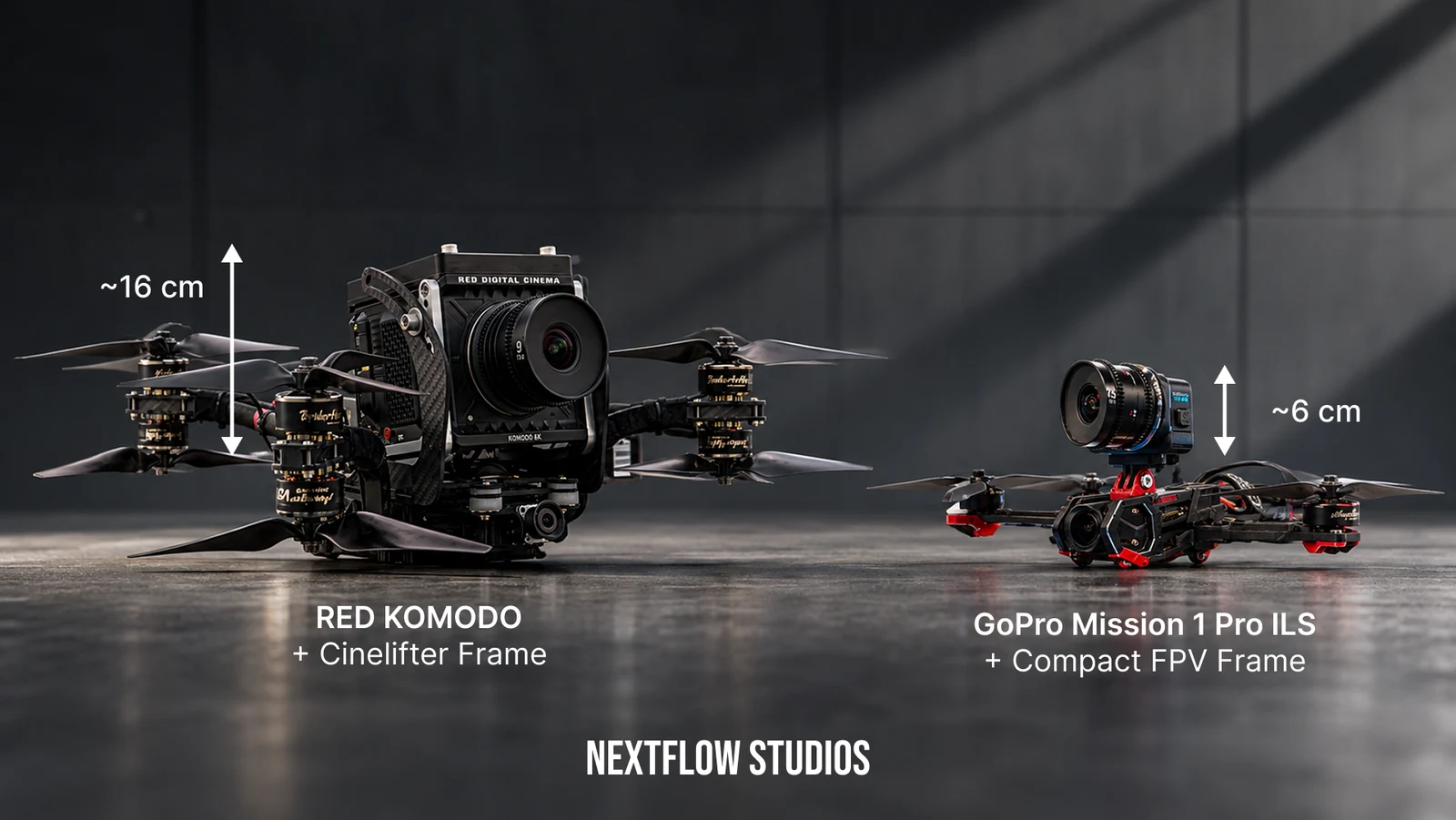
For years, professional FPV cinematography has largely relied on adapting traditional cinema cameras to specialised heavy-lift drones. Systems such as the RED KOMODO, Sony FX6 and Blackmagic Micro Studio Camera 4K G2 have made it possible to capture high-end cinema footage from perspectives that conventional camera platforms cannot easily achieve.
But a new camera category is challenging this approach.
The GoPro MISSION 1 PRO ILS combines a 1-inch sensor, interchangeable Micro Four Thirds lenses, 8K recording and a body weighing just 197 grams. It brings several features traditionally associated with professional cinema systems into an exceptionally compact form factor.
This raises an interesting question for aerial cinematography:
Can a compact camera replace a traditional cinema camera on an FPV drone?
The answer depends on the production. But the MISSION 1 PRO ILS could fundamentally change how certain FPV camera systems are designed.
The traditional approach to cinema cameras on FPV drones
Professional cinema cameras have become increasingly common in commercial FPV productions.
A purpose-built cinelifter can carry cameras such as the RED KOMODO or Sony FX6, allowing production teams to capture aerial footage within established cinema workflows.
These systems offer several advantages:
- Larger sensors and different image characteristics
- Professional RAW recording workflows
- Extensive lens ecosystems
- Greater flexibility in exposure and image control
- Integration with established camera departments
- Compatibility with existing post-production pipelines
However, there is a significant trade-off.
Traditional cinema cameras were not primarily designed to fly on small, agile aircraft.
Their weight, dimensions and additional accessories influence almost every aspect of the drone.
A camera that weighs close to one kilogram before adding a lens requires a very different aircraft from a camera weighing less than 200 grams.
This affects the entire production setup.
What makes the GoPro MISSION 1 PRO ILS different?
The MISSION 1 PRO ILS takes a different approach.
Instead of adapting a conventional cinema camera to an FPV aircraft, GoPro has developed an extremely compact camera with interchangeable lenses and professional recording features.
Its main specifications include:
| Specification | GoPro MISSION 1 PRO ILS |
|---|---|
| Sensor | 1-inch, 50 MP |
| Camera weight | 197 g |
| Lens mount | Micro Four Thirds |
| Maximum resolution | 8K |
| Maximum frame rate | 8K60 |
| 4K slow motion | Up to 240 fps |
| Open Gate | 8K30 / 4K120 |
| Colour depth | 10-bit |
| Log profile | GP-Log2 |
| Maximum bitrate | 240 Mbps |
| Processor | GP3 |
These specifications are based on GoPro's published product information.
The most important characteristic for FPV, however, is not the resolution.
It is the weight.
At just 197 grams, the camera creates possibilities that are difficult to achieve with conventional cinema-camera bodies.
197 grams vs traditional cinema cameras
Consider the difference between the camera bodies alone.
| Camera | Approximate body weight |
|---|---|
| GoPro MISSION 1 PRO ILS | 197 g |
| RED KOMODO 6K | 1,195 g |
| Sony FX6 | 890 g |
| Blackmagic Micro Studio Camera 4K G2 | Approx. 300 g |
Weights are approximate body-only figures. Actual production payloads vary depending on batteries, lenses, mounting hardware and accessories.
The difference becomes particularly relevant when designing an FPV aircraft.
A lighter camera can reduce the required thrust, battery capacity and structural requirements.
Depending on the complete setup, this can translate into:
- Smaller aircraft
- More compact frames
- Greater agility
- Improved acceleration
- Longer potential flight times
- Easier access to confined environments
- Reduced complexity during production
It is important to remember that a 197-gram camera does not automatically result in a lightweight drone. The lens, mount, video transmission, power supply and aircraft still contribute to the total weight.
Nevertheless, the starting point is fundamentally different.
Does a 1-inch sensor deliver cinema-quality footage?
This is where the comparison becomes more interesting.
Traditional cinema cameras such as the Sony FX6 use full-frame sensors, while the RED KOMODO uses a Super 35 sensor.
The MISSION 1 PRO ILS uses a 1-inch sensor.
A smaller sensor generally provides different characteristics in terms of depth of field, low-light performance and field of view.
But sensor size alone does not determine whether footage is suitable for a professional production.
Resolution, dynamic range, colour reproduction, compression, lens quality and lighting all contribute to the final image.
The MISSION 1 PRO ILS offers 10-bit GP-Log2 recording and high-resolution capture, giving post-production teams more flexibility than a conventional action-camera workflow.
However, it should not automatically be considered equivalent to a full-frame or Super 35 cinema camera.
The camera has different strengths.
Its value lies in combining a capable imaging system with a remarkably small physical footprint.
MFT mount does not mean MFT sensor
One important distinction is worth understanding.
The MISSION 1 PRO ILS uses a Micro Four Thirds lens mount, but its sensor is 1-inch.
These are two different things.
The MFT mount allows filmmakers to use compatible Micro Four Thirds lenses, including compact wide-angle lenses, macro lenses and selected speciality optics.
However, the smaller sensor changes the effective field of view.
GoPro specifies an approximate crop factor of 2.7x compared with full-frame when image stabilisation is not applied.
For example, a 10 mm lens produces an approximate full-frame equivalent field of view of 27 mm.
This has direct implications for FPV cinematography.
A lens that appears extremely wide on a traditional MFT camera may provide a considerably narrower field of view on the MISSION 1 PRO ILS.
Lens selection therefore needs to account for the actual sensor size, not just the mount.
Interchangeable lenses: a major step beyond traditional action cameras
One of the biggest differences between the MISSION 1 PRO ILS and conventional GoPro cameras is the ability to use interchangeable lenses.
This introduces a level of creative control that is particularly relevant for professional cinematography.
Instead of relying on a fixed ultra-wide lens, productions can choose optics according to the shot.
Wide-angle lenses
Wide-angle lenses remain particularly useful for FPV.
They allow the drone to fly close to subjects while maintaining a broad field of view.
Typical applications include:
- Indoor architectural sequences
- Automotive tracking
- Dynamic brand films
- Industrial environments
- Close-proximity subject tracking
Longer focal lengths
Longer focal lengths create a different visual language.
They can compress the background, isolate subjects and create a more controlled perspective.
For automotive cinematography, this can be useful when the production wants to emphasise the vehicle rather than the surrounding environment.
However, longer focal lengths also make framing more sensitive to drone movement.
Macro and speciality lenses
The ability to use macro and speciality optics also opens up interesting possibilities.
A compact FPV aircraft could potentially capture close-up details and unusual perspectives that would be difficult to achieve with conventional camera rigs.
The key limitation is that the MISSION 1 PRO ILS does not have electronic lens contacts. Compatible lenses therefore require manual focus and manual or fixed aperture control.
For a production, this means lens selection and focus planning need to happen before the flight.
What about 8K and 4K240?
The MISSION 1 PRO ILS offers impressive recording capabilities for its size.
It supports:
- 8K at up to 60 fps
- 8K Open Gate at up to 30 fps
- 4K at up to 240 fps
- 4K Open Gate at up to 120 fps
It also supports 10-bit recording and GP-Log2.
For FPV productions, these capabilities can be particularly useful.
8K recording
Higher resolution provides additional flexibility in post-production.
Depending on the final delivery format, footage can be reframed, stabilised or cropped without immediately dropping below 4K delivery resolution.
This can be useful when the camera is mounted in a fixed orientation and the exact framing cannot be adjusted during flight.
4K240 slow motion
High frame rates allow fast-moving subjects to be captured with considerable slow-motion flexibility.
For example:
- Automotive tracking
- Sports productions
- Dynamic brand sequences
- Water and industrial environments
- High-speed movement through architecture
However, maximum frame rate should not be confused with maximum image quality.
Resolution, exposure, sensor performance and compression still matter.
The biggest advantage: smaller FPV aircraft
This is where the MISSION 1 PRO ILS could have the greatest impact.
Traditional cinema-camera FPV systems often require large cinelifters.
These aircraft are designed around substantial payloads and can deliver impressive results, but their size also limits where and how they can operate.
A smaller camera changes the equation.
A lighter camera package can make it possible to design an aircraft around agility rather than maximum payload.
That is particularly interesting for:
Indoor FPV
Indoor environments often require precise movement through corridors, doorways and architectural details.
A smaller camera-and-aircraft combination can offer greater flexibility when navigating confined spaces.
Automotive interiors
The camera's compact dimensions also make it interesting for mounting inside vehicles.
GoPro specifically highlights the possibility of fitting the camera into tight spaces, including vehicle interiors.
Combined with an FPV system, this creates opportunities for transitions between interior and exterior shots.
Close-proximity tracking
A smaller aircraft can potentially operate closer to certain subjects and through more restricted environments.
The actual suitability still depends on the aircraft, operating environment, safety assessment and applicable flight permissions.
Where traditional cinema cameras still have an advantage
Despite its impressive specifications, the MISSION 1 PRO ILS does not make traditional cinema cameras obsolete.
There are several reasons why a RED KOMODO or Sony FX6 can still be the better choice.
1. Sensor characteristics
A full-frame or Super 35 sensor offers different creative possibilities, particularly regarding depth of field and low-light performance.
For productions that rely heavily on these characteristics, larger cinema cameras remain highly relevant.
2. Professional recording workflows
Traditional cinema cameras offer established recording formats and workflows.
The RED KOMODO, for example, records REDCODE RAW, while the Sony FX6 offers professional recording options within the Sony Cinema Line ecosystem.
The MISSION 1 PRO ILS uses H.265/HEVC recording in MP4 with GP-Log2.
These are different workflows with different implications for storage, post-production and image processing.
3. Lens control
The MISSION 1 PRO ILS requires compatible manual-focus and manual-aperture or fixed-aperture lenses.
Traditional cinema cameras generally offer more extensive lens-control options, depending on the lens and configuration.
For complex productions, this can be a decisive factor.
4. Production integration
A production may already be built around RED, Sony or another established cinema-camera system.
Matching colour science, recording formats, lens characteristics and monitoring workflows can be more important than reducing camera weight.
The best aerial camera is not necessarily the smallest one.
It is the one that integrates most effectively into the wider production.
MISSION 1 PRO ILS vs RED KOMODO vs Sony FX6
The following comparison illustrates the different approaches.
| Category | MISSION 1 PRO ILS | RED KOMODO | Sony FX6 |
|---|---|---|---|
| Sensor | 1-inch | Super 35 | Full-frame |
| Camera weight | 197 g | Approx. 1,195 g | Approx. 890 g |
| Maximum resolution | 8K | 6K | 4K |
| Highest relevant frame rate | 4K240 | 4K60 | 4K120 |
| Recording workflow | H.265 / GP-Log2 | REDCODE RAW | XAVC / S-Log3 |
| Lens mount | MFT | RF | E-mount |
| Main advantage | Compactness | Cinema RAW and global shutter | Full-frame and exposure flexibility |
Specifications are simplified for comparison. Recording modes, frame rates and supported configurations vary. The camera weights are body-only approximations.
For a broader look including the Blackmagic, see our RED Komodo vs Sony FX6 vs Blackmagic Micro Studio Camera 4K G2 comparison.
The comparison makes one thing clear.
The MISSION 1 PRO ILS is not trying to outperform the RED KOMODO or Sony FX6 in every category.
It is offering a different balance between image capabilities and physical size.
Which camera should you use for a professional FPV production?
The decision should depend on the intended shot.
Choose the MISSION 1 PRO ILS when:
- Aircraft size and weight are critical
- The production requires a compact camera setup
- High frame rates are important
- 8K or Open Gate capture provides useful flexibility
- Interchangeable lenses are desired
- The camera needs to fit into confined spaces
Choose the RED KOMODO when:
- Global shutter is important
- REDCODE RAW is required
- The production uses a RED camera workflow
- Super 35 imaging is preferred
- The shot justifies a heavier aircraft
Choose the Sony FX6 when:
- Full-frame imaging is important
- Low-light performance is a priority
- 4K120 recording is required
- Variable ND is valuable
- The production uses Sony Cinema Line cameras
Choose the Blackmagic Micro Studio Camera 4K G2 when:
- A compact cinema-camera body is required
- Blackmagic RAW is part of the workflow
- A Micro Four Thirds lens system is preferred
- Ultra HD at up to 60 fps is sufficient
More on this option in Blackmagic Micro Studio Camera 4K G2 on an FPV Drone.
The important point is that these cameras are not direct replacements for one another.
They serve different production requirements.
Could the MISSION 1 PRO ILS replace a traditional cinema camera on FPV drones?
For certain productions, potentially yes.
If the final image does not require the sensor characteristics, recording workflow or lens-control capabilities of a larger cinema camera, the MISSION 1 PRO ILS may provide a more efficient solution.
It could allow productions to use smaller aircraft, access tighter environments and create shots that would otherwise require more complicated setups.
But for high-end cinema productions where a specific camera workflow, larger sensor or particular image characteristics are essential, traditional cinema cameras remain relevant.
The most interesting development is not that one camera replaces another.
It is that productions now have more options.
Instead of choosing between a lightweight action camera and a heavy cinema camera, filmmakers have access to an increasingly capable middle ground.
The future of FPV cinematography: choosing the system around the shot
The development of compact cinema cameras changes how aerial production can be approached.
For a long time, the camera determined the size of the aircraft.
A large cinema camera required a large cinelifter. A smaller action camera allowed for more compact and agile systems.
The MISSION 1 PRO ILS introduces another possibility: a relatively small camera with interchangeable lenses, high-resolution recording and professional colour options.
This could make it possible to design more specialised FPV systems around specific shots rather than relying on a single heavy-lift platform.
For professional production teams, that is arguably more important than any individual camera specification.
The future is unlikely to belong exclusively to lightweight cameras or traditional cinema systems.
It will belong to productions that know when to use each.
Our approach to camera selection at NextFlow Studios
At NextFlow Studios, we see camera selection as part of the overall production design.
A camera should never be selected simply because it has the highest resolution, largest sensor or most impressive specifications.
We consider the intended image, movement, environment and final delivery before deciding which system makes sense.
For one production, a RED KOMODO on a heavy-lift cinelifter may be the right choice.
For another, a Sony FX6 may provide the ideal balance between full-frame imaging and professional workflow.
And for a confined indoor sequence, a compact system such as the MISSION 1 PRO ILS could offer significant advantages.
Our approach is straightforward:
Start with the image. Build the production around it.
Conclusion: Is the GoPro MISSION 1 PRO ILS the future of FPV cinema cameras?
The GoPro MISSION 1 PRO ILS represents an interesting development for professional FPV cinematography.
Its combination of a 1-inch sensor, interchangeable MFT lenses, 8K recording, 4K240 slow motion and a 197-gram body brings a new level of flexibility to compact aerial camera systems.
It does not replace the RED KOMODO, Sony FX6 or other traditional cinema cameras in every production.
But it could make some of their applications possible with significantly smaller aircraft.
For indoor filming, automotive interiors, compact FPV systems and productions where agility is more important than maximum sensor size, this is a compelling proposition.
Traditional cinema cameras will continue to have their place.
The real opportunity is having the freedom to choose between different systems – and selecting the one that delivers the right image for the project.
The best FPV camera is not necessarily the biggest or the lightest. It is the one that makes the shot possible.
About NextFlow Studios
NextFlow Studios is a Munich-based production studio creating premium visual content for commercial, architectural, automotive and brand productions in Germany and worldwide.
Our work goes beyond traditional drone filming. We combine FPV and aerial cinematography with professional videography and photography, creating visual content around the specific needs of each production.
Our aerial capabilities range from compact indoor FPV systems and dynamic outdoor FPV drones to cinema-camera configurations and stabilized aerial platforms. Depending on the project, we work with different professional camera systems and build the aerial setup around the required image, movement and production environment.
Our services include:
- Aerial Cinematography – FPV, cinema drones, stabilized aerial systems and specialised aerial camera setups
- Videography – commercial films, brand content, architectural films and production projects
- Photography – professional architectural, commercial and brand photography
- Production Planning – concept development, shot planning, location coordination and aerial production logistics
- Drone Operations – flight planning, pilots, permissions and production coordination
Based in Munich, Germany, NextFlow Studios works with local clients as well as agencies, production companies and brands bringing projects to Germany from abroad. We also support productions worldwide, depending on the project's requirements.
This means a project does not need to be treated as a standalone drone shoot. We can contribute to the wider visual production – from aerial cinematography and FPV to videography and photography.
Whether the project requires a dynamic FPV sequence, cinema-camera aerial footage, architectural cinematography, automotive tracking or a complete visual production, our approach remains the same:
Start with the image. Build the production around it.
If you are planning a production in Munich, Germany or elsewhere in the world, contact NextFlow Studios.
Frequently asked questions
Is the GoPro MISSION 1 PRO ILS a professional cinema camera?
GoPro positions the MISSION 1 PRO ILS as a compact interchangeable-lens cinema camera. It offers a 1-inch sensor, 10-bit GP-Log2, 8K recording, high frame rates and a native MFT lens mount. Its capabilities and workflow differ from larger traditional cinema cameras.
Can the MISSION 1 PRO ILS replace a RED KOMODO on an FPV drone?
For certain shots, it may be a suitable alternative, particularly when weight and aircraft size are important. However, it does not offer the same sensor format, global shutter or REDCODE RAW workflow as the KOMODO.
Is the MISSION 1 PRO ILS better than the Sony FX6 for FPV?
Neither camera is universally better. The MISSION 1 PRO ILS is significantly lighter and supports higher maximum frame rates, while the FX6 offers a full-frame sensor, professional cinema workflow and integrated electronic variable ND.
Does the MISSION 1 PRO ILS have a Micro Four Thirds sensor?
No. It has a 1-inch sensor but uses a native Micro Four Thirds lens mount. This distinction affects the effective field of view and the choice of compatible lenses.
How much does the MISSION 1 PRO ILS weigh?
The camera weighs approximately 197 grams, including its MFT mount but without a lens. The complete FPV payload will be heavier once the lens, mounting hardware and additional equipment are included.
Can you use cinema lenses on the MISSION 1 PRO ILS?
GoPro supports compatible MFT lenses and certain adapted lens systems, including speciality and PL-mount optics. Lens compatibility depends on the adapter, image coverage and manual focus and aperture requirements.
Is the MISSION 1 PRO ILS suitable for indoor FPV?
Its compact body makes it particularly interesting for indoor applications. However, the final suitability depends on the lens, complete aircraft dimensions, flight characteristics, environment and operational safety requirements.
Does 8K make the MISSION 1 PRO ILS better than traditional cinema cameras?
No. Resolution is only one part of image quality. Sensor characteristics, dynamic range, colour reproduction, lens quality, recording format and post-production workflow all influence the final result.
Planning an FPV production?
Let's define the shot first — then the camera, lens and aircraft to make it happen.
Get a free quote