How Cinema Lenses Affect FPV Drone Cinematography
In FPV drone cinematography, the camera is only part of the equation. The lens has an equally important influence on the final image – determining the field of view, perspective, depth of field and overall visual character of a shot.
Choosing the right cinema lens for an FPV drone is therefore not simply a matter of image quality. Focal length, weight, focus control, aperture and physical dimensions all affect how the aircraft can be configured and flown.
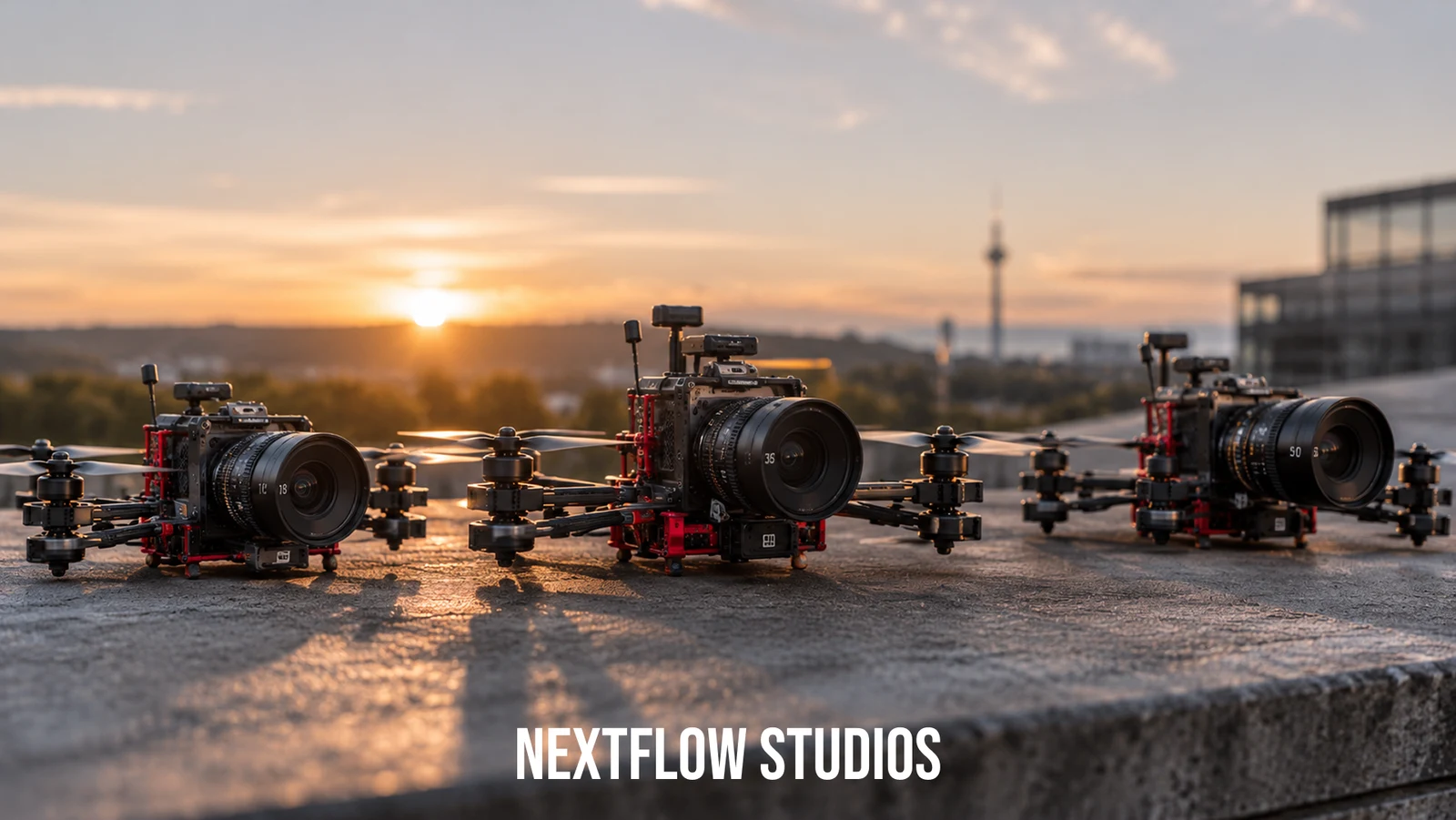
A wide-angle lens may be ideal for immersive interior movements, while a longer focal length can create a more compressed perspective for automotive tracking or architectural details. The right choice depends on the intended image and the capabilities of the complete aerial camera setup.
Why Does Lens Selection Matter in FPV Cinematography?
Traditional cinematography allows camera operators to change lenses relatively freely. With an FPV drone, every additional component influences the aircraft.
The lens affects several aspects of the production:
- Field of view: How much of the environment is visible in the frame.
- Perspective: How foreground and background elements relate visually.
- Depth of field: How much of the image appears in focus.
- Weight: How much additional payload the aircraft must carry.
- Physical dimensions: How the camera and lens fit within the aircraft.
- Focus control: Whether focus can remain accurate during movement.
- Light transmission: How the lens performs under different lighting conditions.
These factors are interconnected. A lens that produces an excellent image on the ground may not be the most practical option for a particular FPV aircraft.
Professional FPV cinematography requires a balance between optical performance, camera configuration and flight characteristics.
1. Focal Length: Controlling the Perspective
Focal length is one of the most influential decisions when selecting a lens. It determines the angle of view for a given sensor size and changes how the environment is represented within the image.
Wide-Angle Lenses
Wide-angle lenses are particularly useful for FPV cinematography because they capture a large portion of the environment.
Typical applications include:
- Indoor architectural walkthroughs
- Tight spaces and corridors
- Immersive location reveals
- Dynamic movements around subjects
- Automotive tracking with a strong sense of proximity
A wide field of view can make movements feel more immersive. Foreground objects move noticeably relative to the background, creating a strong sense of depth and motion.
However, wide-angle lenses can also introduce visible distortion, depending on the optical design. Straight architectural lines may appear curved, particularly towards the edges of the frame.
For architectural productions, the balance between an immersive perspective and accurate representation of the space is particularly important.
Standard Focal Lengths
Standard focal lengths provide a more natural perspective compared with very wide lenses. They can be useful when the production requires a more balanced relationship between the subject and its surroundings.
Potential applications include:
- Architectural details
- Controlled movements through larger spaces
- Brand films
- Automotive sequences
- General commercial cinematography
The narrower field of view requires more careful flight planning. The aircraft's position and movement have a greater influence on what remains inside the frame.
Longer Focal Lengths
Longer focal lengths create a narrower field of view and can produce a more compressed visual relationship between foreground and background.
They can be particularly useful for:
- Automotive tracking from a greater distance
- Architectural details
- Isolated subjects within large environments
- More controlled cinematic compositions
However, longer focal lengths introduce additional challenges for FPV operations. Small changes in aircraft position can have a more noticeable effect on framing. Camera movement also becomes more apparent, making smooth flight and careful composition especially important.
Longer lenses are not automatically better for FPV cinematography. They are useful when the desired perspective justifies the additional technical demands.
2. Sensor Size and Crop Factor
Focal length alone does not determine the final field of view. The camera's sensor size is equally important.
A 24mm lens produces a different angle of view on a full-frame sensor than on a Super 35 or Micro Four Thirds sensor. This is why focal lengths should always be considered in relation to the camera system.
| Camera Format | General Characteristics |
|---|---|
| Full Frame | Wider field of view for a given focal length |
| Super 35 | Narrower field of view than full frame |
| Micro Four Thirds | Narrower field of view than Super 35 and full frame |
| 1-inch sensor | Different field of view and lens requirements depending on the camera design |
Crop factor provides a way to compare the field of view of different sensor formats relative to full frame. However, crop factor does not change the physical focal length of the lens. It describes the difference in captured field of view.
For FPV productions, this distinction matters when comparing camera systems. A lens selected for a full-frame camera may produce a substantially different composition when used on a smaller sensor.
The camera and lens should therefore be considered together during production planning. For a format-by-format camera comparison, see Sony FX6 on an FPV Drone: When Does It Make Sense?.
3. How Do Wide-Angle Lenses Create the Feeling of Movement?
One of the defining characteristics of FPV cinematography is its ability to create an immersive sense of movement. Wide-angle lenses contribute significantly to this effect.
When the aircraft moves close to an object, the foreground appears to move rapidly while the background changes more gradually. This creates strong parallax – the apparent difference in movement between objects at different distances from the camera.
For example, when flying through an architectural interior, a wide-angle lens can emphasise the transition between rooms, reveal spatial relationships and make the viewer feel closer to the environment. In automotive cinematography, the same principle can make a vehicle appear more dynamic when the aircraft moves close to it.
However, the effect should be intentional. An extremely wide perspective can make objects appear distorted or disproportionately large when they are close to the lens.
The best lens is not necessarily the one with the widest field of view. It is the one that creates the intended visual experience without compromising the subject.
4. Lens Weight: A Critical Factor for FPV Drones
Unlike a conventional camera rig, an FPV aircraft has strict payload limitations. Every component contributes to the total weight, including:
- Camera body
- Lens
- Lens mount
- Camera cage or mounting plate
- Power components
- Recording media
- Additional accessories
The lens can become a particularly important part of the overall camera package. A compact prime lens may be considerably easier to integrate into an FPV setup than a larger cinema zoom lens.
This does not mean that heavier lenses cannot be used. It means that the aircraft must be selected and configured accordingly.
Why Does Weight Change Flight Characteristics?
Adding weight affects more than flight time. It can influence:
- Acceleration
- Braking distance
- Turning behaviour
- Responsiveness
- Motor load
- Battery consumption
- Overall flight stability
The position of the lens and camera package also matters. A poorly balanced setup can affect the aircraft's centre of gravity and make handling more difficult.
This is particularly relevant for cinelifters carrying professional cinema cameras. A RED KOMODO with a compact prime lens creates a different payload requirement from the same camera equipped with a larger cinema zoom, matte box and additional accessories. Read more in RED Komodo on a Cinelifter: What You Need to Know.
The complete camera configuration must be considered before the aircraft is finalised.
5. Prime Lenses vs Zoom Lenses
The choice between prime and zoom lenses is another important consideration. Both have advantages, but their suitability for FPV cinematography depends on the production.
Prime Lenses
Prime lenses have a fixed focal length. They are often attractive for aerial camera setups because certain compact prime lenses offer a relatively lightweight and straightforward configuration.
Their advantages include:
- Fixed focal length and predictable framing
- Potentially compact dimensions
- Often strong optical performance
- Wide aperture options
- A consistent lens configuration
For FPV productions, primes are particularly useful when the shot has already been planned around a specific perspective. The limitation is flexibility. Changing the field of view requires changing the lens or adjusting the camera's position.
Zoom Lenses
Zoom lenses provide a variable focal length, allowing the camera team to adjust framing without physically changing lenses. This can be valuable in conventional cinematography.
For FPV drones, however, zoom lenses introduce additional considerations:
- Higher weight in many configurations
- Larger physical dimensions
- More complex mounting requirements
- Potentially different balance characteristics
A zoom lens may still be the right choice for a specialised production, but it should be evaluated as part of the entire aircraft and camera system.
For many FPV applications, a carefully selected prime lens offers a more straightforward solution.
6. Aperture and Depth of Field
Aperture determines how much light passes through the lens and influences depth of field. A wider aperture allows more light to reach the sensor and can create a shallower depth of field.
This can be useful when the production aims to separate a subject from the background. For example, an automotive tracking sequence may benefit from a more pronounced subject separation, depending on the desired visual style.
However, shallow depth of field introduces challenges for FPV cinematography. The camera is moving continuously, and the distance between the subject and lens can change quickly. If the focus is not maintained, the subject may become soft during the movement.
A deeper depth of field can provide more tolerance for changes in distance, which may be beneficial for complex FPV sequences. The correct aperture therefore depends on the camera, sensor, lens, lighting and planned movement.
Does a Wider Aperture Always Produce a Better Image?
No.
A wide aperture can be useful in low-light conditions or when a shallow depth of field is part of the creative intention. However, it does not automatically improve the final image.
The focus requirements of the shot, available light and desired depth of field should determine the aperture. For dynamic FPV sequences, maintaining focus throughout the movement may be more important than achieving the shallowest possible depth of field.
7. Manual Focus and Focus Control
Focus is one of the most challenging aspects of using cinema lenses on FPV drones. In conventional production, a focus puller can adjust focus according to the camera's movement and the subject's distance.
An FPV drone introduces a different situation. The aircraft may accelerate, change direction, approach a subject or move through several spaces within a single take.
If the lens uses manual focus, the production needs a strategy for maintaining the required focus distance. Possible approaches include:
- Fixed focus: The lens is set to a predetermined distance. This can work for shots where the subject remains within a relatively consistent focus range.
- Deep depth of field: Using a smaller aperture can increase the range of distances that appear acceptably sharp, depending on the sensor and lens.
- Remote focus systems: Specialised camera and lens configurations may support remote focus control. However, integrating such systems adds weight, complexity and operational requirements.
- Pre-planned flight paths: A carefully designed movement can help maintain predictable distances between the camera and subject.
The appropriate approach depends on the shot and camera system.
For a complex tracking sequence, focus should be considered during pre-production rather than treated as an issue to solve after the aircraft is already built.
8. Image Stabilisation and Lens Characteristics
Lens-based optical image stabilisation can be useful in conventional handheld or shoulder-mounted cinematography. On FPV drones, however, its role is more complicated.
The aircraft experiences rapid movements and vibrations that differ from those of a handheld camera. Depending on the lens and camera system, optical stabilisation may interact with the movement in ways that are not ideal for every aerial shot.
Some productions may benefit from stabilisation, while others may prefer a configuration without lens-based stabilisation and rely on suitable camera mounting, mechanical isolation and post-production tools.
The right approach depends on:
- Camera sensor and recording mode
- Lens stabilisation system
- Aircraft vibration characteristics
- Mounting configuration
- Desired camera movement
- Post-production workflow
Stabilisation should always be evaluated as part of the complete system.

When fully stabilised movement matters more than FPV dynamics, read FPV vs. Stabilized Drone: Which Is Right for Your Production?.
9. Which Cinema Lens Fits Which FPV Production?
The following examples illustrate how lens selection can change according to the production objective.
| Production Type | Lens Considerations | Creative Objective |
|---|---|---|
| Indoor architecture | Wide-angle, controlled distortion | Reveal spatial relationships |
| Automotive tracking | Wide to standard focal lengths | Dynamic vehicle movement |
| Large architectural spaces | Wide or standard focal lengths | Balance environment and subject |
| Cinematic detail shots | Standard or longer focal lengths | Isolate specific features |
| Industrial filming | Depends on distance and environment | Show processes and scale |
| Brand commercials | Selected according to visual references | Consistent visual language |
These are not fixed recommendations. The appropriate focal length depends on sensor format, camera position, lens design and the desired framing.
A lens should never be selected based on focal length alone.
10. Planning the Lens Before Building the Drone
One of the most important decisions in professional FPV cinematography happens before the production day. The camera and lens combination should be defined early enough to influence the aircraft configuration.
This allows the production team to assess:
- Camera compatibility: Does the camera support the required lens mount and recording format?
- Lens dimensions: Does the lens physically fit within the intended aircraft setup?
- Payload: Can the aircraft carry the complete camera package?
- Balance: Can the camera and lens be mounted without compromising the centre of gravity?
- Focus: Can the required focus strategy be achieved?
- Flight characteristics: Does the configuration still allow the intended movement?
- Post-production: Does the recording setup meet the project's delivery requirements?
This is particularly important when a production requires a specific cinema camera. The same aircraft may behave very differently depending on whether it carries a compact prime lens or a larger zoom configuration. Compare platforms in Cinelifter vs Cinewhoop: Which FPV Drone Should You Use?.
Planning these details early avoids unnecessary compromises later.
The NextFlow Approach: Camera and Aircraft as One System
At NextFlow Studios, we consider the camera, lens and aircraft as parts of one production system.
The right lens is not necessarily the most expensive or technically advanced option. It is the one that supports the intended image while remaining compatible with the aircraft and operating environment.
For a compact indoor FPV sequence, a lightweight wide-angle setup may be the most practical choice. For an automotive commercial, a different focal length and a dedicated cinema-camera configuration may deliver the desired perspective.
Our aerial capabilities range from compact indoor FPV systems to specialised camera builds and cinema-camera platforms. We combine these with professional videography and photography when a project requires a broader visual approach.
This allows the lens and camera setup to be selected according to the creative objective rather than forcing every shot into the same configuration. For a broader platform overview, see Choosing the Right FPV Drone for a Commercial Shoot.
Conclusion: The Lens Shapes More Than the Image
Cinema lenses influence much more than the field of view of an FPV shot.
Focal length determines perspective. Aperture affects light and depth of field. Focus requirements influence how a movement can be executed. Weight and physical dimensions affect the aircraft itself.
For professional FPV cinematography, lens selection is therefore both a creative and technical decision. The most effective setup is one where camera, lens and aircraft work together to deliver the intended image.
Start with the perspective. Select the lens. Build the aircraft around the shot.
About NextFlow Studios
NextFlow Studios is a Munich-based production studio creating premium visual content for commercial, architectural, automotive and brand productions in Germany and worldwide.
Our work goes beyond traditional drone filming. We combine FPV and aerial cinematography with professional videography and photography, creating visual content around the specific needs of each production.
Our aerial capabilities range from compact indoor FPV systems and dynamic outdoor FPV drones to cinema-camera configurations and stabilised aerial platforms. Depending on the project, we build the aerial setup around the required image, movement and production environment.
Our services include:
- Aerial Cinematography – FPV, cinema drones, stabilised aerial systems and specialised aerial camera setups
- Videography – commercial films, brand content, architectural films and production projects
- Photography – professional architectural, commercial and brand photography
- Production Planning – concept development, shot planning, location coordination and aerial production logistics
- Drone Operations – flight planning, pilots, permissions and production coordination
Based in Munich, Germany, NextFlow Studios works with local clients as well as agencies, production companies and brands bringing projects to Germany from abroad. We also support productions worldwide, depending on the project's requirements.
This means a project does not need to be treated as a standalone drone shoot. We can contribute to the wider visual production – from aerial cinematography and FPV to videography and photography.
Whether the project requires a dynamic FPV sequence, cinema-camera aerial footage, architectural cinematography, automotive tracking or a complete visual production, our approach remains the same:
Start with the image. Build the production around it.
If you are planning a production in Munich, Germany or elsewhere in the world, contact NextFlow Studios.
Frequently asked questions
Why are cinema lenses important for FPV drone cinematography?
Cinema lenses influence the field of view, perspective, depth of field and visual character of an FPV shot. They also affect the camera package's weight, dimensions and focus requirements.
What focal length is best for FPV drone filming?
There is no universal best focal length. Wide-angle lenses are often useful for immersive interior movements, while standard and longer focal lengths can be suitable for automotive tracking, architectural details and more controlled compositions.
Can FPV drones use professional cinema lenses?
Yes. Suitable cinelifters can carry professional camera and lens configurations, provided the aircraft is designed for the complete payload. Weight, dimensions, mounting and focus control must all be considered.
Are prime lenses better than zoom lenses for FPV drones?
Prime lenses can offer a relatively compact and straightforward setup. Zoom lenses provide more framing flexibility but may introduce additional weight and mounting complexity. The best choice depends on the production.
How does lens weight affect an FPV drone?
Additional lens weight increases the aircraft's total payload and can affect acceleration, braking, turning behaviour, battery consumption and flight time.
Is manual focus practical for FPV filming?
It can be, particularly when the movement and subject distance are predictable. For more complex shots, the production may require a focus strategy involving fixed focus, greater depth of field or specialised remote focus equipment.
Do wide-angle lenses create distortion?
Some wide-angle lenses introduce noticeable distortion, particularly towards the edges of the frame. The extent depends on the optical design and any correction applied in-camera or during post-production.
Does a larger sensor always require a different lens?
Lens compatibility depends on the camera's mount and image circle, while the sensor size determines the captured field of view. A lens may physically fit a camera but still not cover its entire sensor.
Planning an FPV production?
Let's define the shot first — then the camera, lens and aircraft to make it happen.
Get a free quote